
Review · 1-DAY TOURS
Osaka and Nara Attractive One Day private Tour
Osaka and Nara in one smooth day. This private tour threads modern Osaka and ancient Nara together with air-conditioned pickup and a driver who keeps you moving. I especially like the hands-on logistics, plus the on-board hotspot that helps you stay in sync.
I also like the day’s balance: you get iconic stops like Osaka Castle and Todai-ji, but you’re not paying entry fees at every corner because Shitennoji and Dotonbori are free. One thing to consider is that the schedule has limited breathing room, with about 2 hours built in for travel between sites, and the big-ticket viewpoints are optional and paid on arrival.
In This Review
- Quick hits worth knowing
- Price and what you actually get for $550
- Where you start, where you end, and how the day flows
- Osaka Castle: the samurai-era centerpiece, with an optional ticket
- Shitennoji Temple: early Buddhism, calm grounds, free entry
- Dotonbori: lights, street food, and where the fun actually happens
- Umeda Sky Building: big-city views for a small extra fee
- Nara Park: deer time plus an easy base for photos
- Todai-ji Temple and the Great Buddha: optional, but hard to forget
- How the 10-hour schedule works in real life
- Guide quality, and what the private part means for you
- Value check: who this tour is best for
- Should you book this Osaka and Nara private day?
- FAQ
- How many people are in a group?
- How long is the tour?
- Is pickup offered, and where does it start?
- What’s included in the price?
- What entry fees are not included?
- Are there any optional stops?
- Do I get a mobile ticket?
- Is free cancellation available?
- Is the tour suitable if I’m traveling with kids or pets?
Quick hits worth knowing
- Private group day for up to five people, with only your group participating.
- Air-conditioned vehicle plus child seats, tolls, and taxes covered.
- On-board hotspot so you can map, message, or translate on the go.
- Free time at Dotonbori and Shitennoji, so your day has both structure and flexibility.
- Optional paid highlights include Osaka Castle, Umeda Sky, and Todai-ji, each with a listed fee on arrival.
- Strong guide signal in past experiences, with names like Talha, Ben, and Malik called out for helping guests get around and enjoy the day.
Price and what you actually get for $550
At $550 per group (up to 5), you are not paying per person. That matters, because a private Osaka and Nara day can get pricey fast once you add transport, tickets, and the time tax of figuring out trains with a packed schedule. Here, most of the heavy lifting is handled: an air-conditioned vehicle, private transportation, tolls and taxes, and even child seats are included.
You’re also buying back time. The whole day runs about 10 hours, and the plan allocates time at each major site plus around 2 hours for travel between areas. In plain terms: you spend your energy at sights, not wrangling connections and station transfers.
The one honest caveat is that some of the most famous attractions are optional. Osaka Castle, Umeda Sky, and Todai-ji have entry fees that are paid directly on arrival. So your total day cost can rise, depending on what you choose to do.
A few more Osaka days to weigh up
- Osaka Go Karting Tour with Funny Costume
★ 5.0 · 2,658 reviews - Osaka Castle: Museum and Tower Entry Ticket
★ 4.5 · 2,380 reviews - Osaka: Shinsekai Food Tour with 13-15 Dishes at 5 Eateries
★ 4.8 · 2,204 reviews
Where you start, where you end, and how the day flows
You meet at Osaka Station 3-chōme-1-1 in Umeda (Kita Ward), and the tour ends back near that meeting point. That is a smart base because Umeda is central for Osaka logistics, and it also helps you tack on extra shopping or dinner afterward without a long ride.
The flow of the day is also pretty balanced. You’re set up to see:
- A major landmark in Osaka (Osaka Castle, if you choose it)
- A historic Buddhist temple in Osaka (Shitennoji)
- One of Osaka’s most famous food and lights streets (Dotonbori)
- A high-city viewpoint that shows the scale of Osaka (Umeda Sky Building, if you choose it)
- Then you swing into Nara for the classic temple and deer experience (Todai-ji, Nara Park)
Because it’s private, your group can usually move at the pace that works for you. Just keep in mind the plan uses a tight timing model. If you stop for photos and snacks, it’s worth doing it efficiently, or you can lose time you might have wanted at the next site.
Osaka Castle: the samurai-era centerpiece, with an optional ticket
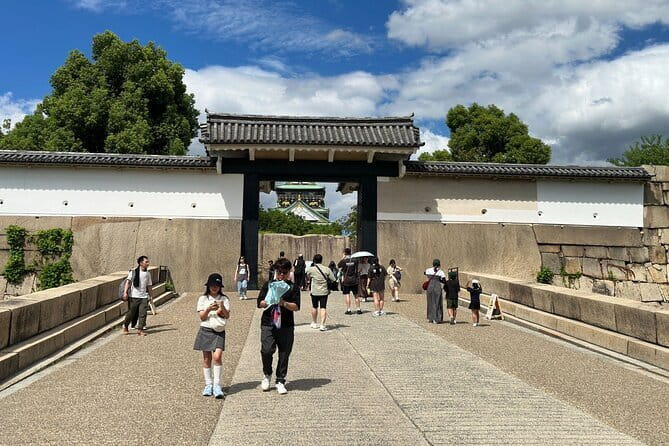
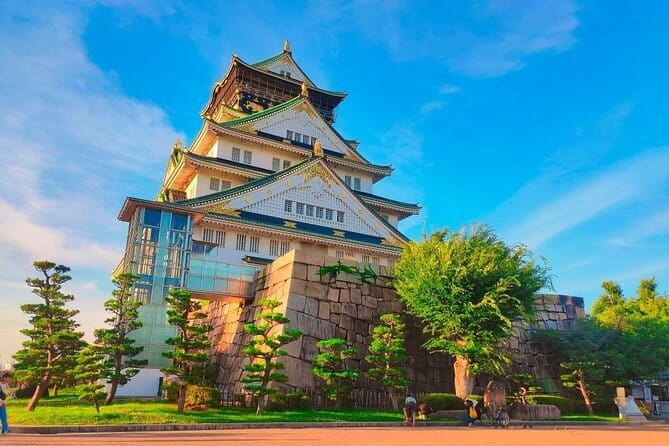
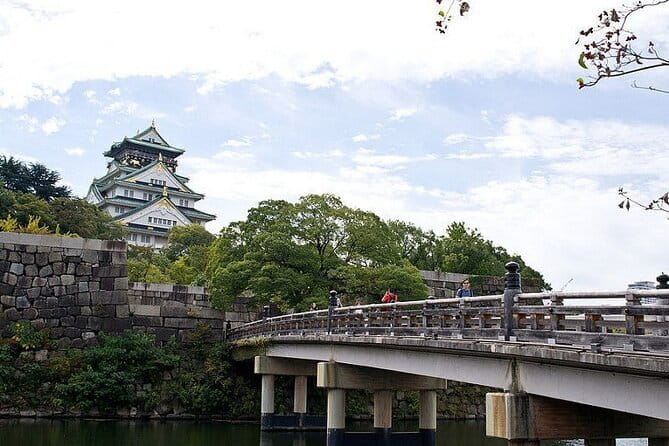
Osaka Castle is the headline photo stop for many people, and for good reason. The original castle was built in the late 1500s by Toyotomi Hideyoshi, and it became a symbol of the unification of Japan after a long civil war period. The castle later played a role in the Battle of Osaka (1614 to 1615), which is tied to the end of the Toyotomi clan’s rule.
Today’s structure is a modern reconstruction completed in 1931 after the original was destroyed multiple times through history. That means you are not seeing the exact same building from centuries ago, but you are getting a clear sense of why the site matters and how it functions as a landmark in the city.
Practical tip: Since the castle entry is optional and priced separately (listed as about $5), decide early. If you want the castle interior and not just the exterior views, budget for it and arrive ready to spend the full hour there.
Shitennoji Temple: early Buddhism, calm grounds, free entry
Shitennoji Temple is one of Osaka’s oldest and most important Buddhist sites. It was originally established in 593 AD by Prince Shōtoku, and it is often described as one of Japan’s first officially founded Buddhist temples. The temple was built to honor the Four Heavenly Kings (Shiten), protectors believed to guard the world from evil.
The layout you see today reflects early temple architecture, including a five-story pagoda in a symmetrical arrangement. Even though the complex has been rebuilt over time due to fires and natural disasters, it keeps much of its original layout.
This is one of the best “value” stops in the day because admission is free and the experience is still substantial. It is also a great contrast to the city energy later in Dotonbori, giving you a calmer window to reset.
A different sort of day in Japan:
- Osaka Food Tour: 13 Dishes at 5 Local Eateries
★ 5.0 · 2,149 reviews - Hungry Osaka Street Food Tour:15 Tastings & 3 Drinks with a Local
★ 5.0 · 1,727 reviews - Osaka: teamLab Botanical Garden Entry Ticket
★ 4.5 · 1,710 reviews - Osaka: Tea Ceremony Experience
★ 4.9 · 1,426 reviews
Dotonbori: lights, street food, and where the fun actually happens
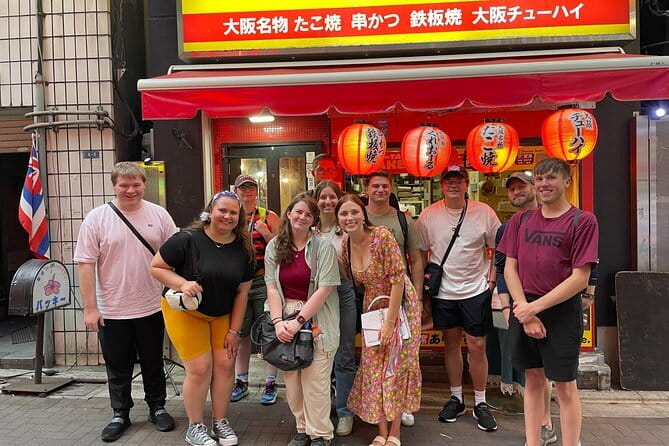
Dotonbori is Osaka’s famous canal-side strip, known for neon signs and that late-night glow that people associate with the city. The iconic imagery includes huge illuminated billboards like the Glico Running Man, a symbol of the area since the 1930s.
The best part of Dotonbori is that you can do it your way. The plan sets aside about 2 hours, which is long enough to walk, snack, and still get to the next stop without stress. The streets are especially good for:
- Takoyaki (octopus balls)
- Okonomiyaki-style savory pancakes
- Kushikatsu (deep-fried skewers)
- Ramen and other local dishes
Practical tip: Go in hungry, but don’t over-plan. In a two-hour window, you’ll enjoy the street more if you pick one or two must-eats and leave room for wandering and photos.
Umeda Sky Building: big-city views for a small extra fee
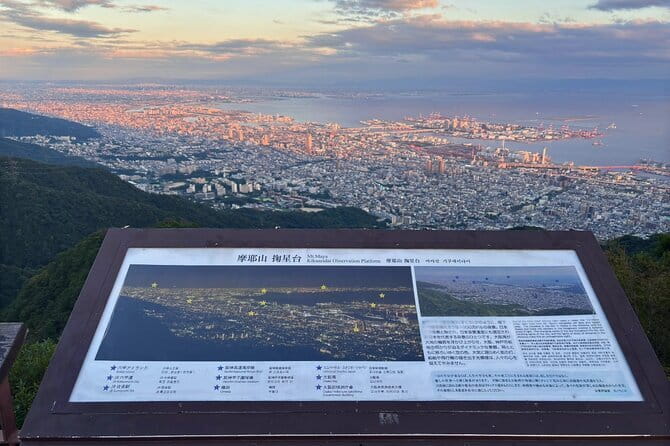
Umeda Sky Building is Osaka’s modern mirror. It was completed in 1993 and rises to about 173 meters, made of two connected towers with a floating garden observatory near the top. The key wow factor here is the panoramic view: you get a 360-degree look at the city.
There’s also a sensory detail while you go up. The towers connect at the top using glass-covered escalators, so the ascent feels light and open, more like a guided experience than a straight ride.
Umeda Sky is listed as optional and paid on arrival, about $10. If your group loves skyline views, add it. If you’d rather use that time for shopping in Umeda or just slow down, it is easy to skip without ruining the rest of the day.
Nara Park: deer time plus an easy base for photos
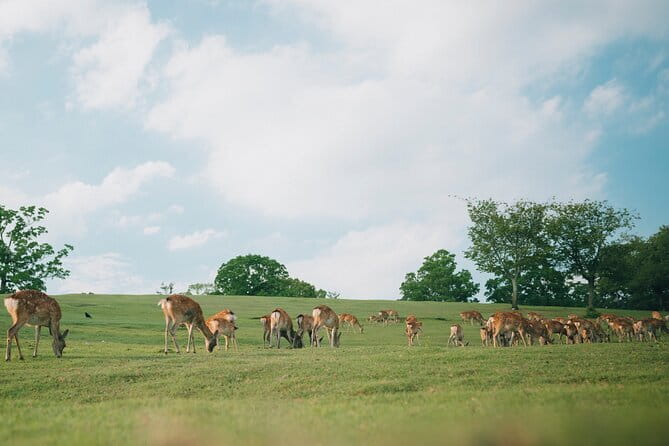
Once you arrive in Nara, the day slows in a good way at Nara Park. The park is known for its free-roaming deer, and it sits near major cultural sites like Tōdai-ji Temple, Kōfuku-ji Temple, and Kasuga Taisha Shrine.
The deer are considered sacred messengers in Shinto belief, and there are said to be over 1,000 deer roaming in the park. They are used to people and are typically calm. Visitors can buy special deer crackers, shika senbei, to feed them, and the deer are known to bow.
The park stop in this plan is about 1 hour, which is enough time to do the classic deer moment and take in the surroundings without turning it into a half-day project.
Practical tip: Wear comfortable shoes. The park paths can be uneven and busy, especially around peak daylight hours.
Todai-ji Temple and the Great Buddha: optional, but hard to forget
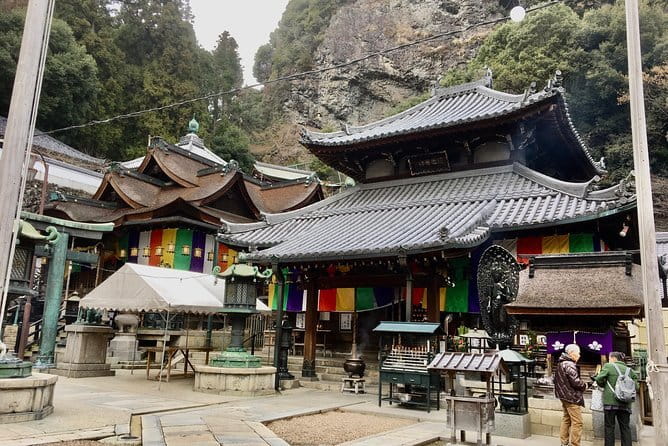
Todai-ji Temple is the Nara anchor, famous for the Great Buddha Hall (Daibutsuden) and the massive bronze statue of Vairocana Buddha, called the Daibutsu. The statue dates to 752 AD, and it is about 15 meters tall and weighs around 500 tons.
Todai-ji was originally constructed in the 8th century and became a major center for Buddhism, commissioned by Emperor Shōmu as part of a broader effort to strengthen Buddhism’s place in unifying the country.
In this plan, Todai-ji is a long stop, about 2 hours, and it is optional with an entry fee listed at about $2 on arrival. If you want the most iconic spiritual scale of the day, you should strongly consider doing it. It’s one of those places where even if you know the basics, seeing the scale in person does the heavy lifting.
How the 10-hour schedule works in real life
The timing is built like this:
- 1 hour at Osaka Castle (optional)
- 1 hour at Shitennoji (free)
- 2 hours at Dotonbori (free)
- 1 hour at Umeda Sky (optional)
- 2 hours at Todai-ji (optional)
- 1 hour at Nara Park (free)
- plus about 2 hours for travel
That math is clean, and it’s a good sign because it means the plan isn’t pretending you can do everything at a relaxed speed. This kind of day works best if you treat each stop like a strong chapter instead of a slow novel.
Here’s how to make it feel smoother:
- At each stop, pick one or two “musts” before you arrive (a view at the castle, a pagoda angle at Shitennoji, one snack at Dotonbori).
- Use the on-board hotspot to confirm your next meeting spot or direction, if you’re separating briefly for photos.
- If anyone in your group has mobility needs, you’ll want to confirm how long you can comfortably stay at the optional paid sites, because those are the places where walking and stairs can add up.
Guide quality, and what the private part means for you
This is a private activity, so only your group rides along. In past experiences, specific guide names like Talha, Ben, and Malik were mentioned for being helpful and for guiding guests through the day with good suggestions.
That said, there is also a caution flag tied to how the tour is delivered. One unhappy case described it as more like transport than a full guided narrative, where you are dropped and picked up at agreed times. For you, the best takeaway is simple: before the day starts, ask what level of guidance you can expect at each stop. You want clarity on how much commentary you’ll get, especially at the temples and viewpoint.
Also, while the schedule is structured, it’s still your day. You can ask for customization based on your interests. If your group prefers shopping time in Umeda over one of the optional paid sites, that’s the kind of swap you might be able to request.
Value check: who this tour is best for
This tour is a strong match if you want:
- A full day that covers Osaka and Nara without split planning
- A private setup for families, couples, or small groups of up to five
- Comfort features like child seats and an air-conditioned vehicle
- A day that mixes famous places with free stops where you can just enjoy walking
It is less ideal if you want lots of downtime, because the 10-hour structure is designed to hit major highlights. It can also be a tougher fit if your group hates optional paid add-ons, since Osaka Castle, Umeda Sky, and Todai-ji each have a listed admission fee.
One more value note: it is commonly booked about 53 days in advance on average. If your dates are tight, planning earlier is smart.
Should you book this Osaka and Nara private day?
Book it if you want a private, comfortable Osaka and Nara experience with the important sights covered in one go, plus practical included perks like child seats and the on-board hotspot. The mix of free stops like Shitennoji and Dotonbori with optional paid powerhouses like Umeda Sky and Todai-ji makes it flexible enough to match different budget comfort levels.
Hold off or ask extra questions if you care a lot about deep guided storytelling at every stop. The data includes one complaint that it felt like mainly transportation with fixed pickup times. Also, while the official cancellation terms are structured for fairness, one past incident involved a same-day cancellation due to a driver being ill. That’s rare, but it’s another reason to travel with a plan B mindset.
If your goal is an efficient, friendly day that gets you the Osaka lights, the Nara deer, and that Great Buddha scale without the stress of transit logistics, this one is easy to recommend.
FAQ
How many people are in a group?
The tour price is for up to 5 people per group.
How long is the tour?
The duration is about 10 hours.
Is pickup offered, and where does it start?
Pickup is offered, and the tour starts at Osaka Station 3-chōme-1-1 Umeda, Kita Ward, Osaka 530-0001, Japan. It ends back at the meeting point.
What’s included in the price?
Included features are an air-conditioned vehicle, private transportation, child seats, tolls and taxes, and a hotspot on board. There are also mobile tickets mentioned.
What entry fees are not included?
Not included are fees for Osaka Castle (listed as $5 USD), Umeda Sky (listed as $10 USD), and Todai-ji Temple (listed as $2 USD). Shitennoji and Dotonbori are listed as free, and Nara Park is listed as free.
Are there any optional stops?
Yes. The Osaka Castle, Umeda Sky, and Todai-ji Temple stops are described as optional, and the admission is paid directly on arrival.
Do I get a mobile ticket?
Yes, mobile ticket is included.
Is free cancellation available?
Yes. You can cancel for a full refund up to 24 hours in advance.
Is the tour suitable if I’m traveling with kids or pets?
Child seats are included. Service animals are allowed.
Newly listed around Osaka
- Osaka’s Best and Brightest: Private Full-Day Tour by Vehicle★ 5.0 · 147 reviews
- Kansai/KIX Airport to or from Osaka/Kyoto Private Transfer★ 5.0 · 20 reviews
- Osaka Food Adventure Tour: Walking with a Local Guide★ 5.0 · 119 reviews
- Osaka in a Nutshell: Three hour bike tour★ 5.0 · 121 reviews
- Osaka Walking Tour to Local Gems, Food & Culture★ 5.0 · 103 reviews
- Eat Osaka: Street Food Cooking in an Authentic Kitchen!★ 5.0 · 87 reviews
- Osaka Food Tour with 10 Classic Japanese Tastings & Drinks★ 5.0 · 38 reviews
- Full Day Guided Tour in Osaka by Van★ 5.0 · 27 reviews
1-Day Tours, compared.
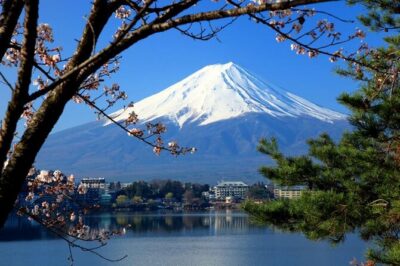
Mt Fuji and Hakone 1-Day Bus Tour Return by Bullet Train
Read our review →
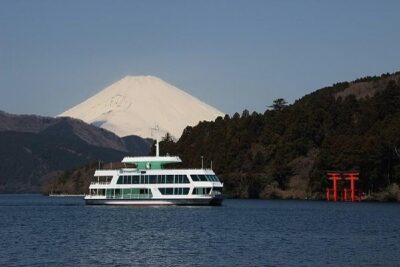
Mt Fuji & Hakone Cruise, Drum Show Bullet Train 1 Day from Tokyo
Read our review →
Peaceful Hiroshima & Miyajima UNESCO 1 Day Bus Tour
Read our review →
Fushimi Inari, Kinkakuji, Bamboo Grove 1 Day Bus Tour
Read our review →

Browse the lists this tour appears in