
Review · HISTORICAL TOURS
Fukuoka Essentials: History, Culture, & Charms
Fukuoka hits fast when you walk with a local. I love how this short, focused route pairs Shofukuji Zen calm with city-energy stops like Kawabata. One thing to keep in mind: it is mostly on foot, and food or any attraction tickets are not included, so plan for snacks and extra costs.
What really makes it feel different is the private, personalized feel. A guide meets you at the CASETiFY STUDiO Amu Plaza Hakata store by the big clock, then adjusts pacing and what you spend time on. I also like that the tour is in English and Czech, and the best versions of this experience come from guides who answer questions and tailor the day to your interests.
For a first-time visit to Hakata, this is a smart way to get your bearings in a few hours. You get temple atmosphere, shrine stories, and a rooftop view that makes the whole area feel real and walkable.
In This Review
- Key things to know before you go
- Starting at CASETiFY STUDiO Amu Plaza Hakata: easy meetup, fast momentum
- Shofukuji Temple: Zen calm and real age in Kyushu
- Tochoji Temple: the Buddha statue contrast that makes both places click
- Kushida Jinja: where Hakata’s main shrine and festivals meet
- Kawabata Shopping Street: food, shopping, and that everyday Hakata rhythm
- Sumiyoshi Jinja: a different shrine style with a sea connection
- Hakata Station rooftop panorama: your farewell view over Kyushu
- Price and value: what the $58 per person really buys
- Guides, pace, and the small things that make it work
- Who should book this Fukuoka essentials walk
- Should you book this tour?
- FAQ
- How long is the tour?
- Where is the meeting point?
- What places are included in the walking route?
- Is hotel pickup available?
- What languages is the guide available in?
- Is the tour private?
- Are food and drinks included?
- Are attraction tickets included?
- Is transportation included?
- What is the cancellation policy and booking payment option?
Key things to know before you go
- Shofukuji Temple in Kyushu: you start with a major Zen stop tied to the region’s oldest temple legacy.
- Kushida Jinja’s festival connection: this shrine links to the famous Hakata Gion Yamakasa.
- Kawabata Shopping Street is all senses: snacks, shops, and the everyday rhythm of central Hakata.
- Sumiyoshi Jinja’s seaside character: a shrine with distinctive architecture and a sea connection.
- Hakata Station rooftop payoff: a wide city view, especially nice near sunset.
- Private guide, adjustable pace: tours run like a guided walk, not a rigid bus circuit.
Starting at CASETiFY STUDiO Amu Plaza Hakata: easy meetup, fast momentum
Your day begins right where most people already end up anyway, Amu Plaza Hakata. The meeting point is the CASETiFY STUDiO store, right by the main entrance, under the big clock. If you are trying to reduce stress on day one in a new city, this helps a lot. You do not need to hunt for a random side street meeting point.
From there, you head on foot toward the first big spiritual landmark, with a short walking stretch that also works as a warm-up. It is a practical setup for getting oriented quickly. You walk, you look around, and the guide can spot what you seem interested in, temples, history, daily life, or just photo stops.
One note that matters: while hotel pickup is available on request for central locations, the default start point is this Amu Plaza Hakata area. So if you are staying a bit outside the center, confirm pickup early or be ready for a short self-transfer.
A few more Fukuoka days to weigh up
- Fukuoka’s Sacred Path: Temples, History & Culture
★ 5.0 · 17 reviews - World Heritage Shirakawa-go and Experience Tours from Kanazawa
★ 5.0 · 4,049 reviews - World Heritage Kyoto & Nara Uji Authentic Matcha Experience
★ 5.0 · 1,573 reviews
Shofukuji Temple: Zen calm and real age in Kyushu
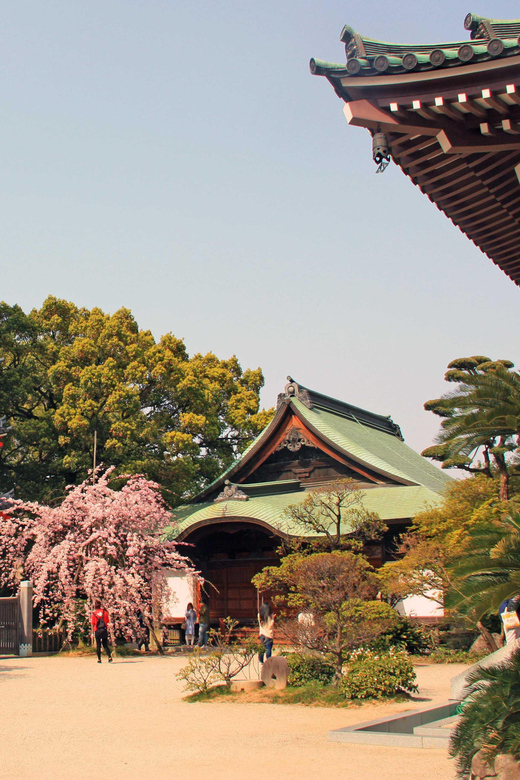
Shofukuji is one of those places that changes the sound in your head. Even before you learn details, the architecture and pacing tell you to slow down. This is the oldest Zen Buddhist temple in Kyushu, and that age shows in the way the grounds feel settled.
What makes this stop especially valuable for a walking tour is how it frames the rest of the day. You start with Zen Buddhism, so later when you visit shrines and see city festival energy, you understand the contrast. You are not just “seeing a temple.” You are getting a baseline for how religion and place work in Fukuoka.
Expect a guided walk through the temple area, with time to notice architectural details and absorb the quiet rhythm of the grounds. The tour style here is not about rushing for photos. It is about learning what you are looking at and why it matters locally.
Who this part is for: If you like history you can actually stand inside of, this is a strong opening act. It is also a good stop if you prefer calm places over constant shopping streets.
Watch-outs: Wear shoes you can walk in comfortably. Temple grounds mean uneven surfaces in places, and the whole day is built around walking between stops.
Tochoji Temple: the Buddha statue contrast that makes both places click
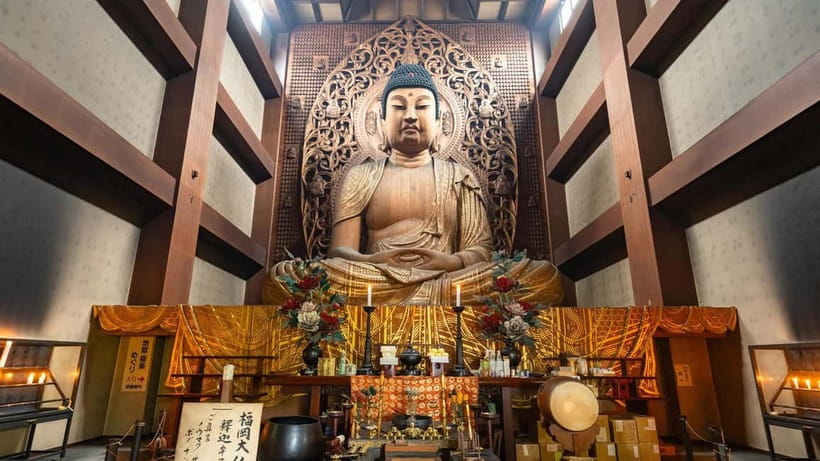
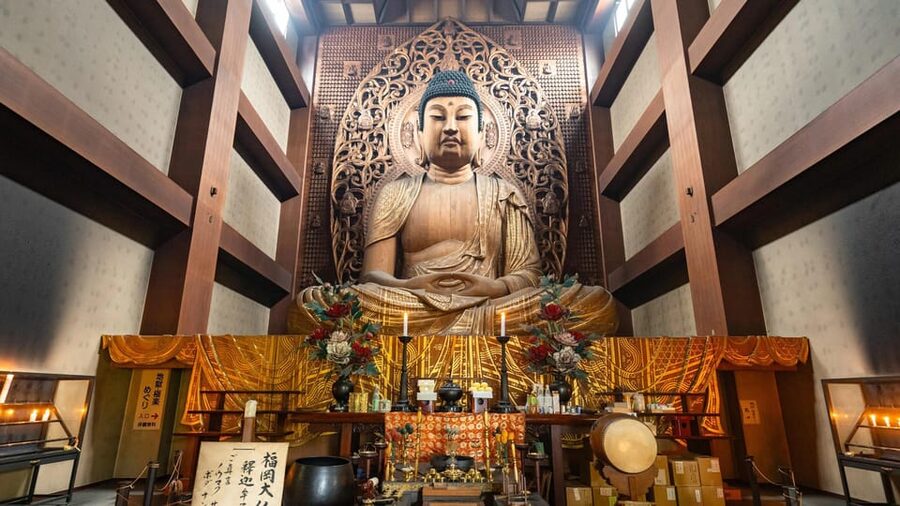
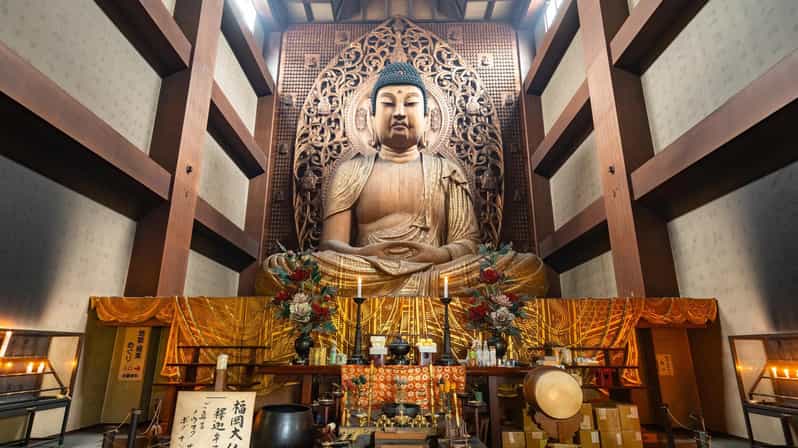
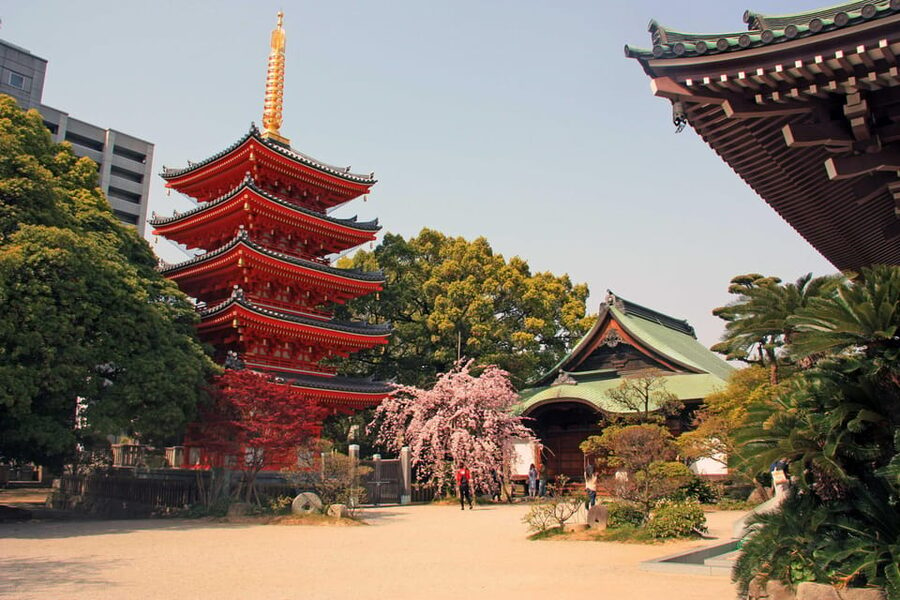
Right after Shofukuji, you also visit Tochoji Temple. The highlight here is different: it is known for a magnificent Buddha statue. That contrast is the point. Shofukuji leans into Zen quiet and temple mood, while Tochoji lets you focus on a bigger, more immediately striking visual anchor.
I like this pairing because it gives you two ways to experience Buddhist sacred space without making the day feel repetitive. You see how the style and emphasis can shift even within the same broad religious world.
Your guide helps connect what you are seeing with the bigger picture of Fukuoka and Kyushu cultural life. You will likely leave with more than “I saw temples.” You will have a clearer sense of how place, belief, and art show up in everyday geography.
Tip: Take a moment to pause before you move on. In a busy city, a full minute of stillness at a temple statue or courtyard gives you a better memory than just snapping and going.
Kushida Jinja: where Hakata’s main shrine and festivals meet
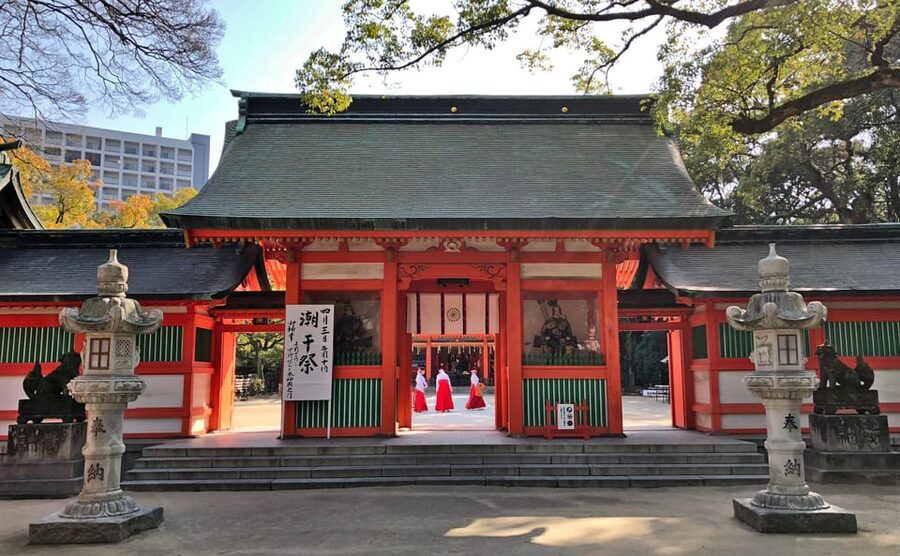
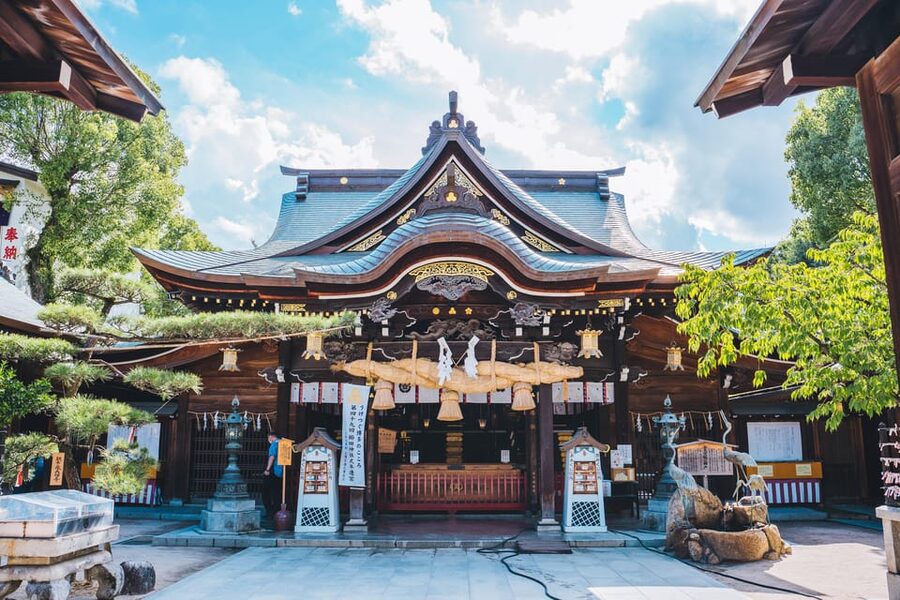
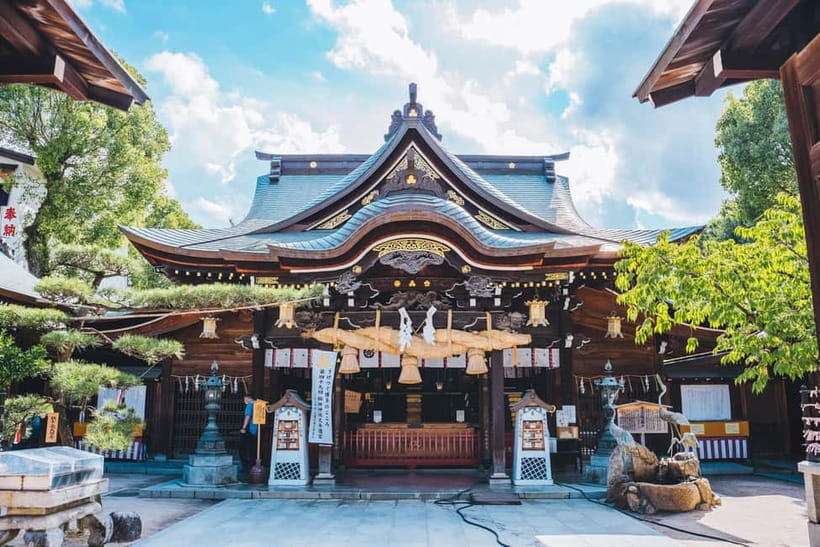
Next up is Kushida-jinja Shrine, often described as Fukuoka’s main shrine. This is where the day becomes more than quiet reflection. The atmosphere here is connected to real community life and major celebrations.
Kushida Jinja is central to the Hakata Gion Yamakasa festival, which means the shrine is not only a historical site. It is tied to yearly ritual, movement, and public excitement. Even if you visit outside festival season, you get the sense that this place is built to hold gatherings.
What I like about including a main shrine like Kushida is that it gives context for why Fukuoka feels the way it does. The guide’s job is to connect the intricate building details with the living culture around them, so the shrine feels purposeful, not just decorative.
You will typically tour the shrine grounds with guidance through what to notice, where to look, and how the shrine’s role in Hakata fits into Kyushu identity.
Good fit: If you enjoy festivals and want to understand them in a real place, Kushida is where the story starts making sense.
A different sort of day in Japan:
- Mt. Aso & Takachiho Gorge Tour with Optional Boat Ride
★ 4.7 · 222 reviews - Fukuoka: Takachiho Gorge & Scenic Railway One Day Tour
★ 4.8 · 178 reviews - Private Fukuoka Tour with a Local, Highlights & Hidden Gems 100% Personalised
★ 5.0 · 143 reviews - Fukuoka: Beppu Hells HotSpring, Frog Temple & Yufuin DayTrip
★ 4.4 · 84 reviews
Kawabata Shopping Street: food, shopping, and that everyday Hakata rhythm
After temples and shrine architecture, Kawabata Shopping Street is a needed reset. This traditional arcade is where Fukuoka feels like Fukuoka, not a postcard.
Your tour includes time here that is deliberately unscheduled. You get around 15 minutes of free time to look, snack, or pick up something small. That short window is smart. You do not spend the entire tour shopping, but you do get the chance to step into local commerce on your terms.
This is the part that works best for your senses. Shops spill out with goods, you catch aromas from food stalls, and the arcade’s energy tells you how people actually pass through the area day to day. If you have dietary limits or you want to keep the day light, free time is useful. You can decide fast and keep moving.
Practical advice: If you are sensitive to crowds or the smell of street food, choose one snack, then step slightly aside to eat. It keeps the experience pleasant without turning your day into a long wait.
Sumiyoshi Jinja: a different shrine style with a sea connection
Then comes Sumiyoshi Jinja, and the theme here is contrast again. This shrine has a distinctive architecture that differs from the style you might expect from other shrines, and it also has a connection to the sea.
That sea link matters because it changes the mood. Even in an urban environment, you can feel how the shrine’s identity ties to water, travel, and protection. It is one of those places where you can walk the grounds and notice how the layout supports calm.
Your guide brings attention to what makes it unique and helps you read the details without drowning you in facts. The goal is clarity, not a worksheet.
Tip: Slow down here, and give yourself time to look from multiple angles. Architecture that is different from the norm is easiest to understand when you shift your viewpoint.
Hakata Station rooftop panorama: your farewell view over Kyushu
The last “wow” moment is Hakata Station. Instead of finishing in a cramped street, you go up to a rooftop viewpoint that lets you see the city stretch out. This is the perfect last step because it pulls the day together.
A rooftop view does two things. First, it helps you remember where everything sits in the map of Hakata. Second, if timing lines up with the sun, the view gets noticeably better as light fades and the city starts turning on its lights.
Even if you do not stay long, the rooftop perspective is a strong way to end a walking-based tour. You step away from the details, see the broader pattern, and realize you covered a lot of ground with purpose.
Photo tip: Bring your camera or phone with enough battery. Rooftop lighting can be tricky, and you will want a few attempts, not just one.
Price and value: what the $58 per person really buys
The price is listed at $58 per person, with an experience length that can run 3 to 8 hours depending on starting times and your pacing. The included portion is a 3-hour tour with a local host, and the structure is built around walking between nearby sights.
Here is what you are paying for beyond “someone shows you temples”:
- Private and personalized: you are not stuck in a group rhythm that ignores your questions.
- Context: the guide ties each stop into a bigger story about Fukuoka and Kyushu.
- A smart route: temples plus shrine plus shopping plus a rooftop view is a balanced snapshot of Hakata life.
- Local translation of the place: English and Czech guidance means you do not have to guess what each detail means.
Not included is also important. Food and drinks are not included, and tickets to attractions are not included. That does not make the tour bad value, but it does mean you should budget a bit for snacks, drinks, and any ticketed entries you encounter. If you want a fully “all-in” day with zero extra spending, this is not that kind of tour.
If you compare it to spending half a day bouncing between sites on your own, the value is in the order and explanations. Instead of choosing randomly, you get a plan that makes the city make sense.
Guides, pace, and the small things that make it work
This experience stands or falls on the guide, and the feedback around hosts like Radim (and also another guide named Louise) points to a few consistent strengths.
- They adjust the walk to how you feel. One person even described that the pace changed after noting physical limitations.
- They answer questions in a way that stays friendly and practical, not like a lecture.
- They tailor the tour so it matches interests, including shopping and restaurant suggestions.
If you want a day that feels like a conversation and not a script, this tour format is built for that. You are walking at human speed, asking questions between stops, and getting context while you move.
Who should book this Fukuoka essentials walk
This is a great fit if you:
- want a first time in Hakata route that hits major spiritual sites plus everyday street life
- prefer walking over a vehicle circuit
- like getting explanations as you go, especially around Shofukuji and Kushida Jinja
- want a finish that feels like closure, with the rooftop panorama at Hakata Station
It may not be the best fit if:
- you expect a fully seated, minimal-walking outing
- you want food fully handled for you, since snacks and drinks are not included
- you dislike mixing temples, shrines, shopping streets, and views in one half-day flow
Should you book this tour?
I think you should book it if you want a compact, high-impact way to understand Hakata without getting lost or overplanning. The route makes sense: Zen calm at Shofukuji, visual contrast at Tochoji, community context at Kushida Jinja, real street energy on Kawabata, then a quieter sea-connected stop at Sumiyoshi, ending with a rooftop overview from Hakata Station.
If your budget allows a guided private walk, the value is strongest when you actually use the guide. Ask questions. Tell them what you care about. That is where the tour becomes more than sightseeing.
If you hate walking or you want a food-first day, you might be happier with a different style of tour. But if you want to leave Fukuoka feeling oriented, informed, and pleasantly tired in the best way, this one is a very solid choice.
FAQ
How long is the tour?
The duration is listed as 3 to 8 hours, and it includes a 3-hour tour with a local host. Starting times depend on availability.
Where is the meeting point?
The meeting point is CASETiFY STUDiO Amu Plaza Hakata store, right next to the main entrance, under the big clock.
What places are included in the walking route?
The tour includes Shofukuji, Tochoji Temple, Kushida-jinja Shrine, Kawabata Shopping Street, Sumiyoshi Jinja, and scenic views around Hakata Station, including the rooftop view.
Is hotel pickup available?
Hotel meetup is available on request for central locations.
What languages is the guide available in?
The live tour guide is available in English and Czech.
Is the tour private?
Yes, private group options are available, including a private and personalized experience.
Are food and drinks included?
No, food and drinks are not included.
Are attraction tickets included?
Tickets to any attractions are not included.
Is transportation included?
Transportation costs are not included. The tour is described as a walking experience, and other transport can be arranged for an additional cost.
What is the cancellation policy and booking payment option?
There is free cancellation up to 24 hours in advance for a full refund. You can also reserve now and pay later.
Newly listed around Fukuoka
- Fukuoka: Yufuin & Beppu Day Tour (Dazaifu / Brewery Options)★ 4.6 · 31 reviews
- Fukuoka: Okinawa-Style Shisa Amulet Making Workshop★ 5.0 · 7 reviews
- Fukuoka: Private Nightlife and Hidden Gems Tour with a Local★ 5.0 · 11 reviews
- Fukuoka’s Sacred Path: Temples, History & Culture★ 5.0 · 17 reviews
- Fukuoka Private Custom Tour with Local Guide★ 5.0 · 11 reviews
- Fukuoka: Takachiho Gorge, Amano Iwato & Scenic Train Tour★ 3.8 · 12 reviews
- Fukuoka: Nanzoin Temple and Reclining Buddha Guided Tour★ 4.5 · 7 reviews
- Fukuoka: Hakata Doll Painting Experience★ 4.8 · 30 reviews
Historical Tours, compared.
World Heritage Shirakawa-go and Experience Tours from Kanazawa
Read our review →
World Heritage Kyoto & Nara Uji Authentic Matcha Experience
Read our review →
World Heritage Shirakawa-go Morning Guided Tour
Read our review →
Hiroshima Historical Walking Tour – Why A-Bomb was Dropped
Read our review →
Hiroshima Peace (Heiwa) Walking Tour at World Heritage Sites
Read our review →
Yanaka Walking Tour: Historic and Traditional District of Tokyo
Read our review →
Shinjuku Historical Walking Tour & Secret Backstreets
Read our review →Browse the lists this tour appears in