Review · OSAKA TOURS
Sharpen Japanese Knives in Osaka
Sakai is famous for knives, and this workshop shows why. I like how the day starts with a quick look at real knife-making and purposes, then moves into hands-on sharpening with whetstones. I also love that the lesson covers not just edges, but the traditional handle fitting part. One thing to consider is that the experience depends on good weather, and you are doing a short walk between stops.
The guide I met was Yuji, and his English is good enough to follow the details without slowing down. The group stays small, up to 5 people, so you get time to ask questions while you work on your own knife. You also get a provided apron, sharpening tools, and coffee or tea, which makes the cost feel easier to swallow.
In This Review
- Key highlights
- Why Sakai Is Still the Knife-Making Heart of Japan
- What You Actually Learn: Edge Sharpness and Traditional Handles
- Stop 1: Sakai Traditional Industrial Hall and the Knife-Making Map
- Stop 2 at Wada Store: Whetstone Sharpening With Real Craft Guidance
- How the lesson feels, moment to moment
- Price and Value: What $213 Buys in Osaka Craft Time
- Getting There Without Stress: Meeting Point, Transit, and Timing
- Who Should Book This Osaka Knife Sharpening Tour
- A Quick Reality Check on Logistics and Weather
- Book It or Skip It: My Honest Take
- FAQ
- How long is the knife sharpening experience in Osaka?
- Where is the meeting point?
- Is the tour admission free for the first stop?
- What should I bring?
- Are meals included?
- Is the group size small?
- Can most people participate?
- What is the cancellation and weather policy?
Key highlights
- Knife city Sakai roots: Learn why the area is tied to knife craft for generations
- Stop 1 museum-style walk-through: See different knife types and how metalwork starts
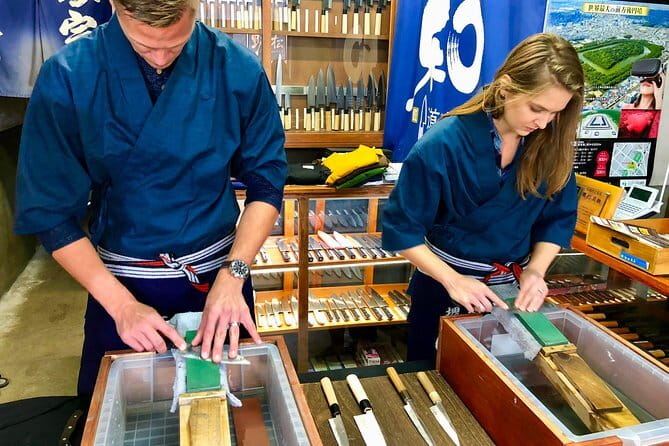
- Whetstone sharpening lesson: Work on technique using the tools in class
- Traditional handle fitting: Learn how handles go onto blades the traditional way
- Small group size: Maximum 5 people, with strong guide attention
- Hands-on pace: About 2 hours total, end back at the meeting point
Why Sakai Is Still the Knife-Making Heart of Japan
Sakai is one of those places where the craft feels older than tourism. The area is often called knife city because knife work has been important here for around 450 years, and the skills keep getting refined. That matters, because you are not learning “general sharpening.” You are learning in a neighborhood built around metalwork.
What I liked most is how the experience connects craft to purpose right away. You see that knives are made for different tasks, not just for looking cool on a kitchen shelf. Once you understand that, sharpening makes more sense. You start thinking about what you want your edge to do, and then the whetstone lesson becomes practical, not mysterious.
A few more Osaka days to weigh up
- Osaka Go Karting Tour with Funny Costume
★ 5.0 · 2,658 reviews - Osaka Castle: Museum and Tower Entry Ticket
★ 4.5 · 2,380 reviews - Osaka: Shinsekai Food Tour with 13-15 Dishes at 5 Eateries
★ 4.8 · 2,204 reviews
What You Actually Learn: Edge Sharpness and Traditional Handles
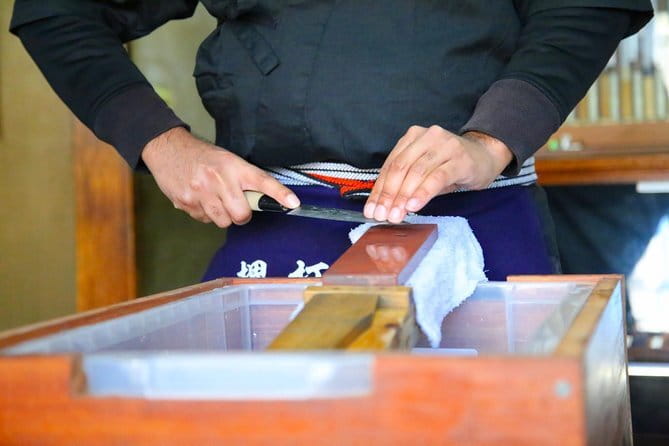
This is not a lecture where you watch someone else work. You sharpen and you handle the process yourself. The workshop part is built around whetstones, and the goal is that you learn how to sharpen Japanese knives properly, step by step.
You also get a part people often skip. In addition to sharpening, you learn how to fit the handles into the blades traditionally. That is a big deal if you love Japanese cooking tools, or if you have ever wondered why some knives feel different in the hand. Getting the handle fitting right changes comfort and control, which is half the battle in using a sharp knife well.
If you have never used a whetstone before, this still makes sense because the class is structured around tools and technique you practice. The upside is real-world skill. The downside is you will want to pay attention, because sharpening technique does not work by accident.
Stop 1: Sakai Traditional Industrial Hall and the Knife-Making Map
The first stop is the Sakai Traditional Industrial Hall. It is timed at about 30 minutes, and it is admission ticket free. Even with a short slot, the point is clear: help you understand the range of knives, then show how they are made by hand.
This part works well because it sets context. You start seeing that Japanese knives are designed with intention. Different shapes and types exist for different jobs, and handmaking is part of what shapes performance. You are basically getting a quick orientation so the later sharpening practice has meaning.
What to watch for here is how the displays explain purpose. If you focus on that, you will leave Stop 1 with questions in your head that the workshop can answer. And if you come in as a plain kitchen-cooking person, it still helps. You will understand why certain edges behave differently and why sharpening is not one-size-fits-all.
A small consideration: because this stop is short, you will not have a lot of time to linger in every corner. Go with curiosity, but keep moving so you do not feel rushed when the workshop starts.
Stop 2 at Wada Store: Whetstone Sharpening With Real Craft Guidance
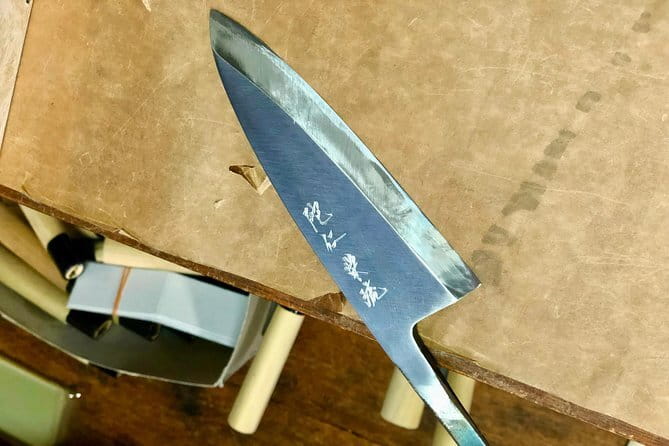
The second stop is at Wada Store, and this is where the main action happens. The session runs about 1 hour 30 minutes, and the admission ticket is included. You sharpen using some whetstones, and you practice with guidance from the people running the workshop.
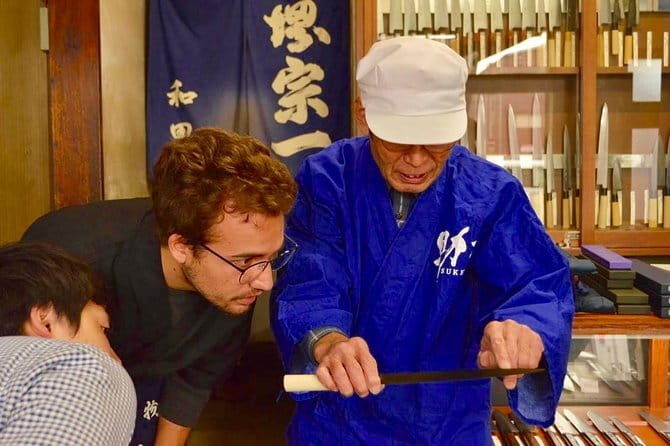
This is also where the reviews really line up. The experience is repeatedly described as workshop-level amazing, with expert craftsmen you can work alongside. In one account, Yuji met the group on time at Sakai station and led an easy walk to the knife museum, then continued through the shop lesson. The common theme is direct coaching, not just standing nearby.
A different sort of day in Japan:
- Osaka Food Tour: 13 Dishes at 5 Local Eateries
★ 5.0 · 2,149 reviews - Hungry Osaka Street Food Tour:15 Tastings & 3 Drinks with a Local
★ 5.0 · 1,727 reviews - Osaka: teamLab Botanical Garden Entry Ticket
★ 4.5 · 1,710 reviews - Osaka: Tea Ceremony Experience
★ 4.9 · 1,426 reviews
How the lesson feels, moment to moment
You start with the basics and then work through the process on your own knife. The goal is that you learn how to sharpen properly, not just how to copy one motion. You will also learn the traditional method for fitting the handle onto the blade.
That handle part is worth your attention. It is easy to think of a knife as one object, blade plus handle. But in traditional construction, the handle fitting is part of how the knife becomes stable and comfortable. By the end, you understand why the craft people care so much about the fit, not just the edge.
You get apron and the sharpening tools, plus coffee and/or tea. That small comfort helps, because sharpening sessions can be tiring if you are leaning over something for too long. You will likely feel better after the first break cup, then get back to it with better focus.
Price and Value: What $213 Buys in Osaka Craft Time

Let’s talk value in a way that actually helps you decide. At $213 for about 2 hours, you are paying for three things:
- Hands-on instruction with sharpening and handle fitting, using whetstones and tools
- Expert guidance in a craft neighborhood, including a guided museum-style stop
- Small group attention, capped at 5 travelers
The first stop being free for admission keeps the structure efficient. The second stop includes the lesson and the workshop ticket, so most of your money goes straight into practical skill time.
What helps most is that you get what you need to participate: apron, sharpening tools, and coffee or tea. And you work with your own knife. If you regularly cook with a Japanese knife, this kind of structured practice can be worth a lot more than a generic demo, because you leave with technique you can repeat.
One thing to weigh: this is not a full day with lunch included. If you plan your schedule like a pro, you will be fine. If you forget, you might feel hungry during the time gap between the end and your next meal.
Getting There Without Stress: Meeting Point, Transit, and Timing

The meeting point is Wada Store, 1-chōme-1-1 Shinmeichōhigashi, Sakai Ward, Sakai, Osaka 590-0935, Japan. The tour ends back at the meeting point, so you do not have to figure out how to reconnect to your day.
It is near public transportation, which is a practical win. In one review, the guide met people at Sakai station and they walked about half a mile to the knife museum. Use that as a realistic gauge. You should be ready for a short walk, then a workshop where you are standing and working.
The good part: the tour length is about 2 hours total. That makes it easier to slot into a broader Osaka plan. The less good part: because it is short, you need to arrive on time. The experience is structured, and everything depends on moving smoothly from the industrial hall to the sharpening shop.
You also get a mobile ticket. That is simple and helps if you do not want to chase printed papers.
Who Should Book This Osaka Knife Sharpening Tour

This tour fits best if you want hands-on skill and you are curious about how craft neighborhoods work.
You will probably love it if:
- You own a Japanese knife and want to learn sharpening technique using whetstones
- You want to learn more than edge maintenance, including traditional handle fitting
- You like small group tours where questions are actually answered
- You enjoy seeing how tools are made by hand, and why different knife types exist
It may not be the best fit if:
- You only want big-city sightseeing, with long photo breaks
- You hate any walking at all, because there is at least some transit-style movement between stops
- You want a full food day, because lunch and snacks are not included
A Quick Reality Check on Logistics and Weather
The experience requires good weather. If it gets canceled due to poor weather, you will be offered a different date or a full refund. Also, this booking is non-refundable and cannot be changed for any reason, so treat it like a firm plan unless weather threatens it.
Group size is capped at 5, so the experience stays personal. And most travelers can participate, which usually means the activities are not restricted to a niche skill level.
Book It or Skip It: My Honest Take
If you are deciding whether to book, here is the simple version. Book it if you want real sharpening practice and a clear explanation of how Japanese knives are made and maintained. The strongest point is that the learning is hands-on, guided by craftsmen, with a teacher like Yuji who can explain details in English and keep the lesson moving.
Skip it if your goal is mostly sightseeing and you are not interested in edge care or handle fitting. This is a skill-focused experience, tied to Sakai knife craft, and it works best when you show up ready to participate.
If you do book, bring your knife and treat the whetstone time like the main event. You will get more out of it by asking questions during the work, not by trying to memorize everything after.
FAQ
How long is the knife sharpening experience in Osaka?
It runs for about 2 hours.
Where is the meeting point?
Meet at Wada Store, 1-chōme-1-1 Shinmeichōhigashi, Sakai Ward, Sakai, Osaka 590-0935, Japan.
Is the tour admission free for the first stop?
The Sakai Traditional Industrial Hall stop is free (admission ticket free). The sharpening lesson stop at Wada Store has the admission ticket included.
What should I bring?
You should bring your knife. An apron and the sharpening tools are included.
Are meals included?
Coffee and/or tea are included. Lunch, dinner, and snacks are not included.
Is the group size small?
Yes. The maximum group size is 5 travelers.
Can most people participate?
Most travelers can participate.
What is the cancellation and weather policy?
The experience is non-refundable and cannot be changed. If it is canceled due to poor weather, you will be offered a different date or a full refund.
Newly listed around Osaka
- Traditional Japanese Music show & Experience Tour in Osaka★ 5.0 · 25 reviews
- Meet Locals experience Fun Chat Drink Osaka International Party★ 5.0 · 61 reviews
- Sushi and Japnese foods cooking class in Osaka★ 5.0 · 51 reviews
- Sushi Class in Osaka Dotonbori★ 5.0 · 37 reviews
- Kyoto Day Trip from Osaka Port – Private Shore Excursion★ 5.0 · 13 reviews
- Guided Photography Tour in Osaka: Capturing Memories★ 4.5 · 20 reviews
- Nara, Todaiji Temple & Kuroshio Market Day BUS Tour from Osaka★ 3.5 · 18 reviews
- Retro Osaka Street Food Tour: Shinsekai★ 4.5 · 77 reviews
Osaka Tours, compared.

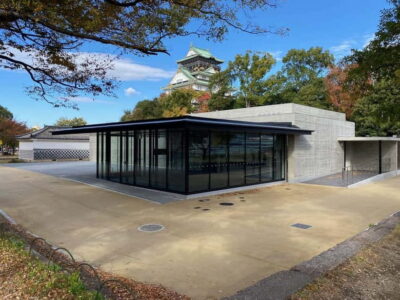

Shinsekai Food Tour with 13-15 Dishes at 5 Eateries
Read our review →
Osaka Food Tour: 13 Dishes at 5 Local Eateries
Read our review →
Hungry Osaka Street Food Tour:15 Tastings & 3 Drinks with a Local
Read our review →