
Review · SAMURAI SWORD & NINJA TRAINING
Guided Night Tour to Feel the Samurai Culture in Kanazawa
Night turns Kanazawa into a living museum. This guided tour threads together samurai-era streets, tea-house lanes, shrines, and photo stops, all in the evening glow.
I especially love how the walk links places you might see on a map into one clear story about Kanazawa’s past, from Owaricho’s old merchant power to Nagamachi’s samurai streets. I also like the small-group pace, because it feels relaxed even when you are moving through dark lanes and along the river at night.
One consideration: it is an outdoor, mostly nighttime walking route, so cold weather, dim sidewalks, and a few narrow stretches can add friction. Bring warm layers and stick to the guide’s path.
In This Review
- Key takeaways before you go
- Kanazawa at night: why this tour works better after dark
- Meeting point at Mister Donut, and the smooth start to a dark-city walk
- How the 2-hour loop is paced, and what you should expect to do
- Stop 1: Kazuemachi Chayagai and Owaricho’s old economic center
- Stop 2: Higashi Chaya District lantern lanes and geisha-area atmosphere
- Stop 3: Asanogawa Bridge illumination and the Asano River’s role
- Stop 4: Kanazawa Castle Otebori moat walls and Edo-era water lines
- Stop 5: Oyama Shrine and the Go-Shinmon gate
- Stop 6: Nagamachi Bukeyashiki ruins, stone pavements, and old samurai lanes
- Price and value: why $56.50 can make sense for this route
- The guides make a difference, and names you might hear
- What to wear and bring for a comfortable night in Kanazawa
- Optional routing, transportation, and when you might need to pay extra
- Who this Kanazawa samurai night tour is best for
- Should you book it?
- FAQ
- How much does the Kanazawa Guided Night Tour to Feel the Samurai Culture cost?
- How long is the tour?
- Where do I meet for the tour?
- Where does the tour end?
- Is admission included at the stops?
- How big is the group?
- Do I need to arrange transportation to the meeting point?
- What should I bring or wear?
- Are bathrooms available during the tour?
- Can service animals join the tour?
Key takeaways before you go
- Tea district + samurai district in one night: you get both sides of traditional Kanazawa culture without cramming daytime sights.
- Illuminated river views: the Asano River bridges are lit for a magical nighttime effect.
- Edo-period look at the moat: Otebori’s water-lined stone walls are a time capsule.
- Photo-friendly stops: you pause often, so you are not speed-walking through the best bits.
- One group per day, max 6 people: expect a guided vibe rather than a crowd scene.
- Flexible end point: you typically finish in Korinbo, with options to end around Omicho market or Higashi tea-house area by request.
Kanazawa at night: why this tour works better after dark
Daytime Kanazawa is lovely, but night is where the city’s traditional layout really shows itself. You are walking narrow lanes, crossing stone and river edges, and passing buildings that feel calmer once the daylight crowds thin out. This tour is built for that rhythm.
The big win for me is how the night setting helps you “read” the city. When you hear the stories behind places like Owaricho and Nagamachi Bukeyashiki, the streets stop being just scenery. You start to understand why these areas mattered, how people moved through them, and what the daily life vibe was like in earlier centuries.
Also, the route is short enough to stay enjoyable. It is about 2 hours, so you get a solid sampler without committing to an all-night marathon. The group cap helps too, since you are not stuck behind a wall of people every time the guide points something out.
More Samurai & Ninja Sessions in Kanazawa
- Kanazawa: Samurai Residence Remains Nomura Family admission
★ 4.4 · 111 reviews - Kanazawa: Samurai, Matcha, Gardens and Geisha Full-Day Tour
★ 4.9 · 75 reviews - Full-Day Tour from Kanazawa: Samurai, Matcha, Gardens and Geisha
★ 5.0 · 68 reviews
Meeting point at Mister Donut, and the smooth start to a dark-city walk
The meeting spot is at Mister Donut Kanazawa Musashi Shop (Aokusamachi, 88番地 1F). It is an easy landmark, which matters in Kanazawa at night. You should arrive a little early so you can find the group before the first walk begins.
The tour ends in Korinbo, but the ending point can be adjusted. The information says the dissolution place is not only around Korinbo, and the operator may meet your request, with possible areas including Omicho market area and Higashi tea house area. That is handy if you want to connect quickly to your next stop for drinks or dinner.
One more practical note: there is no hotel pickup. Plan on getting yourself to the meeting point using public transportation. The tour is listed as near public transportation, so you should have options.
How the 2-hour loop is paced, and what you should expect to do
This is a guided walking tour with frequent photo stops. The itinerary is broken into six main stops, and each one is timed (15 to 30 minutes per stop). Many of the sites are listed as free admission, which means you are mainly paying for the guide and the route planning, not entry fees.
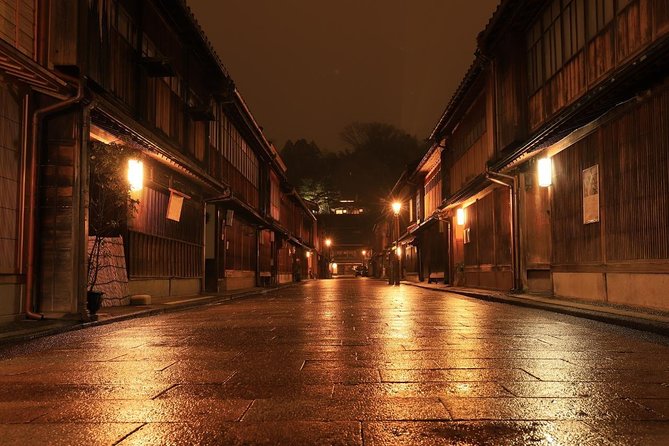
The walking can include dark or narrow roads. The guide’s instructions matter here, so follow them closely. That is not just safety talk, it is also how you end up at the best angles for night photos.
Group size is capped at a maximum of 6 travelers, and the tour is limited to one group per day. That usually means more conversation time and fewer chances to get separated from the group when the sidewalks get crowded.
Stop 1: Kazuemachi Chayagai and Owaricho’s old economic center
Your first stop is Kazuemachi Chayagai, with about 30 minutes here. The walking begins through Owaricho, described as the former Kanazawa economic center during the samurai era. The pitch is simple: you start in the area where the city’s wealth and influence shaped what you see today.
Owaricho is also where you can notice the kind of stately, authentic buildings that tend to survive best in areas with a long memory. After that, the route heads through a lively back alley to Chayagai.
Why this stop matters at night: alleyways and canal-adjacent streets tend to feel more intimate after dark. The stories the guide shares help you connect the “who lived here” and “why it mattered” dots. You get a sense of Kanazawa as a city that valued tradition, not a city frozen behind museum glass.
More Samurai and Ninja sessions in Kanazawa:
- Kanazawa Private Tour: Highlights of an Old Samurai Town
★ 5.0 · 46 reviews - Kanazawa Ninja Temple Half Day E-bike tour
★ 5.0 · 14 reviews - Kanazawa “Near Ninja Temple” : Japanese Calligraphy Class
★ 5.0 · 13 reviews - Tokyo: Samurai Restaurant Show Ticket with 2 Drinks
★ 4.5 · 1,307 reviews
Stop 2: Higashi Chaya District lantern lanes and geisha-area atmosphere
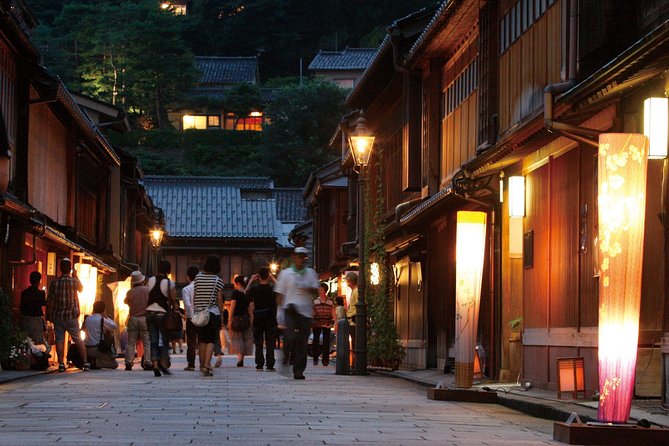
Next is Higashi Chaya District for 15 minutes. This is another classic traditional district, known for its tea-house culture. The tour keeps moving at a pace that works for first-timers, without turning it into a long lecture.
This is also where you likely benefit from having a guide. Even if you have been reading about Kanazawa, it is hard to choose which side streets to take when everything looks “old” but not necessarily meaningful. With the guide, you get the context for what you are seeing, and you also get photo chances during the better-lit stretches.
A small tip from what I’d watch for on a night walk like this: pay attention to the lighting and where the buildings face the street. In many preserved districts, the “public” view is planned, and the nighttime illumination makes that planning obvious.
Stop 3: Asanogawa Bridge illumination and the Asano River’s role
Then you shift to the water at Asanogawa Bridge for about 15 minutes. The Asano River is framed as important to Kanazawa’s history and lifestyle, and at night you see why. The bridges on the Asano River are illuminated, creating a magical atmosphere.
This is one of those stops that works even if you are not deep into samurai studies. River views are universal, and at night they turn into visual proof that the city’s “old systems” still shape daily life.
If you are a photo person, this is one of the places to slow down and take your time. You will likely get clearer shots with a steady approach, not a last-second sprint.
Stop 4: Kanazawa Castle Otebori moat walls and Edo-era water lines
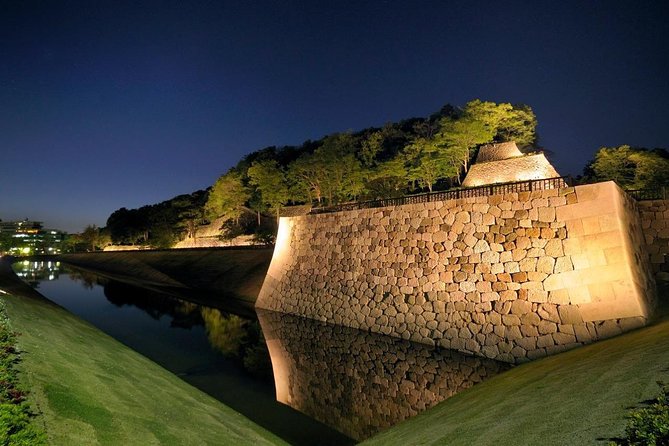
Stop 4 is Kanazawa Castle Otebori, about 15 minutes. Otebori is the moat lined with stone walls surrounding Kanazawa Castle. The water is said to have not been drained even in modern times, so the appearance is described as unchanged since the Edo period.
This is a big deal because a moat is more than decoration. It is a defensive and organizational feature that influenced how people moved around the castle area. At night, when the stone and water edges catch the light, it is easier to picture how this landscape functioned.
One practical caution: night light-ups can create glare and reflections. For photos, you might want to experiment with angles rather than shooting from exactly where the crowd stands.
Stop 5: Oyama Shrine and the Go-Shinmon gate
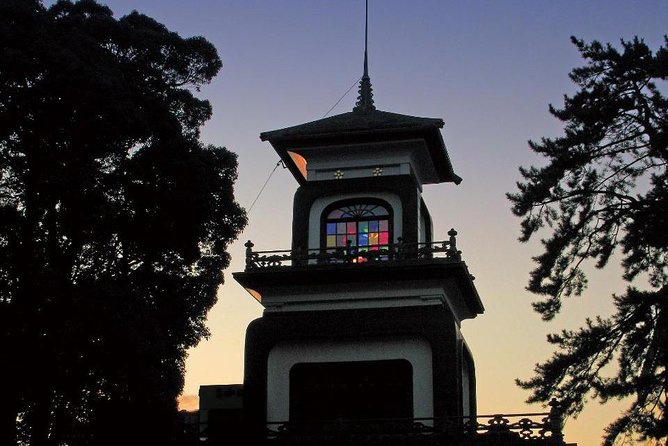
Your next stop is Oyama Shrine for about 15 minutes. This shrine is noted for its peculiar Go-Shinmon gate, dedicated to Toshiie Maeda, the founder of the Kaga Domain.
What I like here is that it adds a different flavor to the tour. You are not just seeing entertainment districts and samurai streets. You are also seeing the formal religious and political threads that shaped the domain system.
A gate like this becomes more interesting at night because lighting changes how you perceive the structure. Even if you are not an architecture expert, you can still appreciate the craftsmanship and the sense of ceremony.
Stop 6: Nagamachi Bukeyashiki ruins, stone pavements, and old samurai lanes
The final stop is Ruins of Nagamachi Bukeyashiki for about 30 minutes. This is where the tour leans fully into samurai culture. Old samurai residences still remain, and it is also where some citizens live. That “living history” detail matters, because it keeps the experience grounded.
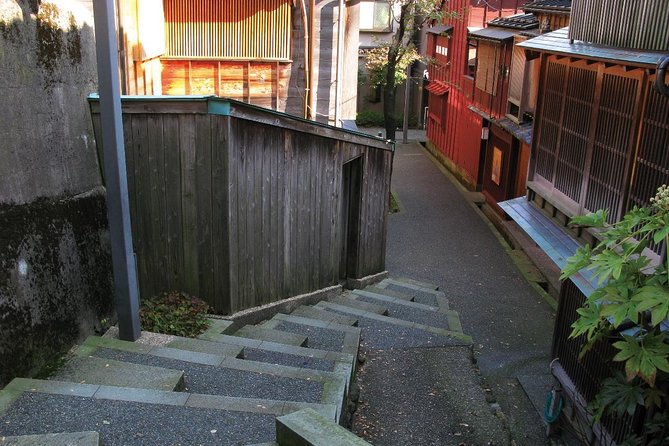
The setting is described as elegant old streets with stone pavements and earthen walls. This is the part of the tour where you likely understand why guides keep emphasizing the layout. In Nagamachi, the street materials and boundary walls help you imagine the daily rhythm of a residence district.
Also, this stop is a good “wrap” for the whole night. Starting from Owaricho’s former economic center, moving through tea-house districts, crossing illuminated river views, then ending at samurai residences gives you a strong sense of how Kanazawa’s power, culture, and daily life were arranged.
Price and value: why $56.50 can make sense for this route
At $56.50 per person, you are paying for a short guided route with multiple major traditional areas. Because the stop admissions are listed as free at each stop, your cost is largely the guide and the planning.
Is it worth it? I think it can be, especially if:
- You are new to Kanazawa and want a fast orientation of what is where.
- You prefer night photos and quieter streets, not a solo scavenger hunt.
- You value history context, not just views.
The tour’s small group size helps justify the cost too. With a max of 6 people and one group per day, the guide can keep things moving without herding everyone like cattle. That usually means better questions and clearer answers.
One caution: if you expect a constant stream of high-energy storytelling, your experience may depend on the guide and the group dynamic. The reviews include one note about a guide being less enthusiastic or talkative, and that the route could feel doable on your own. So, if you want a lot of narration, come ready to ask questions.
The guides make a difference, and names you might hear
Multiple guides are praised by name in the feedback I saw. Hiromi-San and Miki-San both show up in standout reviews, with comments about friendliness, helpful explanations, and making history feel real. Other guide names mentioned include Ohhara, Masayo, Nozomi, and Ms Shirai, each described as professional, kind, and very informative.
Even with a great route, the guide controls the “story glue” between stops. A strong guide will point out details you would otherwise miss, and they will also give suggestions for what to do next in Kanazawa.
What to wear and bring for a comfortable night in Kanazawa
This tour is simple, but it asks you to be practical.
- Wear comfortable shoes. The course is walking through traditional districts and around riverside and castle areas.
- Dress for cold at night, especially in winter. The info explicitly says temperatures may get low during winter.
- Bring drinks and plan your bathroom timing. There are several bathrooms on the tour course, but it is recommended to use them before you start. Automatic vending machines are also available along the course.
- Expect dark or narrow roads. The guide may route you through dim passages, so follow instructions rather than shortcutting.
Also, the tour lists Free Wi-Fi as X. So do not rely on it to load maps or translation tools.
Service animals are allowed, and most travelers can participate. If you are expecting a baby, the tour says you can attend, but you should consider your physical condition before booking.
Optional routing, transportation, and when you might need to pay extra
The route can adjust based on the situation. The information says they may use a route bus or taxi on the way depending on circumstances. If that happens, transportation expenses are borne by the customer.
If you are the type who hates surprises, it is worth asking about the chance of using transport before departure, so you know what to expect. And if you have a free bus pass from earlier in the day, bring it.
Who this Kanazawa samurai night tour is best for
This tour is a good fit if you:
- Want samurai culture in Kanazawa without building a night route yourself.
- Like traditional districts and illuminated scenery, especially along the Asano River.
- Enjoy learning how different parts of a city connect historically.
- Prefer a small group setting, max 6 travelers, with one group per day.
It is also a nice first-night option, because you end in Korinbo, a lively area for continuing your evening. Just plan your next meal with the idea that you might be walking and you may feel cold after outdoor stretches.
If you love totally free-form exploring with no structure, you could technically piece together parts on your own. But the whole point of this tour is that you get a guided storyline and better pacing for night conditions.
Should you book it?
I would book it if you want a guided “Kanazawa at night” orientation focused on samurai culture plus tea-house districts, with illuminated river views and a moat that visually ties you back to the Edo period. The small group size, photo stops, and free admissions at stops help it feel like solid value.
Skip it or think twice if you hate cold night walks, dislike guided pacing, or want something other than street-level sightseeing and stories. This tour is mostly outdoors, so your comfort matters.
If you do book, wear good shoes, bring a warm layer, and treat it like a guided photo walk with smart context. That is where this experience shines.
FAQ
How much does the Kanazawa Guided Night Tour to Feel the Samurai Culture cost?
The price is $56.50 per person.
How long is the tour?
It lasts about 2 hours.
Where do I meet for the tour?
You meet at Mister Donut Kanazawa Musashi Shop, 920-0907 Ishikawa, Kanazawa, Aokusamachi, 88番地 1F.
Where does the tour end?
The tour ends in Korinbo, Kanazawa. The dissolution place can also be adjusted to areas such as Omicho market area or Higashi tea house area, if requested.
Is admission included at the stops?
The stops listed in the itinerary have admission ticket free noted for each stop.
How big is the group?
The tour has a maximum of 6 travelers, and it is limited to one group per day.
Do I need to arrange transportation to the meeting point?
Hotel pickup is not available. The meeting point is near public transportation, so you’ll need to get there yourself.
What should I bring or wear?
Wear comfortable shoes. Bring warm measures for cold nights in winter, and prepare drinks since the info recommends using bathrooms before the tour begins.
Are bathrooms available during the tour?
Yes, there are several bathrooms on the tour course. They will be indicated to you during the tour, and there are also automatic vending machines along the course.
Can service animals join the tour?
Yes, service animals are allowed.
More Evening Experiences in Kanazawa
- Kanazawa Night Tour with Local Meal and Drinks
★ 5.0 · 148 reviews - Kanazawa Night Tour With Full Course Meal
★ 4.9 · 16 reviews - Kanazawa Night Foodie Tour (Private Option Available)
★ 5.0 · 11 reviews - Kanazawa Night Foodie Tour
★ 4.5 · 6 reviews
Newly listed around Kanazawa
- Private Tour of Shirakawago and Gokayama from Kanazawa★ 5.0 · 50 reviews
- Taste of Kanazawa (Food tasting in Omicho Market & Higashi Chaya)★ 5.0 · 58 reviews
- Kanazawa private 1 day/Photoshoot by professional photographer★ 5.0 · 33 reviews
- Private Tour of Shirakawago from Kanazawa (Half Day)★ 5.0 · 24 reviews
- Private Ring Craft Experience in Kanazawa★ 5.0 · 22 reviews
- Private Tour Kanazawa, Shirakawago, Hida Furukawa,Takayama★ 5.0 · 108 reviews
- Noto Full Day Driving Tour (Private Car)★ 5.0 · 6 reviews
- Noto peninsula 1 day/Photoshoot with professional photographer★ 5.0 · 9 reviews
Samurai Sword & Ninja Training, compared.
Samurai Ninja Museum Guided tour and Experience
Read our review →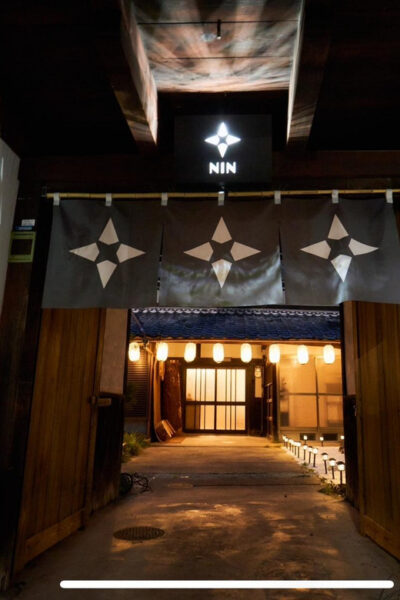
Kendo and Samurai Experience with Uniform and Gear
Read our review →
Samurai Sword Class by Experts in Traditional Arts
Read our review →
Skip the lines Basic Ticket at SAMURAI NINJA MUSEUM KYOTO
Read our review →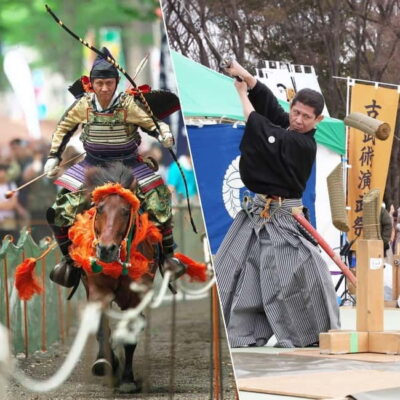
Samurai Sword & Archery Class from Samurai Descendant
Read our review →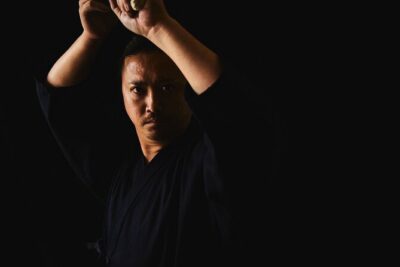
Browse the lists this tour appears in