
Review · LICENSED GUIDES & PRIVATE DRIVERS
Kurashiki Half-Day Private Tour with Government-Licensed Guide
Kurashiki feels like Japan’s canal city. I really like the way this private half-day tour blends postcard canals with real local industry, and I also love that you get a government-licensed, multilingual guide who can steer the day around what you want. One thing to keep in mind, it is a walking tour, and most museum admissions are not included.
This is a smart way to see Kurashiki without trying to “do everything” on your own. The route is built around choosing 2 to 3 stops from a menu, so you spend less time commuting and more time actually looking, reading, and asking questions.
It runs about 4 hours, costs $107.50 per person, and the vibe is relaxed, not rushed. If your ideal day is quiet strolling, good stories, and a little time for denim shopping, you’ll be in your element.
In This Review
- Key things to know before you go
- Where Kurashiki Bikan really wins (canals, storehouses, and old-town pace)
- Ohara Museum of Art: Japan’s Western-art moment on the canal
- Torajiro Kojima Memorial: when Kurashiki connects artists and collections
- Ohashi House: merchant-class life, shown through a 1796 town house
- Ivy Square and Kurabo Memorial Hall: cotton mills and brick re-used
- Kojima Jeans Street and Kurashiki Denim Street: textile heritage you can actually buy
- The natural-history and Momotarō options: lighter stops with local flavor
- How the 4-hour pace stays comfortable (and where you might feel it)
- Price and value: why $107.50 can make sense for the right traveler
- A practical menu of stop combos (so you don’t overthink it)
- Should you book this Kurashiki half-day private tour?
- FAQ
- How long is the Kurashiki half-day private tour?
- Is this tour private?
- Is pickup offered, and how do I meet the guide?
- What’s included in the price?
- Are entrance fees included for museums and attractions?
- Can I choose which places to visit?
- Is transportation provided?
- Is there a mobile ticket?
- Can I cancel for free, and how late can I cancel?
- Are service animals allowed?
Key things to know before you go
- Choose 2 to 3 sites, so the guide can match your time to your interests
- Bikan Historical Quarter canals and preserved canal routes set the tone right away
- Ohara Museum of Art is a major stop, and it is Japan’s first Western art museum
- Ohashi House adds the merchant-house perspective from Kurashiki’s top business families
- Denim Street and Kojima Jeans Street connect art, design, and the city’s textile legacy
- Admissions are mostly not included, so budget a little extra for museums
Where Kurashiki Bikan really wins (canals, storehouses, and old-town pace)
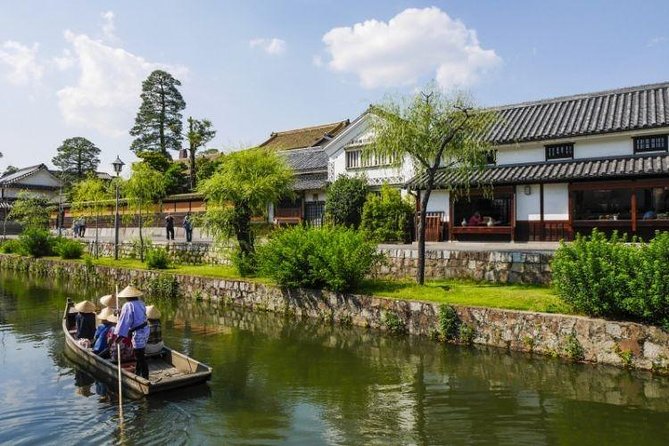
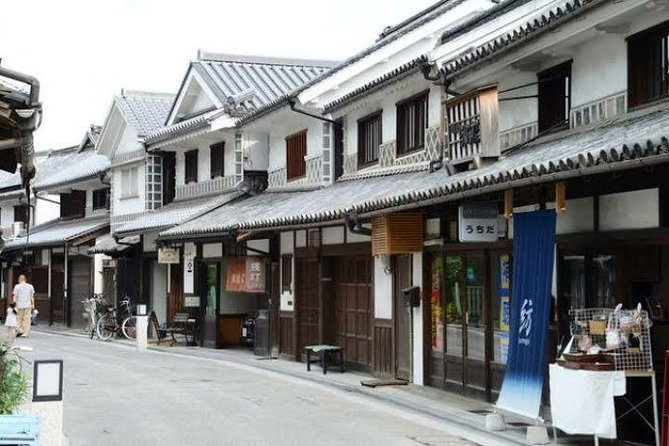
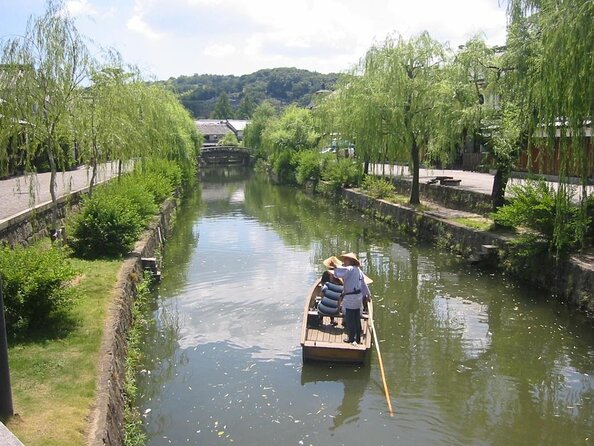
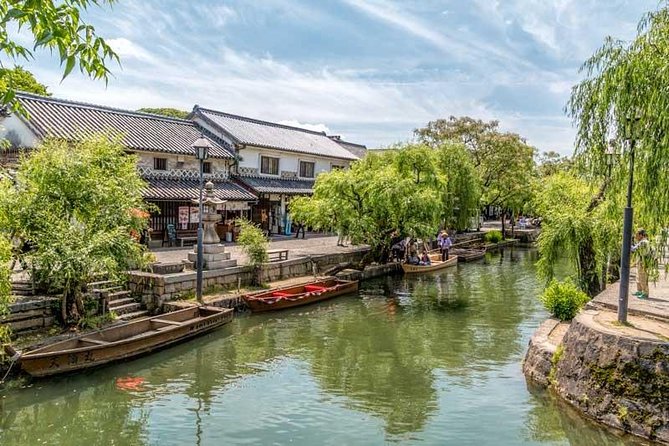
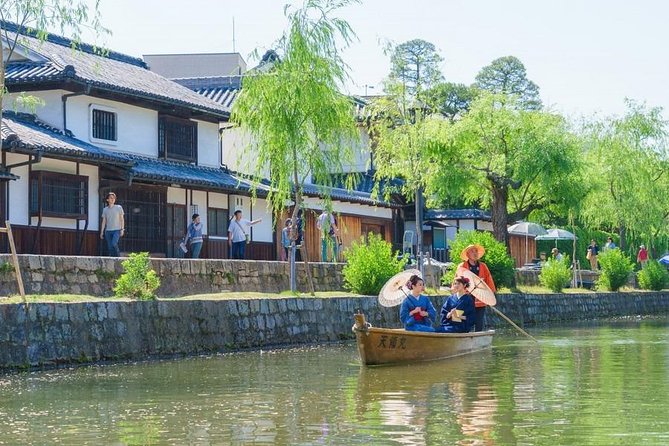
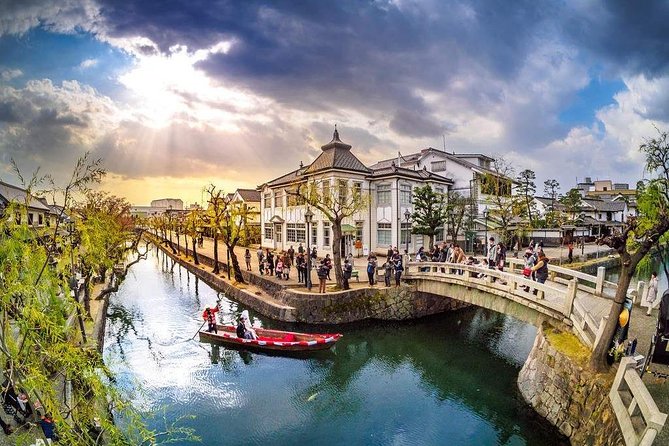
Kurashiki’s Bikan area is the part you tell friends about afterward. You’ll walk through the preserved canal zone, where waterways were built so boats and barges could move between the city’s storehouses and the port. That single detail makes the whole neighborhood click. It is not just scenery. The canals were built to work.
You’ll also get the “Japan, but make it Amsterdam” mood people love, with willow-lined canal edges, old wooden houses, and slim wooden boats in the background. Even if you have seen other canal towns, Kurashiki’s look feels different because it is tied so closely to trade and textiles.
A free stop here helps, too. Since the canal quarter is listed as free admission, you can spend your money on the places that charge entry, like the art museum. I like that kind of planning, especially when your total time is only half a day.
More Private Guides in Japan:
- Tokyo 6hr Private Tour with Government-Licensed Guide
★ 5.0 · 3,902 reviews - Kyoto Early Morning Tour with English-Speaking Guide
★ 5.0 · 1,427 reviews - Tokyo 4hr Private Tour with Government-Licensed Guide
★ 5.0 · 1,394 reviews
Ohara Museum of Art: Japan’s Western-art moment on the canal
If you choose one “serious” art stop, make it the Ohara Museum of Art. This museum is described as Japan’s first museum of Western art, and it is set up in a way that fits the canal-side setting. The main complex sits in three adjacent buildings next to the canal, plus a separate building.
What that means for you during a half-day: it is easy to tie art viewing to walking, instead of doing a museum-and-run. You are not just hopping from one ticketed location to another. You can look, reset your eyes with the canal views, and then come back to the art.
Plan on around an hour for this stop. The catch is simple, admission is not included. If you hate surprises, check your ticket plan ahead of time and expect to pay. Also, if you are not into museums, you can still enjoy Kurashiki without it by swapping this for the more textile-focused or house/mill stops.
Torajiro Kojima Memorial: when Kurashiki connects artists and collections
Next door world, but with a different focus. The Ohara complex includes the Ohara Museum of Art Torajiro Kojima Memorial area, with an Annex and spaces labeled as Craft Art Gallery and Asiatic Art Gallery. The memorial is tied to Kojima Torajiro, and this area is part of why Kurashiki feels like more than “historic streets.”
This is a good choice if you want to understand how Western-style art entered Japanese creative circles. The stop is listed as about an hour, and admission is not included. I treat places like this as “high value if you like context.” If you just want canals and denim shopping, you may prefer to spend that time elsewhere.
Ohashi House: merchant-class life, shown through a 1796 town house
Ohashi House is one of the most compelling stops on the list because it shifts you from “what the city looked like” to “how people lived and worked.” The Ohashi family were a leading merchant group in Kurashiki, and this residence was built in 1796.
In other words, you’re stepping into a machiya-style town house, the kind of home shaped by commerce and close neighbors. During a walking tour, a house stop can do something practical for you. It gives your day a baseline. After seeing canals, museums, and shopping lanes, you can suddenly picture the humans who made it all possible.
The stop is about an hour, and admission is not included. If you’re choosing just two sites, I’d put Ohashi House in the same top tier as Bikan canals, especially if you like architecture and daily-life details more than art rooms.
A few more Japan days to weigh up
- Private Tour to Mt. Fuji and Hakone (Fully Licenced Operator)
★ 5.0 · 1,910 reviews - Fushimi Inari Hidden Hiking Tour (Private Option Available)
★ 5.0 · 1,750 reviews - Private Kyoto Tour with a Local, Highlights & Hidden Gems, Personalised
★ 5.0 · 1,543 reviews - Tokyo Customized Private Tour (Must See Places in 1 Day)
★ 5.0 · 1,499 reviews
Ivy Square and Kurabo Memorial Hall: cotton mills and brick re-used
Kurashiki’s textile story is not abstract. It is built into the city’s buildings.
Start with Ivy Square, a complex of brick buildings covered in ivy that includes museums, restaurants, and a hotel. This area is listed as the site of the first modern cotton mill in Japan. Since the stop is free admission, it is a great “energy reset” between ticketed museums. You can walk, look around, and get your bearings before committing to paid entry.
If you want the deeper industrial timeline, Kurabo Memorial Hall is the next step. It illustrates the history of the Kurashiki spinning mill company, with five rooms covering different time periods from the company’s foundation in 1888 onward. Expect about an hour here, and admission is not included.
This pair works especially well if your priorities are textiles, labor history, and industrial architecture. If you hate museums, you can still get the key idea from Ivy Square without paying for the deeper mill exhibits.
Kojima Jeans Street and Kurashiki Denim Street: textile heritage you can actually buy
Kurashiki’s denim culture can feel like a modern shopping lane until you understand the story behind it. That is where Kojima Jeans Street and Kurashiki Denim Street help.
Kojima Jeans Street is dedicated to Kojima Torajiro, who painted in a Western style. The stop also includes works from Kojima’s own collection, with Egyptian and Islamic art. That mix of artist background and collected works is a reminder that Kurashiki’s identity is more than fabric. It is art, design, and cross-cultural influence, all tangled together.
Kurashiki Denim Street is the practical payoff. Okayama is described as Japan’s denim capital since the 1970s, and Kurashiki’s textile heritage shows up here in vintage-styled denim and a quirky lane of popular Japanese clothing brands. This is where you can slow down, compare cuts, and pick up something that actually fits your style.
Denim Street is listed as a short stop (about 1 minute on the plan), which tells me the tour route likely treats this as a quick browse rather than an all-out retail session. So if shopping is your main goal, tell your guide you want extra time here, and consider trimming museum time to make room.
The natural-history and Momotarō options: lighter stops with local flavor
Not every hour has to be art-focused.
Kurashiki Museum of Natural History is housed in an attractive complex of rice warehouses from the late 18th century. The exhibits are described as household items from across Japan, including ceramics and glassware. This can be a nice break if you feel museum fatigue. Also, it is the kind of stop where walking between rooms keeps you from getting mentally “stuck” like you might in a large gallery.
Momotarou-no-Karakuri-Hakubutsukan is part gallery and part fun-house, focused on the local legend Momotarō, the peach boy. You’ll see memorabilia, toys, and depictions of the character over the years. The ground floor includes a collection of amusements, which hints at a playful side to the visit.
These two are especially useful if you are traveling with kids, teens, or anyone who wants a lighter pace while still getting a uniquely Kurashiki story.
How the 4-hour pace stays comfortable (and where you might feel it)
The whole tour is about 4 hours total, and it is a walking tour. Pickup is offered, but you meet the guide on foot within a designated area, meaning the day is built around stroll time rather than jumping in a vehicle.
That is great if you like to wander and you’re okay with cobblestone-adjacent city walking. It can be less great if you have limited stamina. If you do, treat this as a route-management problem: pick fewer stops that you truly care about, and ask your guide to adjust the time spent at each location.
Also, remember the admissions reality. Some stops are listed as free (Bikan Historical Quarter, Kurashiki Ivy Square), while most others are not included. The more ticketed places you pick, the more you’ll want to plan your money and attention so you do not feel “rushed through” because you’re already juggling costs.
Price and value: why $107.50 can make sense for the right traveler
At $107.50 per person for a half-day private tour, you are paying for three things: time, expertise, and convenience.
Time matters because the tour only asks you to lock in a short window, about 4 hours. Convenience matters because you get pickup and a guide who starts you in the right place and keeps the walking route efficient. Expertise matters because this is a government-licensed, multilingual guide, and that can turn “I saw buildings” into “I understood why these buildings exist.”
The real value shows up when you compare effort. If you DIY Kurashiki, you can do it, but you’ll likely spend extra time figuring out what connects, what matters most, and how to prioritize. Here, the guide helps you pick the best 2 to 3 stops for your interests, so your time doesn’t get wasted.
There is also a social-proof angle. This experience is rated 5 out of 5 with 11 reviews, with a 100% recommendation summary. The strongest praise is not just about seeing sights, it is about the guide’s storytelling and the way they handle translation and questions.
A practical menu of stop combos (so you don’t overthink it)
Since you choose 2 to 3 sites, use this as a simple decision tool.
- Canals + Merchant life: Bikan quarter for the canal context, then Ohashi House to understand merchant-class living. Add a free stop like Ivy Square if you want a break.
- Art-focused half-day: Ohara Museum of Art plus the Torajiro Kojima Memorial. If you still want textiles, squeeze in the denim street browse near the end.
- Textile and industry: Ivy Square for the cotton mill setting, Kurabo Memorial Hall for the 1888 spinning mill story, then Denim Street for the modern payoff.
- Art plus craft vibes: Ohara Museum of Art plus Torajiro Kojima Memorial, then decide between Kojima Jeans Street or a lighter museum stop like natural history.
If you want a gentle reminder, bring your priorities to the guide early. For instance, guides like Sato are praised for making stories land, including an entertaining masking tape anecdote, and for translating what you might not catch. That kind of guide skill matters most when you tell them what you care about.
Should you book this Kurashiki half-day private tour?
Book it if you want a half-day that feels organized, relaxed, and personal, with a licensed guide who can explain the city in plain language and help you choose the best match from the stops list.
Skip it, or modify your expectations, if you hate walking, you want long time inside paid museums, or you are mainly chasing shopping only. This is set up for thoughtful pacing, not a full-day museum marathon or an all-out retail sprint.
If you book, do this one thing: pick your 2 to 3 sites like a recipe. One anchor for Kurashiki’s canal identity (Bikan), one for industry or merchant life (Ohashi House, Ivy Square, Kurabo), and one for textiles or art (Denim Street, Kojima Jeans Street, Ohara). That approach keeps your $107.50 per person feeling justified instead of stretched.
FAQ
How long is the Kurashiki half-day private tour?
The tour runs about 4 hours.
Is this tour private?
Yes. It is a private tour, and only your group participates.
Is pickup offered, and how do I meet the guide?
Pickup is offered. You meet the guide on foot within a designated area of Kurashiki.
What’s included in the price?
Included are a licensed local English speaking guide, a customizable tour of 2 to 3 sites from the listed options, and a meet up with the guide on foot within the designated area.
Are entrance fees included for museums and attractions?
No. Entrance tickets are not included, except for stops listed as free admission (Kurashiki Bikan Historical Quarter and Kurashiki Ivy Square). Other sites are listed as admission ticket not included.
Can I choose which places to visit?
Yes. You select your top activities from the list, and the guide customizes the route to your choices, based on visiting 2 to 3 sites.
Is transportation provided?
No. Transportation fees are not included, and a private vehicle is not provided. This is a walking tour.
Is there a mobile ticket?
Yes. The tour includes a mobile ticket.
Can I cancel for free, and how late can I cancel?
You can cancel up to 24 hours in advance for a full refund.
Are service animals allowed?
Yes, service animals are allowed.
Newly listed around Japan
- Guided Photoshoot of Fushimi Inari Shrine and Secret Bamboo Grove★ 5.0 · 10 reviews
- Tailored Full Day Private Experience of Kyoto for 1 Day Visitors★ 4.5 · 34 reviews
- Kyoto 2 Hours Genuine Kendo / Samurai Experience In Japan★ 5.0 · 57 reviews
- Private car tour Let’s uncover secrets of majestic Kyoto history★ 5.0 · 45 reviews
- Kyoto Hiking Tour: The Nature and Legends of Kurama and Kibune★ 5.0 · 75 reviews
- Full-Day Sightseeing to Kyoto Highlights★ 5.0 · 77 reviews
- Kyoto Satoyama Cycling with Lunch and English Guide★ 5.0 · 19 reviews
- Kyoto Half Day Yamazaki Whisky Museum and Asahi Art Museum★ 5.0 · 11 reviews
Licensed Guides & Private Drivers, compared.
Tokyo 6hr Private Tour with Government-Licensed Guide
Read our review →
Kyoto Early Morning Tour with English-Speaking Guide
Read our review →
Tokyo 4hr Private Tour with Government-Licensed Guide
Read our review →
Kyoto 6hr Private Tour with Government-Licensed Guide
Read our review →
Hiroshima / Miyajima Full-day Private Tour with Government Licensed Guide
Read our review →Early Morning Tour with English-Speaking Guide
Read our review →
Tokyo Private Sightseeing Tour by Car- English speaking chauffeur
Read our review →
Mt Fuji Private Tour with English Speaking Driver
Read our review →Browse the lists this tour appears in