
Review · WALKING TOURS
Tokyo: Asakusa Walking Tour with Japanese Comedian
Asakusa is easier when you laugh. This walk through Asakusa turns Tokyo temple-hopping into a clear, story-driven route led by Karate Comic Ryo, a Japanese comedian who keeps things moving and fun. I like the no-getting-lost structure and the small group size, which means you can ask questions instead of just following. One thing to consider: this is a popular area, so if you go later in the day, you will fight more crowds around Senso-ji and Nakamise.
You do not need to plan. You just show up, start walking, and let the guide connect the dots between Buddhist and Shinto landmarks, plus the everyday shopping street energy right beside them. Expect lots of short stops, photo moments, and history that is explained in plain language, not lecture mode.
In This Review
- Key highlights at a glance
- How a comedian turns Asakusa into a story you remember
- Start at the Asakusa Culture Tourist Information Center view
- Nakamise Street and Kaminarimon, where the icon is also a gateway
- Bentendo and the Bell of Time, Edo-era routine in temple form
- Nisombutsu and Nitenmon Gate, the side sights with extra weight
- Asakusa Shrine and its relationship to Senso-ji
- Yogodo and Awashimado, calmer pauses inside the complex
- Nishisando snacks at Kagetsu-do, plus Hozomon guardians
- Finish at Senso-ji, oldest temple in Tokyo
- Timing and pacing, how to keep the day comfortable
- Price and value, what $37.99 buys on foot
- Who this Asakusa walk is best for
- Should you book Karate Comic Ryo’s Asakusa walking tour?
- FAQ
- How long is the Asakusa Walking Tour with Japanese Comedian?
- What is the price per person?
- Where does the tour start and end?
- How many people are in the group?
- What sites are included during the walk?
- Is there an admission fee for the stops?
- What ticket method is used?
- Is the guide English-speaking?
- Is it close to public transportation?
- Can I bring a service animal?
- What is the cancellation window for a full refund?
Key highlights at a glance
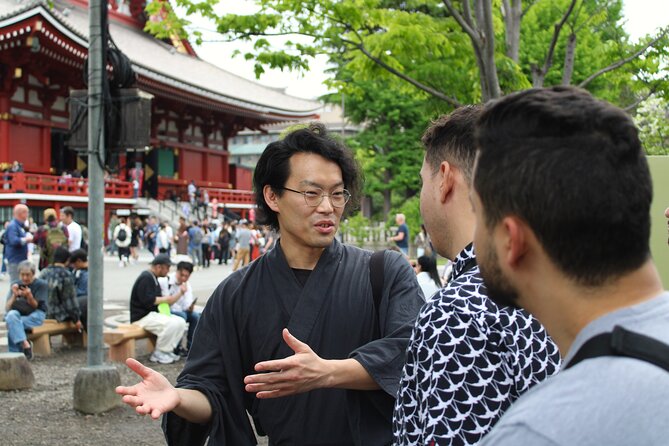
- Japanese comedian guide (Karate Comic Ryo) who mixes jokes with clear explanations
- Small-group feel for easy conversation, limited group size
- A walkable Asakusa route that links Senso-ji and surrounding highlights without stress
- Major landmarks plus calmer corners inside the Senso-ji complex
- Free-entry stops at each scheduled location, so you can spend on snacks
- Snack time on Nishisando with a stop where you can pick up melon-bread
How a comedian turns Asakusa into a story you remember
Asakusa can feel like sensory overload at first, especially around Senso-ji. What helps here is that the tour is designed like a guided storyline, not a checklist. Karate Comic Ryo keeps the pace light, but he also explains what you are looking at, and why it matters.
I really like that you get both worlds in one loop. You start with orientation and shopping street atmosphere, then shift into temple and shrine symbolism. Ryo also comes across as conversational, so the tour does not feel like a monologue. In multiple comments, people highlight how easy it is to chat with him and how patient he is with questions, including family-friendly questions from younger visitors.
The comedic format is not just for laughs. In practice, it helps you remember details like the purpose of specific statues, gates, and courtyards. The one drawback is simple: if you prefer quiet, self-guided sightseeing, this kind of lively guide may feel too interactive.
More Walking Tours in Tokyo
- Tokyo Tsukiji Fish Market Food and Culture Walking Tour
★ 5.0 · 3,184 reviews - Tokyo: Shinjuku Local Bar and Izakaya Guided Walking Tour
★ 4.9 · 1,794 reviews - Tokyo: Tsukiji Fish Market Food and Walking tour
★ 5.0 · 1,724 reviews
Start at the Asakusa Culture Tourist Information Center view
The tour begins at Tokyo Cruise Asakusa Pier area (Hanakawado, Taito City). From there, the first stop is the Asakusa Culture Tourist Information Center, where you can take in the view from the 8th floor.
This is not a random “look at a building” stop. It is a smart way to get bearings fast. When you can see how streets and landmarks connect, the rest of the walk makes sense. You also get an early chance to spot where Nakamise Street feeds toward Senso-ji, and how the shrine-temple cluster shapes foot traffic.
A small practical note: that first segment is short, about 10 minutes, so it is best treated as your orientation moment, not a long photo session. If you take a few quick pictures and keep moving, the day stays smooth.
Nakamise Street and Kaminarimon, where the icon is also a gateway
Next you head to Nakamise Shopping Street near the Kaminarimon gate, the main gate icon for Senso-ji. The tour brings you into the heart of the shopping corridor for a brief, high-impact pass.
Kaminarimon is the kind of landmark that looks dramatic in photos because it is designed to be seen from a distance. Standing there in person, you get a better feel for how the gate funnels you into the larger complex. The shopping street is the bridge between Tokyo’s modern street life and the temple area tradition.
The main drawback is timing. If you come when it is crowded, the flow slows and you will spend more energy navigating. One smart pro tip from people who did the walk early: starting around 8:00am can help you beat the biggest crowd wave, since the markets are not as active right away. If you want less pressure for photos and a calmer experience around the gate, morning is the move.
Bentendo and the Bell of Time, Edo-era routine in temple form
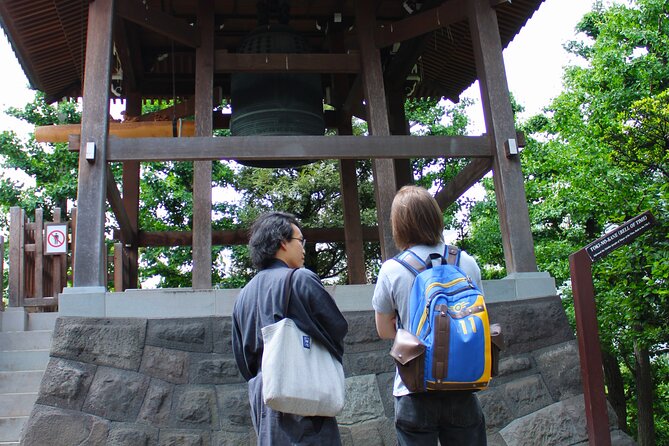
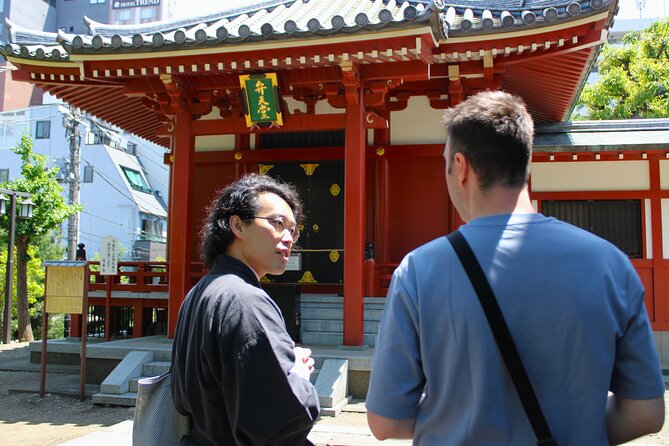
You then step into the Senso-ji neighborhood at Bentendo, focusing on a small cluster that packs meaning. Bentendo is described as tied to the deity of art and prosperity. It is a good stop to learn how Japanese religious spaces often mix reverence with everyday hopes, not just grand monuments.
Right after, you get to the Bell of Time, next to Bentendo. This spot connects you to the Edo period, when monks used regular bell ringing to signal time. Even if you only catch the area briefly, the story helps you see the temple as part of daily city life in the past, not just a tourist backdrop.
A practical tip here: keep your eyes up and around, not only at what is directly in front of you. These corners are where Ryo’s explanations make you notice details you might otherwise walk past.
A few more Tokyo days to weigh up
- Tokyo: Asakusa Walking Tour with Sensoji Temple Visit
★ 4.8 · 1,583 reviews - Tokyo: Tsukiji Fish Market Guided Walking Tour
★ 4.9 · 1,397 reviews - Tokyo Castle & Imperial PalaceーShogun Walking Tour
★ 4.7 · 1,068 reviews - Tokyo: Imperial Palace Japanese History Walking Tour
★ 4.9 · 987 reviews
Nisombutsu and Nitenmon Gate, the side sights with extra weight
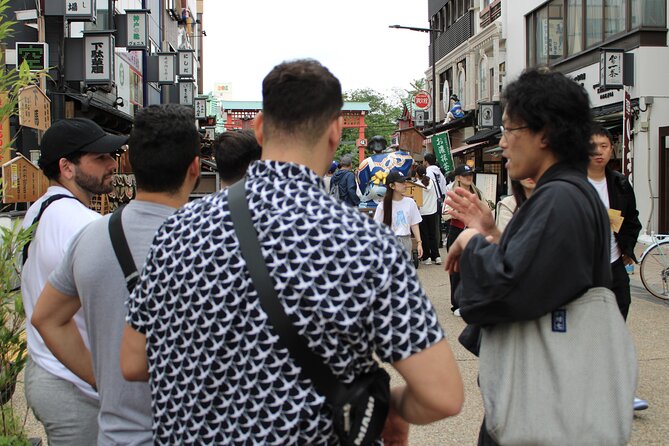
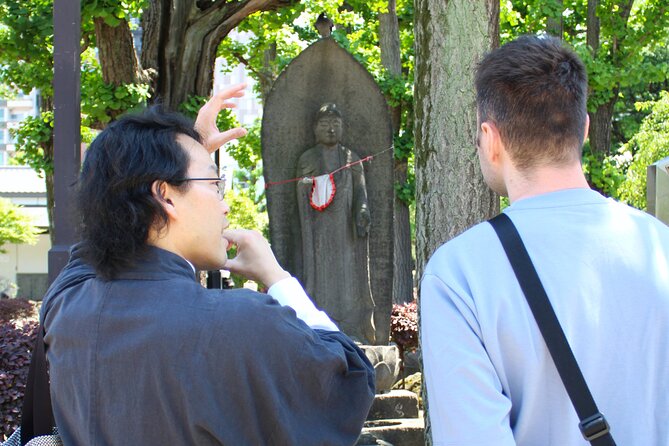
After Bentendo and the bell, the tour moves to Nisombutsu, a calm area featuring bronze and stone statues of Buddhist deities. It is scheduled as a short stop, but it is the kind of location that changes your experience. Instead of racing to the biggest view, you get a quieter pocket where the symbols feel more personal.
Then comes Nitenmon Gate. This gate is noted as a national cultural property and it links to political history: it was used as the shogun’s gate, meaning only the general was allowed to pass. That is a powerful reminder that temples were never isolated from power structures.
When you approach Nitenmon Gate in the flow of a busy complex, you can easily miss how gates themselves are political statements. Having a guide explain the gate’s role helps you interpret the architecture beyond “old and cool.”
The only consideration: because it is inside a landmark-heavy area, you might feel like you are always stepping around crowds. The benefit is that Ryo keeps the stops tight, so you still get meaning, not just motion.
Asakusa Shrine and its relationship to Senso-ji
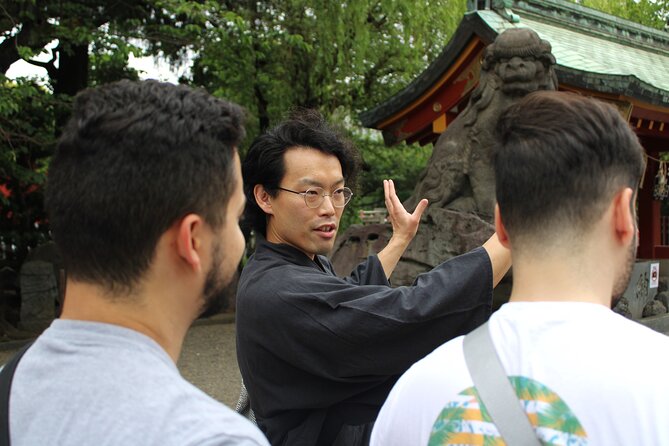
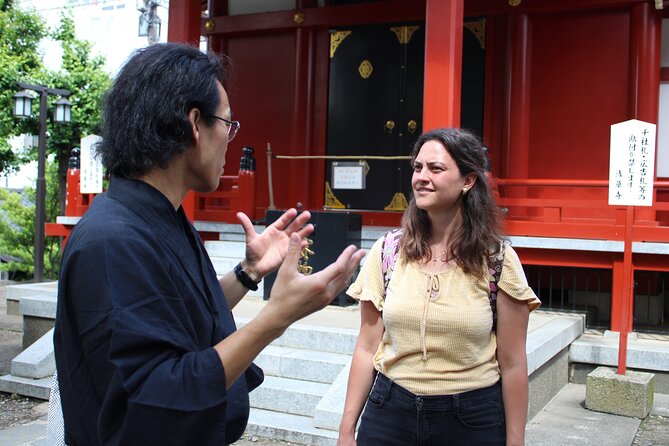
Next, you visit Asakusa Shrine, which has three deities related to the origin of Senso-ji. The tour also points out the storage area for portable shrines, which connects this site to festival culture and processions.
This is one of the strongest “why these places belong together” moments. It is easy to think of Senso-ji as a single destination. Here, you learn that the temple area functions like a network, with nearby shrines and shared origin stories.
You also get a sense of continuity. Even when you are in a tourist-heavy zone, shrine culture is still active and tied to rituals. The portable shrine area is a visual cue for that.
If you are taking the tour with kids, this stop usually lands well because it shifts from statues and gates into something more tangible, objects you can point at and ask about.
Yogodo and Awashimado, calmer pauses inside the complex
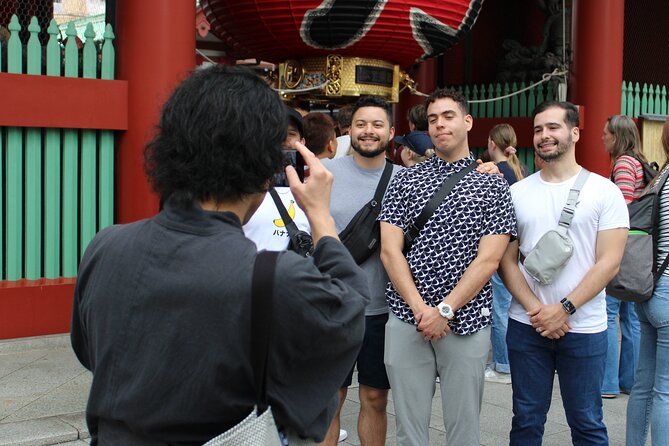
Two more short Senso-ji complex stops follow: Yogodo and Awashimado. These are listed as brief visits, but they matter because they break up the “big feature only” rhythm.
Yogodo is a stop for another temple building within the complex. Awashimado is described as a spot that takes more of a pause style. The value here is pacing. When you are walking through historic areas, you need small breaks from the main flow, and these are structured in a way that lets you step back, look carefully, and reset before the next iconic spot.
Ryo’s storytelling helps again, because these stops are not only about seeing a building. They are about understanding how the complex is layered, with multiple structures serving different devotional purposes.
If you show up tired or you are sensitive to walking, these short, calmer stops are exactly what you want. They keep the experience from feeling like nonstop crowds and constant motion.
Nishisando snacks at Kagetsu-do, plus Hozomon guardians
Now you get the food-and-photo moment on Asakusa Nishisando, with a specific suggestion: you can drop by 花月堂 (Kagetsu-do) for Japanese sweets, including melon-bread.
This is not an optional random detour. It is timed so you can break up the temple intensity with a taste of the local street market culture. Melon-bread in particular shows up in Asakusa like a small edible souvenir. It is also easy to eat while standing, so you can keep moving even if the group is tight.
Right after, you reach Hozomon, another major gate, with guardian statues in front. Gates with guardians are one of the classic ways Japanese religious spaces signal protection and transition. With the guide explaining what you are looking for, these details feel less like decorative background and more like meaningful visual language.
If you care about photos, aim to take them here. It is close to the action, but the guide’s narration gives you something to focus on besides the crowd.
Finish at Senso-ji, oldest temple in Tokyo
The walking tour destination is Senso-ji Temple, described as the oldest temple in Tokyo, with about 1,400 years of history. The big point the guide covers is the main Buddhist deity: Kannon Bodhisattva.
Senso-ji is huge. Without help, you can wander and still feel like you missed the story. Finishing here gives you a payoff: you spend time earlier learning how the complex works, and then you arrive with more context.
One extra detail to look for, shared through the kind of explanations Ryo is known for: he points out symbolic messages and large characters people might miss if they are only scanning for the main hall photo. That is where the comedian-guide style really helps, because it slows you down just enough to notice what the place is trying to communicate.
Also, plan for lingering here after the tour ends. This is the kind of spot where you will want to re-walk your favorite lane once you know what to look for.
Timing and pacing, how to keep the day comfortable
The tour is about 1 hour 30 minutes on the schedule, though in real life the experience can run longer depending on questions and photo time. The good news is that the itinerary is built from short stops, usually 5 to 10 minutes each. That structure prevents fatigue, even when you are navigating dense streets.
Go earlier if you can. One guide-repeated tip from people who joined: starting at 8:00am helps you beat crowds, and it is quieter before the markets really kick off around 10:00am. If you like street food, you can still come later, but your temple moments may be more compressed.
What I also like is that Ryo tends to keep the conversation flowing, so you get more out of the walk without needing to “perform” interest. If you have questions about religion, history, or even everyday life in Japan, he can answer while you keep moving.
Price and value, what $37.99 buys on foot
The price is $37.99 per person, and for the time and format, it is easy to frame as good value. Here is why: the tour is short, it is a guided walk through multiple major landmarks, and the stops are listed as free admission at each scheduled location. That means your spend is more about snacks and souvenirs, not entry fees.
The small-group setup also matters. A cap of six people is mentioned in the tour description, and the broader stated maximum is up to eight. Either way, you are not stuck in a giant line where you cannot hear or ask anything. People consistently highlight that Ryo is patient and willing to answer questions, including for families and teenagers.
There are also practical extras mentioned in the tour features: mobile ticket and group discounts. Mobile ticket means you are not scrambling for paper confirmations, which saves time in a place that already demands your attention.
So yes, the price looks reasonable. But the real value is how much more you see and understand once someone points out what matters.
Who this Asakusa walk is best for
This tour fits well if you are:
- First-time visitors who want a guided on-foot intro to Asakusa and Senso-ji
- People who like history explained in plain, human language
- Families who want a lively guide that can handle lots of questions
- Travelers who want a short route that connects temples, shrines, and street life without decision fatigue
It is also a good pick if you care about the details. Ryo is known for noticing small symbolism and hidden-looking corners that you might walk past. That matters most when you want more than the main photo spots.
If you are traveling on your own and you already know exactly what you want to see, you could technically skip a guide. But if your goal is to get your bearings fast and come away with stories you remember, this is a strong match.
Should you book Karate Comic Ryo’s Asakusa walking tour?
If you want a Tokyo temple area tour that feels organized, funny, and easy to follow, I would book it. The combination of comedy, small-group pacing, and a route that hits the big gates plus the calmer corners is exactly what makes this kind of experience worth it.
Book it especially if:
- You want to reduce stress in a crowded neighborhood
- You plan to spend time around Senso-ji anyway and would like context
- You enjoy guides who answer questions instead of just reciting facts
Only skip if you strongly prefer quiet, independent exploring, or if you hate any interaction with your guide. Otherwise, this is one of the more practical ways to experience Asakusa without turning it into a research project.
FAQ
How long is the Asakusa Walking Tour with Japanese Comedian?
It lasts about 1 hour 30 minutes.
What is the price per person?
The tour costs $37.99 per person.
Where does the tour start and end?
The meeting point is Tokyo Cruise Asakusa Pier 1-chōme-1-1 Hanakawado, Taito City, Tokyo. The tour ends in front of the main hall of Sensō-ji Temple.
How many people are in the group?
The tour is described as small-group, capped at six people, and it also lists a maximum of eight travelers.
What sites are included during the walk?
You visit the Asakusa Culture Tourist Information Center, Nakamise Shopping Street and Kaminarimon, Bentendo, the Bell of Time, Nisombutsu, Nitenmon Gate, Asakusa Shrine, Yogodo, Awashimado, Asakusa Nishisando (with a sweets stop at Kagetsu-do), Hozomon, and Senso-ji Temple.
Is there an admission fee for the stops?
The itinerary lists admission ticket free at each scheduled stop.
What ticket method is used?
You get a mobile ticket.
Is the guide English-speaking?
The provided information includes that the guide’s English is described as very good in guest feedback.
Is it close to public transportation?
The tour information says it is near public transportation.
Can I bring a service animal?
Yes, service animals are allowed.
What is the cancellation window for a full refund?
Free cancellation is available up to 24 hours in advance of the experience start time.
Newly listed around Tokyo
- Private Tokyo Food Tour – A Journey Through Time Through Food★ 5.0 · 36 reviews
- Private Tokyo Tour with Licensed Guide & Vehicle (Max 15 persons)★ 5.0 · 107 reviews
- Private Tokyo Custom Full-Day Tour by Chartered Vehicle★ 5.0 · 16 reviews
- Private Tokyo Custom Half-Day Tour by Chartered Vehicle★ 4.5 · 13 reviews
- Private Outstanding Nikko Tour with English Speaking Driver★ 4.0 · 11 reviews
- Private Sightseeing to Mt Fuji and Hakone with English Driver★ 5.0 · 51 reviews
- Private Snow Monkeys park Day Trip From Tokyo or Nagano★ 4.5 · 26 reviews
- 4 Day Tour – Mount. Fuji, Tokyo, Hakone, Kamakura and Yokohama★ 5.0 · 19 reviews
Walking Tours, compared.
Kyoto Geisha Walking Tour: Gion District & Hidden Gems
Read our review →
Tokyo Tsukiji Fish Market Food and Culture Walking Tour
Read our review →
Gion Geisha District Walking Tour – Stories of Geisha
Read our review →
Shinjuku Local Bar and Izakaya Guided Walking Tour
Read our review →
Asakusa Walking Tour with Sensoji Temple Visit
Read our review →
Kyoto Gion Geisha District Walking Tour – The Stories of Geisha
Read our review →Browse the lists this tour appears in