
Review · WALKING TOURS
Tokyo: Asakusa Walking Tour with Japanese Comedian
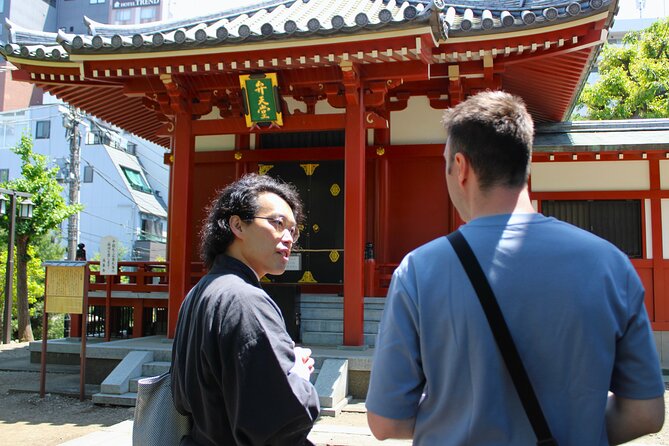
Temple history gets a comedy rewrite in Asakusa. With English-speaking local comedian Ryo, the experience layers Senso-ji sights with clear context on Buddhism and Shinto, plus a top-of-buildings view that helps you understand the neighborhood at a glance.
I love the way Ryo zooms in on specific icons like Kaminarimon Gate and turns big monuments into understandable stories, including why Buddhism and Shinto are right next to each other here. I also like the small-group format and question-friendly pace. One possible drawback: if you already planned your own Asakusa route, you may recognize most stops and want more time for food or souvenir wandering, since the walk is not built for shopping detours.
In This Review
- Key highlights if you book this Asakusa tour
- Asakusa, explained through comedy and honest local context
- Price and timing: where the $31 value actually comes from
- Meeting at Tokyo Cruise and getting there without stress
- From Sumida Park to Skytree views, you get oriented fast
- Kaminarimon Gate and the Asakusa icon story
- Nakamise Shopping Street: how a market road became part of the temple
- Asakusa Shrine and the meaning of Buddhist and Shinto side by side
- Sensō-ji Temple: icons, context, and what to notice
- The comedy angle: how humor makes the cultural facts stick
- Small group comfort and how the pace feels in real life
- Who this Asakusa tour suits best
- Should you book this Asakusa walking tour with Japanese comedian Ryo?
- FAQ
- How long is the Asakusa walking tour?
- What is the meeting point for the tour?
- Is the tour in English?
- Will we skip the ticket line?
- How large is the group?
- Does the tour include shopping for food or souvenirs?
- Where does the tour end?
- Is the tour wheelchair accessible?
- What time should I arrive?
- What is the cancellation policy?
Key highlights if you book this Asakusa tour
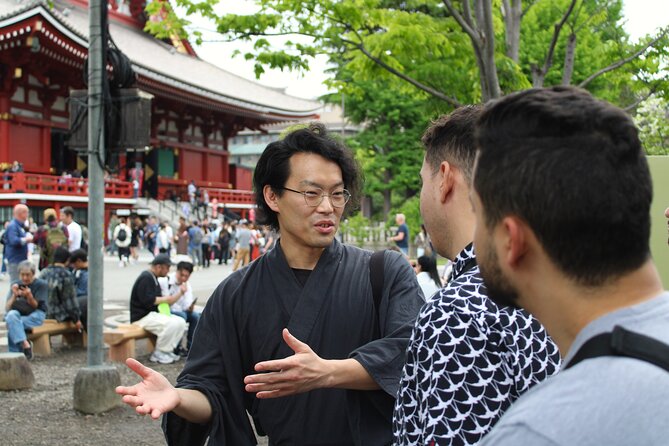
- Ryo as a local guide with 6 years working in Asakusa as a rickshaw driver, so the stories feel grounded in daily life
- Skip-the-ticket-line access so you spend more time looking and less time waiting
- Temple icons made simple, from Kaminarimon Gate to Senso-ji, plus explanations of Buddhist deities and their roles
- Nakamise Shopping Street context, including how Senso-ji grew with support from locals to powerful figures
- Standup-style English humor, using comedy career perspective to make cultural lessons stick
- Small group limit of 8, which keeps the tone relaxed and makes it easier to ask questions
Asakusa, explained through comedy and honest local context
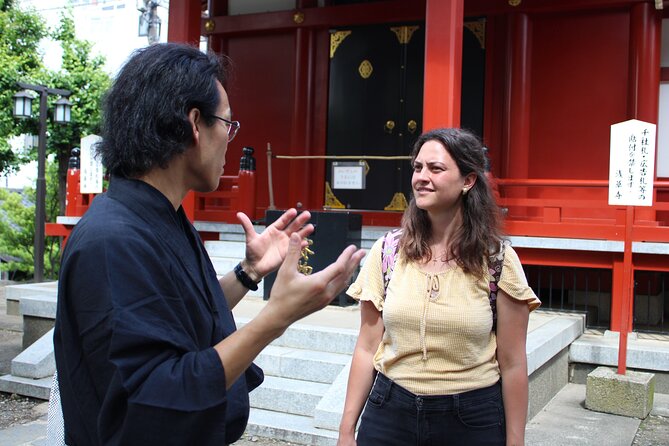
Asakusa can feel like a postcard until you get details in your head. Then it clicks. This walk is built to do that, using a local guide named Ryo, who brings a comedian’s timing to the cultural basics you would otherwise have to piece together yourself.
The tone matters. The tour does not try to sound academic. Instead, it aims for clarity, with stories you can repeat later. You get cultural explanations that help you read what you are seeing at Senso-ji and nearby shrine spaces, including the everyday way Japanese people think about religion and ritual. Add the humor element, and the whole route feels less like memorizing and more like understanding.
I also appreciate that the tour stays focused on the neighborhood itself. You start with landmark orientation, then you move into the temple area where the big icons and statues do the talking. By the time you reach the main temple complex, you are not just looking, you are noticing.
More Walking Tours in Tokyo
- Tokyo Tsukiji Fish Market Food and Culture Walking Tour
★ 5.0 · 3,184 reviews - Tokyo: Shinjuku Local Bar and Izakaya Guided Walking Tour
★ 4.9 · 1,794 reviews - Tokyo: Tsukiji Fish Market Food and Walking tour
★ 5.0 · 1,724 reviews
Price and timing: where the $31 value actually comes from
At $31 per person for a 90-minute walking tour, you are paying for three practical things: a local guide, language support, and saved time. Two of those are concrete. First, the tour includes skipping the ticket line. Second, it keeps the group small, limited to 8 participants, which usually means more direct interaction instead of watching a guide talk over everyone’s photos.
Time is the other part of the value equation. Ninety minutes in Asakusa is long enough to cover the main approach areas and get context at the big stops, but not so long that you lose momentum or feel trapped. If your schedule is tight, this is a smart way to get bearings fast without committing to a long half-day plan.
One note to keep you realistic: the tour does not build in long stops for food or souvenirs. If your ideal Asakusa visit is mostly sampling snacks and browsing shops, you may feel a bit rushed. The guide can point you toward what to do after, but the core experience is structured around temples, shrines, and explanations.
Meeting at Tokyo Cruise and getting there without stress
You meet in front of Tokyo Cruise, the water bus station area at the Asakusa pier. The location is listed as a short walk from Asakusa Station on the Tokyo Metro Ginza Line, about 1 to 2 minutes.
Plan to arrive about 5 minutes early. The tour starts on time and the guide will not wait for late guests. That is especially important here because you are walking straight into the Asakusa sights. If you are cutting it close, you will lose that first chunk of orientation time.
Also understand the end of the experience. You finish at the main temple hall area labeled 本堂. After that, the guide does not pick you up from your hotel or take you to the station. So think of this tour as a smooth introduction to the temple zone, then your free time begins right where the action is.
From Sumida Park to Skytree views, you get oriented fast
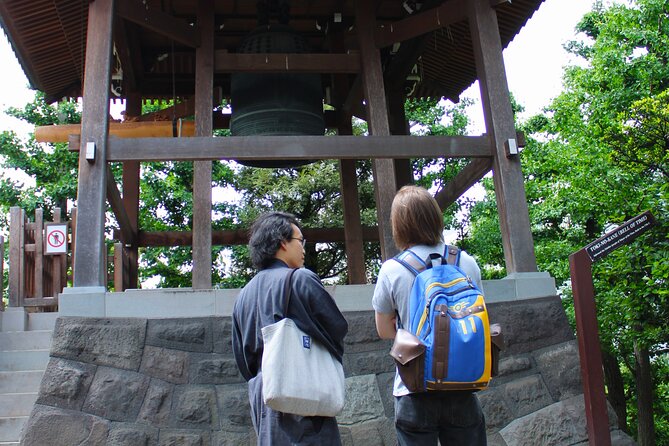
Before you even hit Senso-ji, Ryo sets you up so the rest of the walk makes sense. You pass through Sumida Park, then you move toward Kaminarimon Gate with built-in photo chances.
One part I especially like is the landmark orientation. Ryo shows you references such as Tokyo Skytree and the Asahi Beer Company area before the temple core. That matters because Asakusa is layered, and it is easy to feel lost when you only focus on one famous building. With those big reference points, you understand where you are in the bigger Tokyo map.
You also get a view from the top of a nearby building for free. That is a small detail, but it is the kind of moment that turns photos into understanding. From above, you can often spot how the temple area sits inside the neighborhood street grid. Then, when you walk down, you are not just moving from landmark to landmark. You are reading the district.
A few more Tokyo days to weigh up
- Tokyo: Asakusa Walking Tour with Sensoji Temple Visit
★ 4.8 · 1,583 reviews - Tokyo: Tsukiji Fish Market Guided Walking Tour
★ 4.9 · 1,397 reviews - Tokyo Castle & Imperial PalaceーShogun Walking Tour
★ 4.7 · 1,068 reviews - Tokyo: Imperial Palace Japanese History Walking Tour
★ 4.9 · 987 reviews
Kaminarimon Gate and the Asakusa icon story
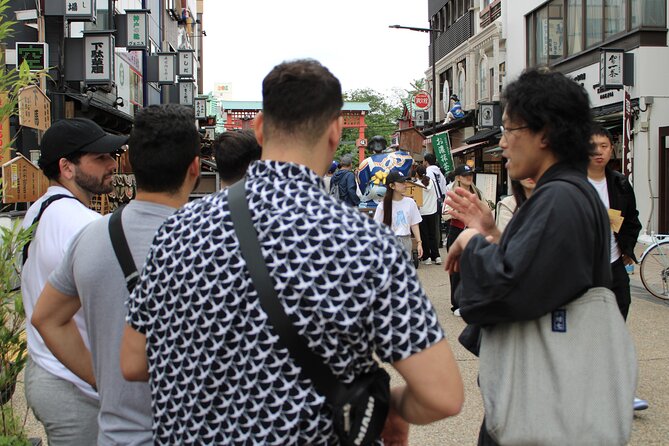
Kaminarimon Gate is the classic entry. The tour treats it as more than a photo stop. Ryo introduces it as the icon of Asakusa, and the tone stays practical: what it is, why it matters, and how it fits into the overall temple experience.
From here, you shift into a part of Tokyo that feels very old-school. The gate funnels you toward the temple approach where you start seeing the religious and cultural logic that is specific to Asakusa.
If you are the kind of visitor who tends to look, snap, and move on, Kaminarimon can feel like just another monumental entrance. With Ryo, it becomes a marker you can interpret. You learn what to pay attention to next, which makes the rest of the route more satisfying.
Nakamise Shopping Street: how a market road became part of the temple
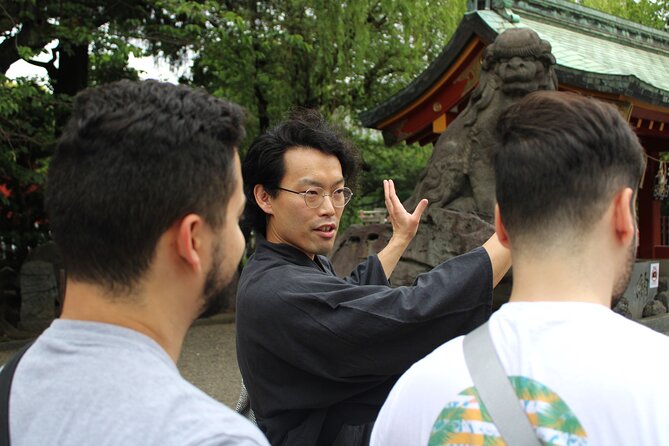
Nakamise Shopping Street is the stretch most people associate with Senso-ji. Here, it becomes a story about how the temple relationship with the community developed over time.
Ryo explains the origin of Senso-ji while showing illustrations, and you also hear how the temple was loved and supported by different groups, including locals and powerful figures across periods. That historical thread changes how you experience the street. Instead of thinking of Nakamise only as shopping scenery, you start seeing it as part of the temple’s social role.
There is also a practical angle. The tour walks you through this area as part of the guided flow, not as a free wandering block. So you are less likely to miss key sights. At the same time, you are not meant to treat it as a full shopping hour. If you want to stop for snacks, you can after the tour. The guide can also give recommendations for what to buy and where, but the main program is built around temple context.
Asakusa Shrine and the meaning of Buddhist and Shinto side by side
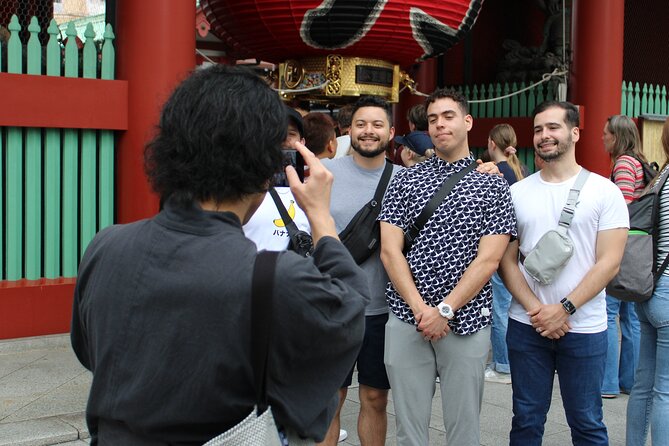
One of Asakusa’s most interesting features is the religious layout: a Buddhist temple and a Shinto shrine close together. The tour uses this as a teaching moment, with Ryo explaining religious views among Japanese people in a way that does not feel like a lecture.
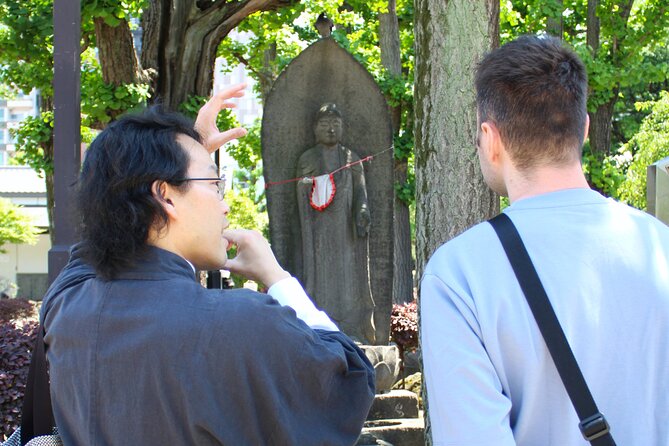
At Asakusa Shrine, you get the chance to connect the idea of religion as practice and community, not just belief. You also see statues of Buddhist deities in the broader area, and Ryo introduces their significance. That kind of interpretation helps you read the symbols you might otherwise scroll past in a photo.
There is a practical downside to consider. If you are expecting a purely architectural tour focused on structures and details like carvings and materials, you might wish for more time on those. But if you want meaning, this part of the walk is where it delivers.
Sensō-ji Temple: icons, context, and what to notice
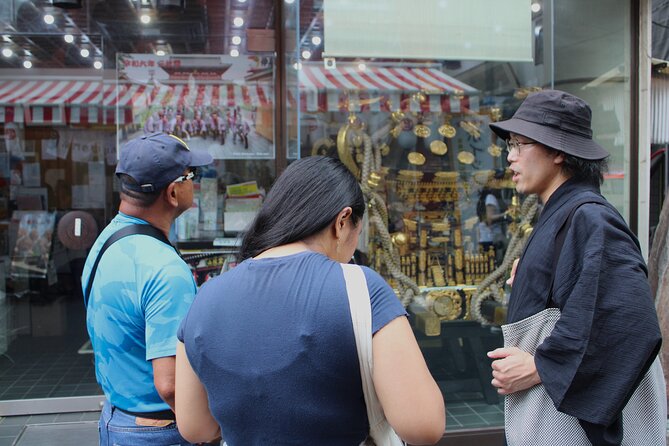
Senso-ji is the headline, and the tour treats it like the centerpiece it is. Ryo guides you through the temple area with attention to the major stops, including guided explanations tied to what you see around you.
You spend time at Senso-ji itself as part of a structured walk. And because the tour includes skipping the ticket line, you are not stuck waiting just to get inside the main area. That time saving matters if you are visiting during busier hours.
What you should focus on during your own viewing is not just the big gate and main hall. The tour encourages you to notice the smaller cues, the statue presence, and the way the religious spaces feel organized for visitors. When your brain knows what it is looking at, the temple becomes more than a landmark.
Also consider the finish point. The tour ends at 本堂, the main hall area. So if you like to take photos slowly and hang back for a moment, you have a natural place to do it without worrying about the group schedule.
The comedy angle: how humor makes the cultural facts stick
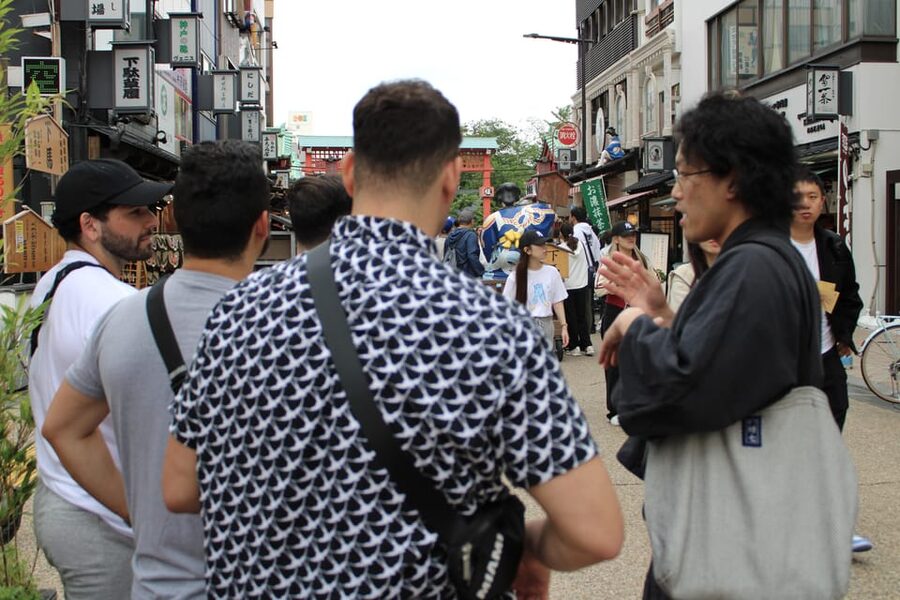
The tour is not just temples with jokes pasted on. It uses humor based on a comedian’s perspective, including standup career experience in English. Ryo’s style is part of why the tour can feel easier to remember later.
Humor is doing real work here. Explanations about religious life can be dry. Funny analogies and a comedian’s phrasing keep your attention, which makes the information land. This is especially useful if your Japanese is limited and you cannot read every sign yourself.
At the same time, comedy is personal. If you prefer a straight history style with zero jokes, this might not match your taste. The tour is built around Ryo’s comedic perspective, so it is part of the package, not an optional add-on.
Small group comfort and how the pace feels in real life
The group limit is 8 participants. That is the kind of number that tends to change the whole experience. You can ask questions and actually get a back-and-forth response instead of getting one fast answer while the group moves on.
It also keeps the pace humane. Ninety minutes is not a sprint, but it is also not a long sit-down tour. This structure works best if you are willing to walk, look, and listen without needing extra time at every corner.
If your travel style is very slow and you want to linger for 20 minutes at each viewpoint, you may find the schedule tight. But if you want a guided framework that gets you oriented and makes the main sights more meaningful, the pace is a strength.
Who this Asakusa tour suits best
You should seriously consider booking this tour if you are:
- Visiting Asakusa for the first time and want a fast, guided orientation
- Interested in how Buddhism and Shinto coexist in one neighborhood space
- The type of traveler who learns best through storytelling and clear explanations
- Want a short tour that fits into a day without swallowing your whole morning or afternoon
You might think twice if you:
- Already have a detailed plan for Asakusa and know you will revisit the exact same spots anyway
- Expect long shopping breaks for food and souvenirs during the official time
- Prefer a purely formal history talk with no comedian-style humor
Should you book this Asakusa walking tour with Japanese comedian Ryo?
Yes, if your goal is to understand Asakusa, not just photograph it. The best reason to book is the combination of practical orientation, religious and cultural context, and a comedian’s humor delivered in English. You also get a real time saver with the skip-the-ticket-line approach.
I would only skip it if you are already committed to doing Asakusa on your own with a self-guided plan and you do not want any structured walking. In that case, the sights may feel familiar and the fixed flow means less flexibility.
If you want a strong starting point for your first temple visit day, this is a very workable choice.
FAQ
How long is the Asakusa walking tour?
It lasts 90 minutes.
What is the meeting point for the tour?
Meet in front of Tokyo Cruise, the Asakusa water bus station area.
Is the tour in English?
Yes. The live tour guide speaks English and Japanese.
Will we skip the ticket line?
Yes, the tour includes skipping the ticket line.
How large is the group?
It is a small group, limited to 8 participants.
Does the tour include shopping for food or souvenirs?
No. The tour has a specific itinerary and will not stop to shop for food or souvenirs. The guide can still recommend places to shop after the tour.
Where does the tour end?
The tour finishes at 本堂 (the main hall area).
Is the tour wheelchair accessible?
Yes, it is wheelchair accessible.
What time should I arrive?
Please arrive at the meeting spot 5 minutes before the tour starts, since the tour starts on time.
What is the cancellation policy?
Free cancellation is available up to 24 hours in advance for a full refund.
Newly listed around Tokyo
- Tokyo: Asakusa Temple & Shrine Walking Tour with Local Guide★ 5.0 · 105 reviews
- Tokyo: Asakusa Sightseeing Tour by Rickshaw★ 4.9 · 195 reviews
- Tokyo Asakusa sightseeing and history walking tour★ 4.7 · 9 reviews
- Tokyo: Old Town Asakusa Guided Tour -Senso-ji Temple Visit★ 5.0 · 12 reviews
- Tokyo: Asakusa Sensoji Night Walk with a Local Brandy★ 4.7 · 7 reviews
- Tokyo Asakusa & Senso-Ji Walking tour With A Guide★ 4.5 · 40 reviews
- Tokyo Asakusa: Miu Kimono Rental and Optional Photoshoot★ 4.9 · 54 reviews
- Tokyo: Asakusa Kimono Dressing and Matcha Experience★ 4.9 · 173 reviews
Walking Tours, compared.
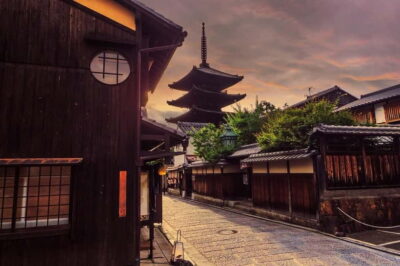
Kyoto Geisha Walking Tour: Gion District & Hidden Gems
Read our review →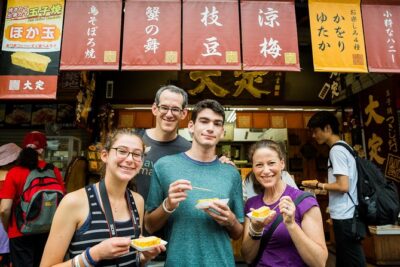
Tokyo Tsukiji Fish Market Food and Culture Walking Tour
Read our review →
Gion Geisha District Walking Tour – Stories of Geisha
Read our review →
Shinjuku Local Bar and Izakaya Guided Walking Tour
Read our review →
Asakusa Walking Tour with Sensoji Temple Visit
Read our review →
Kyoto Gion Geisha District Walking Tour – The Stories of Geisha
Read our review →Browse the lists this tour appears in