
Review · BAMBOO GROVE WALKS
Arashiyama Hidden Gems: Walking Tour escaping crowds
Arashiyama hits different without the crush. This relaxed, small-group walk led by Yusuke Tanaka is one of my favorite ways to see Arashiyama at human speed, with quiet temples and thoughtful local explanations that make the sights feel easier to read. I also like that he helps with photos while you’re moving, not after. The main drawback is simple: you will walk about 3 km, and on a warm day it can feel like a longer stroll than you expect.
You start near the Arashiyama station area, then head into calmer corners where people usually move past. If you choose the option with The Tale of Genji, you’ll get extra literary context for many of the stops, which adds a whole second layer to what you’re seeing.
In This Review
- Key highlights you will actually feel on the ground
- Arashiyama without the crush, planned for real pacing
- Meet Yusuke, and why his route feels calm
- The Tale of Genji option, and when it helps
- Stop-by-stop: what you will see and what to watch for
- Nonomiya Shrine: the black torii and respectful basics
- Arashiyama Bamboo Forest: sound, photos, and a better angle
- Seiryoji Temple: a 1,200-year origin and a national treasure statue
- Daikaku-ji Temple: Saga Gosho grounds with fewer pushy vibes
- Osawaike: the oldest artificial pond and seasonal calm
- Price and value: why $89 can make sense here
- Logistics that matter in Kyoto: timing, snacks, and shoe rules
- Who this tour suits best
- Should you book this Arashiyama walking tour with Yusuke?
- FAQ
- How long is the Arashiyama walking tour?
- What does the tour cost?
- How large is the group?
- Where does the tour start and end?
- How much walking is involved?
- Is a mobile ticket used?
- Do I need to remove my shoes at any point?
- Are temple and pond entry fees included?
- Are there options for Tale of Genji storytelling?
- What is the cancellation policy if weather is bad?
Key highlights you will actually feel on the ground
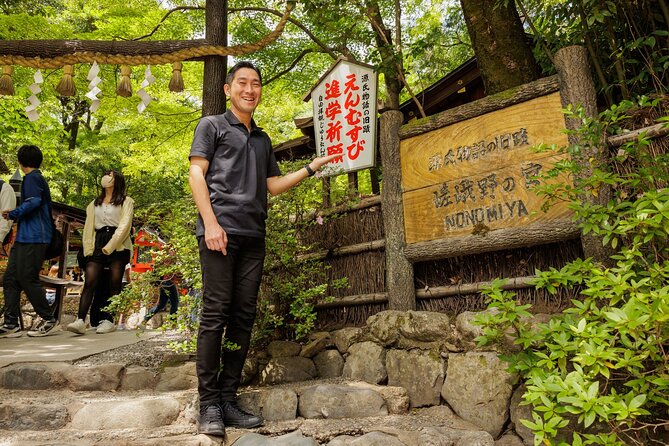
- Nonomiya Shrine’s black wooden torii, one of only two in Japan
- Bamboo forest soundscape and photo time led by Yusuke
- Seiryoji Temple’s Shaka Nyorai national treasure statue in an older temple setting
- Daikaku-ji’s Saga Gosho grounds, tied to an imperial past
- Osawaike pond time in a quieter bamboo backdrop
- Max 6 travelers, so you can ask questions and keep a comfortable pace
Arashiyama without the crush, planned for real pacing
Arashiyama is famous, and that fame can turn your morning into a slow-moving shoulder-to-shoulder situation. What I like about this tour is that it is built around being comfortable first, not around racing between photo spots.
You’ll be out for roughly 3 to 4 hours, but the walking is about 3 km and about 55 minutes of that is during the tour itself. That matters because you can still enjoy breaks, slow looks, and the moment when you notice the little details like moss textures, temple architecture, or the shift in sound as you move away from the main paths.
The group size is capped at 6 travelers. In practice, this means you do not feel swallowed by a crowd. You can also hear the guide without leaning forward constantly, which is a big deal when the stops are quiet and meant for reflection.
One thing to keep in mind: the route is not wheelchair friendly by default. If you have mobility limits, plan for uneven temple grounds and a steady walk time. Also, you may have to remove shoes at two temples, so wear footwear that is easy to take on and off.
More Walking Tours in Kyoto
- Kyoto Geisha Walking Tour: Gion District & Hidden Gems
★ 4.7 · 3,273 reviews - Kyoto: Gion Geisha District Walking Tour – Stories of Geisha
★ 4.7 · 2,187 reviews - Night Walk in Gion: Kyoto’s Geisha District
★ 4.5 · 2,003 reviews
Meet Yusuke, and why his route feels calm
The experience is guided by Yusuke Tanaka, a local Kyoto guide who has directed over 3,000 guests. I like this because the explanations do not feel like a scripted speech. They feel like a guide thinking about how you will actually experience the place.
You also get an original tour booklet of about 15 pages. Even if you are the type who usually skips paper, this is handy in Japan, where it helps you connect names you see on signs with the story you are hearing. And since he enjoys photography as a hobby, he is paying attention to framing while you’re there, not just talking.
A small but real plus: the tour includes helping to take good photos. That is especially useful in bamboo forest areas, where people tend to be standing in the exact wrong spot for their own pictures.
The Tale of Genji option, and when it helps
If you choose the option that includes The Tale of Genji, most of the places on the tour (the exception is the bamboo forest) are tied to the novel. The basic route stays the same either way, but the storytelling gets deeper with the Genji context.
For you, that can change the mood of the walk. Instead of treating temples and shrines as checkboxes, you start seeing how the sites connect to literature and historical imagination. If you have read the novel, you’ll likely pick up references more easily. If you have not, you can still enjoy it, because the guide explains the historical and literary context as you go.
If you want a purely visual and practical tour with minimal narrative, the standard option may suit you better. If you want the place to come with meaning, pick the Genji option.
Stop-by-stop: what you will see and what to watch for
A few more Bamboo Grove walks around Kyoto:
- Kyoto: Fushimi Inari, Kinkakuji, Bamboo Grove 1 Day Bus Tour
★ 4.8 · 4,316 reviews - Osaka/Kyoto:Kinkakuji,Arashiyama,FushimiInariShrine,NaraPark
★ 4.1 · 1,596 reviews - Kyoto/Osaka: Nara, Fushimi Inari Taisha, Arashiyama Bus Tour
★ 4.7 · 1,275 reviews - Kyoto Arashiyama Walking Tour: Bamboo, Monkeys, Gardens & Secrets
★ 5.0 · 1,216 reviews
Nonomiya Shrine: the black torii and respectful basics
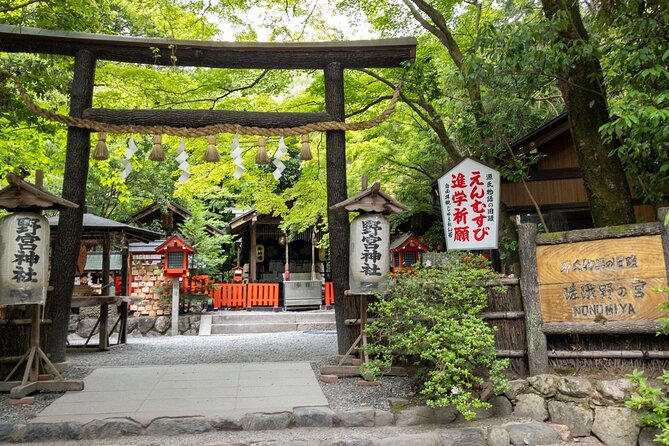
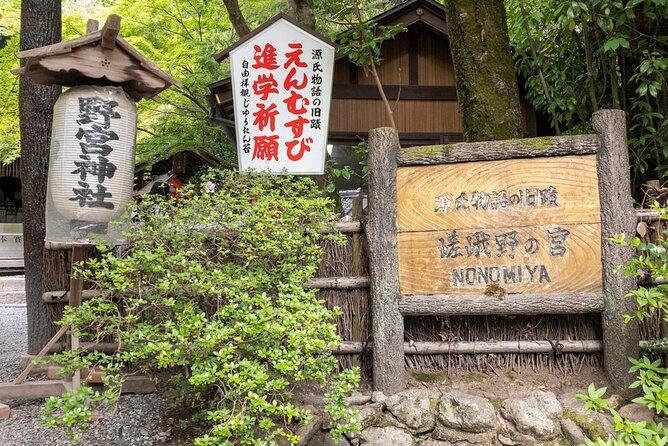
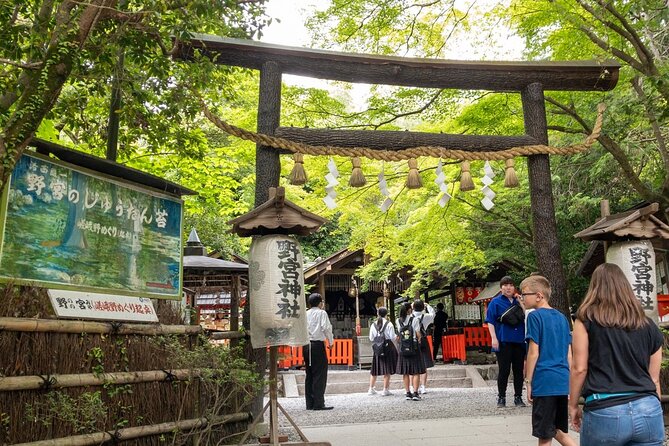
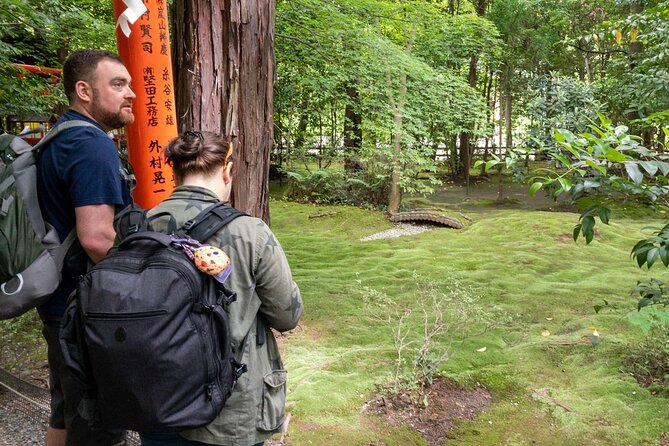
You begin at Nonomiya Shrine at the quiet start of the route. This stop has a feature I would plan my Kyoto trip around: a black wooden torii gate. The tour notes that only two shrines in Japan have black torii, so this is not just a photogenic gate, it is also a rarity.
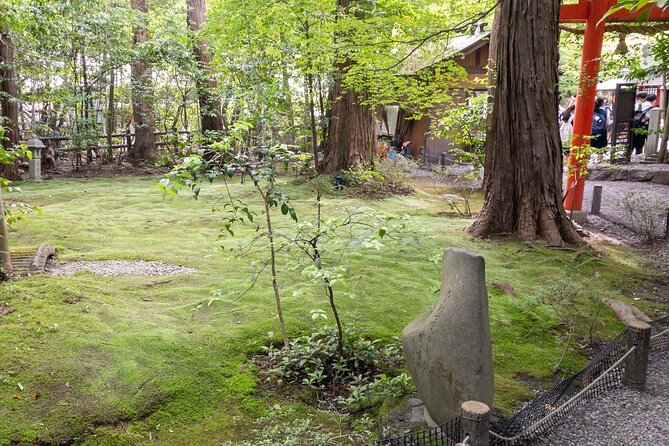
You’ll also see a moss garden, which is a classic Arashiyama cue that the area is meant for slow watching. The guide also covers practical etiquette, including the way of visiting and praying, plus the differences between shrines and temples. That part is easy to overlook, but it makes your later temple visits less confusing.
How much time you get is about 30 minutes. That is usually just enough to take in the gate, settle your bearings, and ask a quick question if you want more context.
Potential consideration: if you hate stopping early and want to get right to big scenery, this opening shrine may feel a bit short. But it sets the tone, and the calm here helps you enjoy the rest of the walk.
Arashiyama Bamboo Forest: sound, photos, and a better angle
The bamboo forest stop is short by design, about 15 minutes. You’ll be focusing on the feel of the place, including the bamboo soundscape. In other words, this is not only about snapping one iconic shot.
One practical advantage is that Yusuke helps with photo time. In a crowded-looking setting, having someone suggest positioning and timing can save you from wasting time taking photos from the same angle everyone else is using.
Because this stop is so short, it helps to arrive with a plan. Decide what you want most: a close bamboo texture shot, a wider frame with depth, or a portrait-style composition. Then use the time for that one goal.
Seiryoji Temple: a 1,200-year origin and a national treasure statue
Next is Seiryoji Temple, where the atmosphere shifts into something older and more reverent. The tour explains that the temple was built about 1,200 years ago originally, and the present building is about 300 years old. That kind of time depth is what makes Arashiyama feel more layered than a typical day-trip.
A highlight here is the Japanese national treasure: the Shaka Nyorai Buddhism statue. If you only remember one “name and why it matters” from this stop, remember Shaka Nyorai, because it is the kind of artifact that anchors a whole temple experience.
You’ll spend about 55 minutes at this stop. That gives you time to move slowly and still absorb the main objects without rushing.
Practical note: you have to take off your shoes to enter inside. If you dislike fiddling with shoe removal on uneven ground, wear shoes that come off easily.
Daikaku-ji Temple: Saga Gosho grounds with fewer pushy vibes
Daikaku-ji is the stop where the tour really earns its reputation for escaping the busiest patterns. The tour describes Daikaku-ji as the former Imperial palace called Saga Gosho, built about 1,200 years ago. You’re not only walking temple paths, you’re seeing grounds tied to an imperial past.
You also get time to enjoy the area without feeling packed. That is the biggest value here for me. Rather than being swept through, you can slow down and look at how the buildings and garden spaces relate to each other.
Time at this stop is about 50 minutes. That seems right for balancing photos, quiet watching, and the moment when the place stops being scenery and starts being a lived environment.
Shoes-off again: you remove shoes to enter inside at Daikaku-ji as well.
Tickets are not included. The tour lists entry as ¥800 for Daikaku-ji temple and Osawa-no-ike pond.
Osawaike: the oldest artificial pond and seasonal calm
After Daikaku-ji, you head to Osawaike. The tour describes it as the oldest artificial pond in Japan. That is the kind of statement that sounds like trivia until you see the scale and the quiet.
You get about 20 minutes here. You’ll enjoy scenery that changes by season and a calmer bamboo backdrop. This is also where your ears matter again. When the main crowd noise fades, you start noticing softer details like water presence and gentle movement around the pond edge.
The tour lists an Osawaike ticket price as ¥300. Since the Daikaku-ji and Osawa-no-ike entry is also listed as ¥800, I suggest you simply bring some yen and expect to pay based on what’s offered at the entrance that day.
Price and value: why $89 can make sense here
The tour costs $89 per person, and it is often booked about 25 days in advance on average. When you look at what’s included, it adds up:
- Guiding by Yusuke Tanaka
- An original tour booklet (about 15 pages)
- Help with taking good photos
- A small-group format with a relaxed pace
Temple and pond entry fees are extra. Based on the tour details, you should expect Seiryoji at ¥500, and Daikaku-ji plus Osawa-no-ike at ¥800, with Osawaike listed at ¥300 as well. Add a little buffer and you will feel prepared.
So is $89 “worth it” compared with doing Arashiyama on your own? For me, yes, if you want two things: a route that helps you escape the most crowded segments, and an explanation that turns name-only places into something you understand as you walk. If you mainly want to wander freely without structure, you might spend less money DIY. But you will probably miss some of the context and the practical how-to of visiting shrines and temples.
Logistics that matter in Kyoto: timing, snacks, and shoe rules
This tour uses a mobile ticket, and the meeting point is near public transportation. That makes it easier to fit into a busy Kyoto day.
Meeting point: Randen-yaJapan, inside the han(n)ari-hokkori square area at Arashiyama station. End point is Daikaku-ji Temple in Sagaosawacho.
Walking reality: the tour includes travel time in the total 3 to 4 hours, and you’ll walk about 3 km total with about 55 minutes of walking during the experience.
Snacks: the tour notes there are not many restaurants around the ending point, so bring a snack if you might want one. I like this advice because temple areas can make you forget timing until you feel hungry. A small buffer keeps the mood calm.
If you prefer to return to the starting point, Yusuke offers a free returning walking tour.
Who this tour suits best
This is a strong match if you:
- Want smaller-group pacing instead of getting swept into crowd movement
- Like history and literature connections, especially if you select the The Tale of Genji option
- Appreciate practical guidance on how to visit shrines and temples
- Care about getting better photos without spending your whole time fighting for the right angle
It may be less ideal if you:
- Have limited tolerance for steady walking on uneven ground
- Dislike shoe removal (it happens at Seiryoji and Daikaku-ji)
- Want a long food stop, since the tour includes local food mentions but does not promise restaurants near the finish
Should you book this Arashiyama walking tour with Yusuke?
Book it if your goal is to experience Arashiyama with breathing room. The mix of Nonomiya Shrine’s rare black torii, the bamboo forest sound and photo time, and the calmer temple grounds at Seiryoji and Daikaku-ji is a great blend of iconic and quieter Kyoto.
I would especially book the Genji option if you have read the novel or even just want a story-driven way to understand why these places mattered. The extra literary storytelling can turn a short walking route into something you carry home.
Skip or reconsider if you are expecting a mostly sit-down experience or if the idea of shoe removal indoors will be a deal-breaker. And if you are sensitive to heat, plan for hydration and take your pace seriously, since one review noted the route felt lengthy for an older traveler on a warm day.
If you want a thoughtful Arashiyama day that does not feel rushed, this is a very good fit.
FAQ
How long is the Arashiyama walking tour?
It runs about 3 to 4 hours.
What does the tour cost?
The price is $89 per person.
How large is the group?
The tour has a maximum of 6 travelers.
Where does the tour start and end?
It starts at Randen-yaJapan inside the han(n)ari-hokkori square area at Arashiyama station. It ends at Daikaku-ji Temple.
How much walking is involved?
The tour includes about 3 km of walking total, with about 55 minutes of walking during the experience.
Is a mobile ticket used?
Yes, the tour uses a mobile ticket.
Do I need to remove my shoes at any point?
Yes. You must take off your shoes to enter inside at Seiryoji Temple and Daikaku-ji Temple.
Are temple and pond entry fees included?
No. Ticket fees are not included. The tour lists Seiryoji at ¥500, and it lists Daikaku-ji Temple and Osawa-no-ike Pond at ¥800 per person, with Osawaike also listed as ¥300.
Are there options for Tale of Genji storytelling?
Yes. There is a The Tale of Genji option that adds deeper literary storytelling. Most locations on the tour (except the bamboo forest) appear in The Tale of Genji, and both options visit the same locations.
What is the cancellation policy if weather is bad?
You can cancel for a full refund up to 24 hours in advance. The tour requires good weather, and if it is canceled due to poor weather, you’ll be offered a different date or a full refund.
Newly listed around Kyoto
- Zen Meditation for Life in Kyoto★ 5.0 · 10 reviews
- Kyoto: Zen Meditation at a Private Temple with a Monk★ 5.0 · 25 reviews
- Kyoto Private Customizable Day Tour with Guide and Vehicle★ 5.0 · 52 reviews
- Private Wagyu Beef Tour with a Local Guide★ 5.0 · 6 reviews
- Kyoto: Gion Geisha District & Sake-in-Hand Walking Tour★ 5.0 · 37 reviews
- Your Private Vacation Photography Session In Kyoto★ 5.0 · 110 reviews
- Private Guided Traditional Buddhist Cooking in Japan★ 5.0 · 16 reviews
- Private Pewter Sake Cup Experience with a Kyoto Artisan★ 5.0 · 31 reviews
Bamboo Grove Walks, compared.
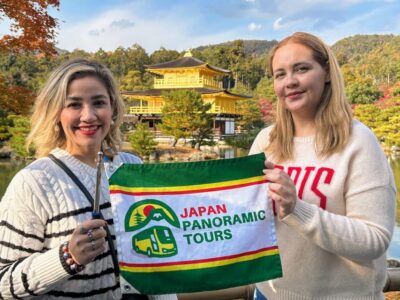
Fushimi Inari, Kinkakuji, Bamboo Grove 1 Day Bus Tour
Read our review →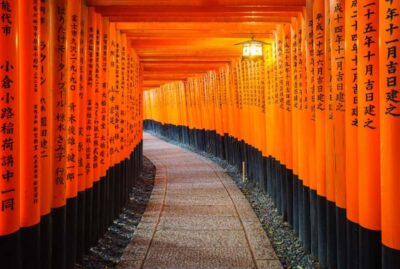
Osaka/Kyoto:Kinkakuji,Arashiyama,FushimiInariShrine,NaraPark
Read our review →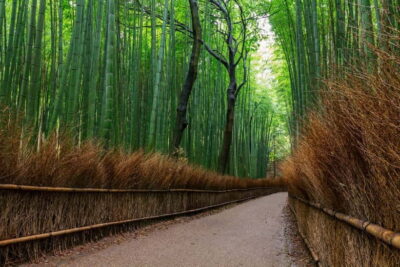
Kyoto/Osaka: Nara, Fushimi Inari Taisha, Arashiyama Bus Tour
Read our review →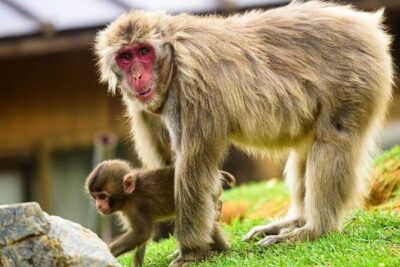
Kyoto Arashiyama Walking Tour: Bamboo, Monkeys, Gardens & Secrets
Read our review →
Arashiyama Bamboo, Temple, Monkeys, or Secret Sake Brewery
Read our review →
Osaka/Kyoto: Arashiyama, Nara & Fushimi Inari Shrine w/Lunch
Read our review →
Nijo, Kinkaku-ji, Arashiyama, Kiyomizu & Fushimi Inari
Read our review →
Kyoto Ghost Tour: Dark Tales, Urban Legends, Bamboo Forest Night
Read our review →Browse the lists this tour appears in