Review · SAMURAI SWORD & NINJA TRAINING
Learning Shodo with a kimono and Trying Samurai Calligraphy
Kimono plus calligraphy, in one hour. This hands-on Shodo session at Samurai Honor in Osaka mixes dressing up, learning brush technique, and getting your name written in kanji. I love how personal it feels, and I also like that it works well as a family activity.
Two specific wins for me: the moment your kanji strokes turn into a name-based final piece, and the photo session where you pose in traditional-style attire. The samurai-style calligraphy segment adds a fun change of pace with a bigger brush and a character concept focused on leaving a feeling behind.
One drawback to plan for: the venue is practical, and you may notice outside noise from the street area. If you want a quiet, gallery-like setting, this is not that.
In This Review
- Key highlights worth planning for
- Finding Samurai Honor in Osaka and what to do before you start
- Shodo 101: from brush grip to stroke order
- Your name in kanji and the final sheet you take home
- Samurai Calligraphy with oversized brush and the idea of blank space
- Kimono photos and your Samurai Honor gift bag
- Price, what you get for $42, and what costs extra
- Who should book, and when to reconsider
- Should you book this Shodo and Samurai calligraphy experience?
- FAQ
- How long is the Shodo and samurai calligraphy experience?
- How much does it cost?
- Where is the experience located?
- What should I bring?
- Are kimono and samurai costumes included?
- What languages are available for the instructor?
- Do I get photos from the session?
- Is calligraphy on kakejiku included?
Key highlights worth planning for
- Your name in kanji: the teacher uses kanji characters they choose for your foreign name.
- Stroke order practice: you learn technique step by step, not just copy a sample.
- A final draft you can keep: your first calligraphy work becomes a take-home souvenir.
- Samurai Calligraphy with oversized brush: you go bigger, more physical, and more expressive.
- Photo shoot in kimono style: you’re photographed dressed as either Yamato Nadeshiko or a samurai.
- A special souvenir bag: your attempted kanji character is carefully written on the bag, and it is not sold elsewhere.
Finding Samurai Honor in Osaka and what to do before you start
This experience takes place at Samurai Honor, Bushi no Homare, in Osaka (Honshu). The address is Excellence Takayama 1F, 2-3-19 Shiginonishi, Joto-ku, Osaka-shi, Osaka 536-0014, and the landmark is a wooden sign that reads Honor of the Samurai. Arrive 30 minutes early so you can change and get instructions before the lesson begins.
You’ll want a simple outfit to start with. Bring a T-shirt, since you’ll change into the included kimono and samurai-style costumes on site. Also, note what is not allowed: no pets, no baby strollers, no baby carriages, no alcohol or drugs, and no nudity.
Small group matters here. The session is limited to 10 participants, so the instructor can guide you while you practice brush hold and stroke order. That also means if you’re doing this with your child, you’re not stuck in a noisy crowd.
Finally, a practical tip: Apple Maps has the wrong address listed for this area. Use Google Maps and aim for the Honor of the Samurai landmark rack.
More Craft Workshops in Osaka
- Osaka: Tea Ceremony, Calligraphy, and Kimono Experience
★ 4.9 · 130 reviews - Kamigata Ukiyoe Museum:Ukiyo-e Woodblock Printing Experience
★ 4.9 · 79 reviews - Osaka: Private Japanese Calligraphy Experience
★ 5.0 · 66 reviews
Shodo 101: from brush grip to stroke order
Shodo learning here runs through a clear progression. First, you change into traditional clothing like a kimono, then you get oriented to mindset and tools. Calligraphy is not treated like a quick craft. You start by learning how to hold the brush and use the tools properly, because the brush angle and pressure are what make the character look right.
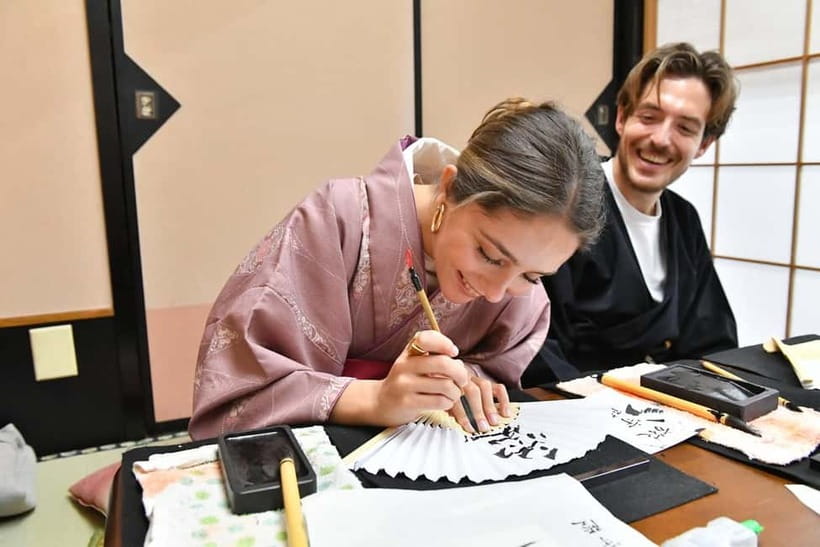
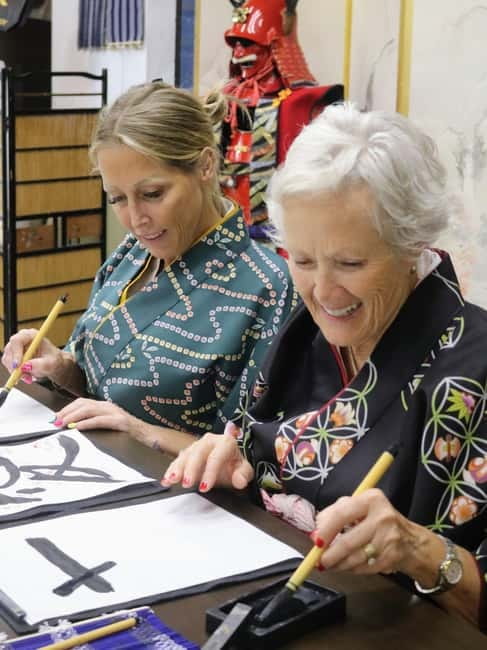
Next comes technique and movement. You practice brush strokes with attention to the basic mechanics, then you move into kanji stroke order for the specific characters you selected earlier. A master calligrapher demonstrates how to write those strokes, and you follow along while keeping the technique in mind.
This is where you’ll feel the biggest difference from simple copying. If you let your strokes wander, your character looks uneven. If you slow down and match the stroke order, it suddenly starts to look like real calligraphy, even if you’re a first-timer.
If you’re traveling with kids, this portion is also smart. Shodo rewards focus more than artistic talent, and the structure breaks the work into manageable steps.
Your name in kanji and the final sheet you take home
One of the most memorable moments is the surprise part. The teacher writes the foreign names of participants using the kanji characters they have chosen. Each kanji character has its own meaning, so you’re not just swapping letters. You’re learning a little layer of the story behind the characters used for your name.
After demonstration and practice, you create a final draft. This is the sheet or option you’ll keep as a memento. The included calligraphy paper, and you may also see optional items like a fan or a hanging scroll setup offered as extras.
What makes this valuable for your trip is that it becomes more than a photo. You end up with something you can frame or store, and it carries your actual brushwork. For many families, this is the piece that kids get most excited to show later.
Photography is part of the package too. After the writing and photos, your images are sent to a designated email address. So you do not need to worry about carrying every photo workflow item with you during the session.
Samurai Calligraphy with oversized brush and the idea of blank space

After the Shodo practice, the experience continues with Trying Samurai Calligraphy. Even if your full slot is sold as a 1 hour experience, the flow described includes Shodo practice plus a samurai-style segment that highlights a single character concept.
You start by thinking about a resignation character for leaving something behind. You reflect on your life so far, imagine who or what kind of feelings you want to leave behind, then you choose a character composition for that last mark in this world.
Then the teaching gets very Japanese in a specific way. You’re introduced to the idea of blank spaces, often explained as beauty of the margins. In plain terms, the character is not only the ink. The spacing around it matters, and that empty area is treated as part of the artwork. You also hear the idea that nothing is beautiful because there is nothing, which sounds poetic, but it basically trains you to look at negative space.
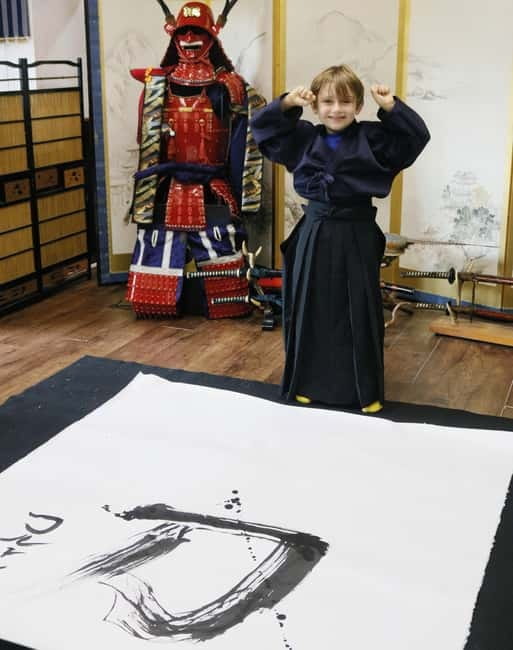
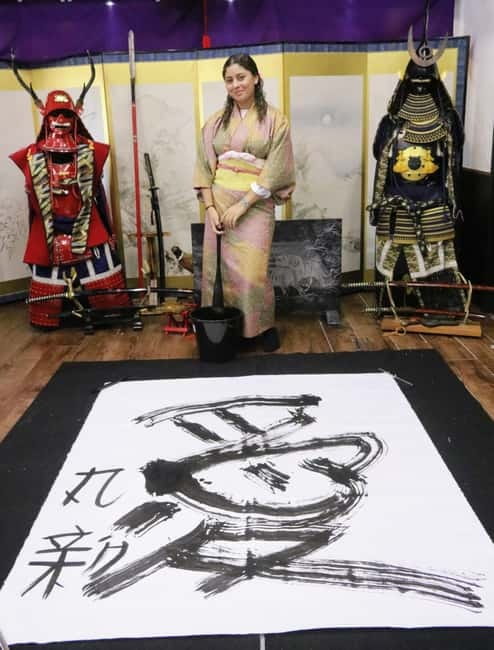
The physical wow moment is the oversized brush. The artist uses a brush more than five times larger than usual to create a powerful yet fragile single character on a large 150 cm x 150 cm sheet. You’re seeing body movement treated as part of writing, not just a desk exercise.
More Kimono Rentals in Osaka
- Osaka: Sumo Show & Experience w/ Optional Kimono & Hot Pot
★ 4.5 · 609 reviews - Learning Zen of Japanese Calligraphy in kimono near Osaka Castle
★ 4.5 · 53 reviews - Osaka: Kimono or Yukata Rental &Photos Service Options
★ 4.9 · 25 reviews - Kimono photoshoot-Includes 100 photo data
★ 5.0 · 21 reviews
Kimono photos and your Samurai Honor gift bag
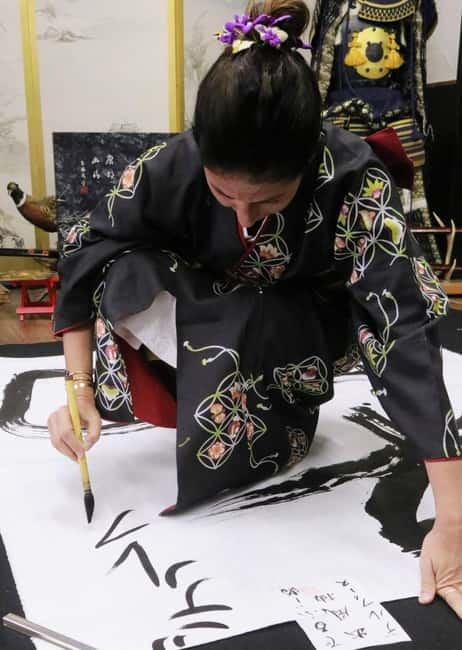
Once your character work is done, you’ll move into the photo part. You’ll be photographed dressed as a Yamato Nadeshiko or a brave samurai. It’s a neat way to connect the calligraphy to the costume theme, and it gives you the kind of souvenir photo that feels more personal than a typical studio rental shot.
Then comes the gift. A calligraphy master carefully writes the kanji character that you attempted today on the surface of your bag. You receive a Samurai Honor original bag as a gift. The best detail is that this bag is not available for sale elsewhere, so it feels tied to your specific session and your specific character.
Included in the experience: kimono and samurai costumes, taxes, tips, and photography data sent by email. The interpreter’s default language is English, with other languages available by request if staff is available (Italian, French, Chinese, Thai, Indonesian, and Spanish are mentioned as options). If you need a specific language, it’s smart to ask before booking.
Also, keep expectations realistic about outfit extras. A Japanese-style hair set for the kimono and hairpin is a paid option, and women’s full attire like obi sash, tabi socks, zori sandals, and basket bag are not included in the default women’s attire package.
Price, what you get for $42, and what costs extra
At $42 per person for a short, guided cultural workshop, this is good value if you want three things: a costume photo moment, real instruction, and a take-home calligraphy piece. You’re not paying just for time. You’re paying for tools, teacher guidance, personalized kanji choices, and the photo set.
Here’s what’s included, based on the experience details: kimono and samurai costumes, a certified professional instructor, taxes, tips, and photography data sent to your email. You also get the teacher-written kanji gift bag tied to what you attempted during the session.
What costs extra or is optional: calligraphy on a kakejiku (hanging scroll) is a paid option, and hair setup for kimono is also paid. Outdoor photo shoot and women’s attire extras are not included in the baseline package. If you’re the type who wants the full traditional styling look without thinking about add-ons, double-check what you’re selecting.
One more practical point: transportation and transfers are not included. Since the workshop is short and you must arrive early for changing, build in enough buffer time so you don’t start stressed.
Who should book, and when to reconsider
This is a strong pick for families and first-timers who want something authentic but not complicated. Calligraphy is taught in a way that children can participate in, and the setup is designed for small group learning with patience and structure.
It’s also a good choice if you enjoy photo souvenirs that feel grounded in an activity. You’re not just wearing a costume. You’re learning strokes, then tying that work to a character and getting photographed in the role theme.
When you might reconsider: if you’re sensitive to noise. The venue is described as having trains passing by outside the door, and the space can feel more utilitarian than ceremonial. Also, if you expect a quiet, museum-like setting, you may not love the surroundings.
The experience has age suitability limits too: children under 5 are not suitable, babies under 1 are not suitable, and people over 95 are not suitable. People with altitude sickness are also flagged as not suitable.
Should you book this Shodo and Samurai calligraphy experience?
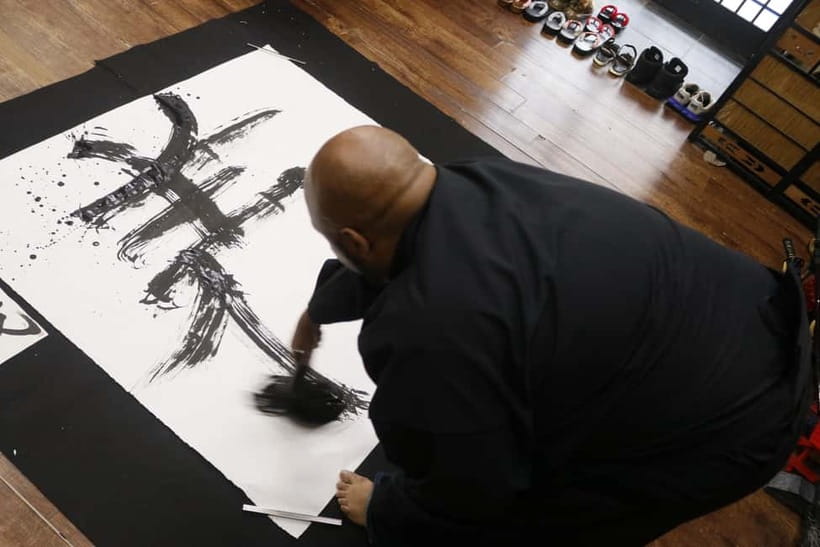
If you want a memorable Osaka activity that combines Shodo, a kimono moment, personalized kanji, and a keepable artwork souvenir, I think this is worth booking. The format is short enough for a busy itinerary, but structured enough that you’ll actually make something, not just sit and watch.
If you’re chasing a perfectly polished venue vibe, or you’re easily distracted by outside sounds, plan around that. Also consider the paid add-ons if you want the full hair and styling look.
If you do book it, treat it like a focused hour. Slow down during stroke order practice, look at the spacing for the blank space lesson, and lean into the photo moment after you’ve created your character. That combo is where the experience clicks.
FAQ
How long is the Shodo and samurai calligraphy experience?
The experience is sold as a 1 hour activity. The described flow breaks Shodo practice into 60 minutes and includes a Trying Samurai Calligraphy segment that is described as 30 minutes, so check the exact schedule when you book.
How much does it cost?
The price is listed as $42 per person.
Where is the experience located?
It takes place at Samurai Honor, Bushi no Homare (Samurai Honor) at Excellence Takayama 1F, 2-3-19 Shiginonishi, Joto-ku, Osaka-shi, Osaka 536-0014.
What should I bring?
You only need to bring a T-shirt. You’ll change into the provided kimono and samurai costumes on site.
Are kimono and samurai costumes included?
Yes. Kimono and Samurai Costumes are included.
What languages are available for the instructor?
The default language is English. Other languages are available by staff availability, including Italian, Spanish, French, Chinese, Thai, and Indonesian.
Do I get photos from the session?
Yes. Photography is included, and the photo data is sent to your designated email address.
Is calligraphy on kakejiku included?
Calligraphy on kakejiku is listed as a paid option, so it is not included in the standard package unless you select that option.
More Samurai & Ninja Sessions in Osaka
- Samurai Training Experience KENDO in Osaka
★ 5.0 · 515 reviews - OSAKA NIGHT FUSION Japanese Taiko Kabuki Samurai Dance Show
★ 4.8 · 155 reviews - Osaka: Samurai Training Experience KENDO in Osaka
★ 5.0 · 111 reviews - Experience Samurai and traditional Culture to the fullest
★ 5.0 · 26 reviews
Newly listed around Osaka
- Matcha Tea Bowl Experience in Osaka★ 5.0 · 11 reviews
- Master Washoku: 5 Core Techniques for Authentic Cooking★ 4.7 · 7 reviews
- Learn Zen in a class of making Matcha tea near Osaka Castle★ 4.8 · 17 reviews
- Kyoto: Immersive Arashiyama & Fushimi Inari by Private Car★ 5.0 · 35 reviews
- Katsu Curry OR Bento Making Cooking Class & Local Shop Tour★ 4.9 · 11 reviews
- JAPAN 7Days Unlimited 4G SIM (OSAKA Pick-up)★ 4.6 · 9 reviews
- Himeji: Private Guide Tour of the Castle from Osaka or Kyoto★ 4.5 · 7 reviews
- Get to know Minoo from Osaka. Katsuoji Temple, Ryuanji Waterfall and Ryuanji Temple★ 5.0 · 16 reviews
Samurai Sword & Ninja Training, compared.
Samurai Ninja Museum Guided tour and Experience
Read our review →
Kendo and Samurai Experience with Uniform and Gear
Read our review →
Samurai Sword Class by Experts in Traditional Arts
Read our review →
Skip the lines Basic Ticket at SAMURAI NINJA MUSEUM KYOTO
Read our review →
Samurai Sword & Archery Class from Samurai Descendant
Read our review →