
Review · HISTORICAL TOURS
Nara World Heritage PRIVATE TOUR
Nara can overwhelm in 5 minutes, unless you have a plan. This private walking tour gets you to Todai-ji and the World Heritage core quickly, and the included deer feeding at Nara Park is the hands-on moment you will remember. I also like the tight pacing, because you see a lot without feeling like you are sprinting. The main drawback to consider is that guide style can make or break the day, and summer heat in August can be intense.
This is built for first-time Nara visits. You get a professional local guide, entrance fees for the sites on the route, and a simple way to do the essentials in just a few hours. You also get a mobile ticket, which means less fumbling at entrances.
If you can handle walking outdoors and you show up prepared for crowds and sun, this tour is a very practical way to understand Nara fast, then explore on your own afterward.
In This Review
- Key things that make this Nara private tour work
- Why Nara feels different when you do it with a guide
- Todai-ji Museum and Nandaimon: getting oriented fast
- Inside Todai-ji: the Great Buddha and the scale trick
- Nara Park and the deer feeding moment
- Ukimido Pavilion: a hexagonal pause over Sagiike
- Kofuku-ji: the Five-Story Pagoda and its sheer presence
- What you really get from a private guide in Nara
- Price and value: $96.67 per person for a short, ticketed plan
- Logistics that affect your day (start point and how to end)
- Who this tour suits best
- Should you book it? My honest take
- FAQ
- How long is the Nara World Heritage PRIVATE TOUR?
- Is this tour private or shared?
- What is included in the tour price?
- Do I need to buy admission tickets for the sites?
- Is deer feeding part of the tour?
- Where does the tour start?
- Where does the tour end?
- What if the weather is bad?
- Is the tour suitable for most people?
Key things that make this Nara private tour work

- World Heritage focus: Todai-ji plus major temple stops in a short time window
- Deer feeding included: 1 packet of cracker is part of the experience
- Fewer logistics headaches: entrance tickets are included for what you visit
- Designed for first-timers: the route helps you get your bearings quickly
- A calm break in the middle: Ukimido Pavilion offers a quieter scenic pause
- Private pace and attention: it is only your group, so you can move at a human rhythm
Why Nara feels different when you do it with a guide
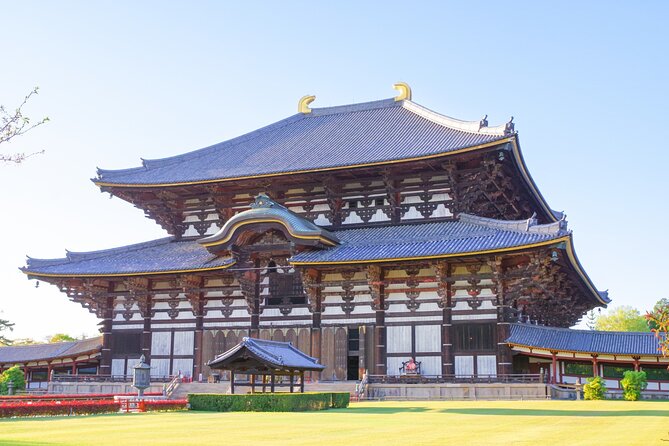
Nara is one of those cities where the landmarks are big, old, and visually intense. Todai-ji alone can make your brain short-circuit, because the scale is hard to understand from photos. A guide helps you read the place while you are still standing in it.
This tour also solves a common problem for visitors: figuring out what to prioritize. When you have a short window, you want the “you can only get this here” moments. That is exactly where the itinerary leans, from Todai-ji’s main complex to Nara Park and its sacred deer.
A good guide makes it feel like the city is talking back. Several guests praised guides by name, especially George and Kimu, for being friendly, patient, and able to turn temple facts into clear stories. There was also one unhappy review where interaction felt flat and scripted, so I will be honest: you should think of this as a guide-dependent experience. If you are sensitive to that, pick a time with good weather and arrive in a calm mindset, so even if the day runs a bit less smoothly, you still get the sights.
More History Tours in Nara
- World Heritage Kyoto & Nara Uji Authentic Matcha Experience
★ 5.0 · 1,573 reviews - Nara: Half-Day UNESCO Heritage & Local Culture Walking Tour
★ 4.8 · 250 reviews - Nara: Bike Tour in Ancient Capital UNESCO World Heritage
★ 5.0 · 43 reviews
Todai-ji Museum and Nandaimon: getting oriented fast
The tour begins at the Todai-ji Museum, inside the Todai-ji General Cultural Center area. This is a smart first move. Before you walk into massive spaces, you get a foothold in what you are about to see. Even if you only catch the highlights, it helps everything else land with more meaning.
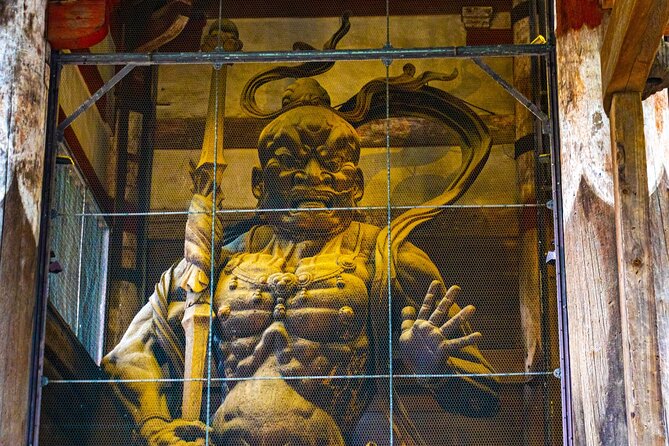
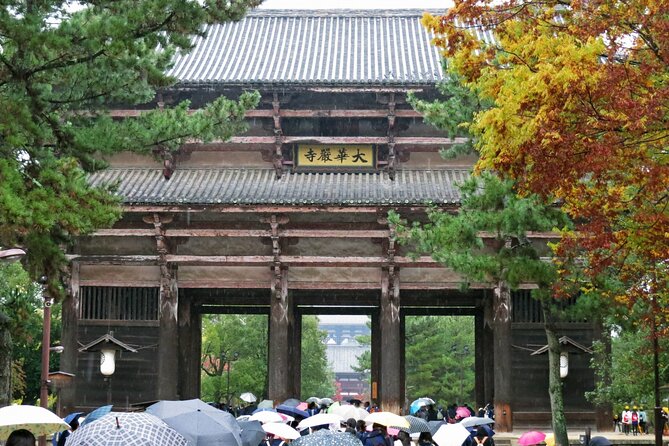
Then you move to Todai-ji Nandaimon, the Great South Gate. This gate is not just a photo stop. It is a kind of threshold. The structure, its age, and the way the complex is laid out are easier to appreciate once you have a few anchor points.
Timing here is short, about 10 minutes at each early stop, so this is not a slow museum day. The value is efficiency. You will be ready to focus once you hit the main temple grounds.
What to watch for: gates and museum areas can get busy, especially if you start later in the morning. One guest advice that matters is simple: go early when crowds are lighter. If your tour offers that possibility, it is worth taking.
Inside Todai-ji: the Great Buddha and the scale trick
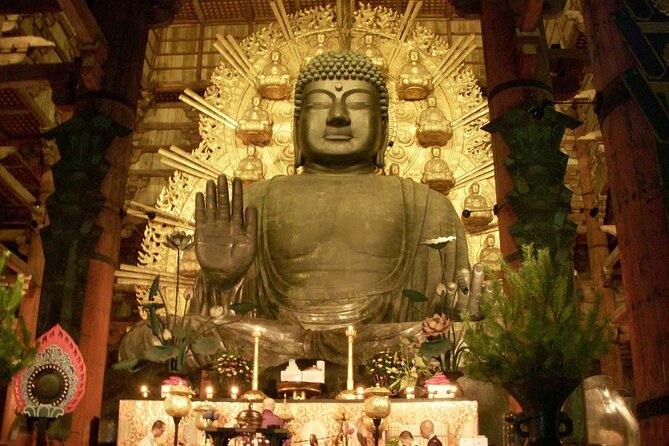
The heart of the day is Todai-ji itself. You are there for about 1 hour and 5 minutes, with admission included. Todai-ji is famous for having the largest Buddha statue in Japan. Standing in the space where the Daibutsu sits is where the site stops being a list of facts and becomes an embodied experience.
The temple grounds are large and framed by nature, so you get a mix of built environment plus open space. That matters because Todai-ji is not just one room. It is an atmosphere. You move through layers, you look back and forth, and the scale keeps changing as your position changes.
From reviews, what people often get most satisfaction from is the explanation quality. Guests described guides who added extra context beyond what you might piece together on your own. That is the real advantage here: your time at Todai-ji is brief enough to stay focused, but detailed enough that a good guide can help you notice the things you would otherwise miss.
Potential drawback: if your guide is not very interactive, you may feel like you are hearing facts without a conversation thread. That is what one critical review hinted at. If you rely on back-and-forth questions, be proactive. Ask simple things like what to look at first, or how the gate connects to the rest of the complex. A strong guide will jump on that.
Nara Park and the deer feeding moment
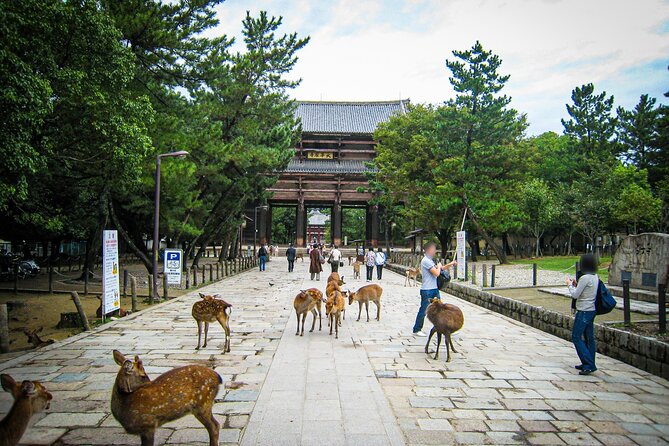
After the temple intensity, the tour steps into Nara Park for around 35 minutes. This is where the city’s most famous character shows up: sacred deer that roam freely. About 1,200 deer live in the park area, and the scene can be wild in the best way.
The deer feeding experience is included, and you get 1 packet of cracker for that part. This is not a generic zoo interaction. The deer are part of Nara’s local spiritual landscape, and the act of feeding connects you to the place in a uniquely Nara way. It also gives you an easy, memorable highlight for kids, couples, and anyone who wants a fun break from temple sightseeing.
Guides seemed to handle this well in positive feedback. One family praised the tour because their children loved the deer, and another guest specifically mentioned how engaging and great the deer were to feed. Even in hot weather, patience mattered. A review noted a guide was accommodating with fussy kids during roughly 39 degrees Celsius conditions.
What to consider: Nara Park can feel crowded, and deer can get bold when crackers are in hand. Your guide will manage the flow, but you should still move calmly. Keep your attention on what your guide is doing, not on chasing the perfect selfie angle. The “perfect photo” is usually less important than staying comfortable around a cluster of deer.
A few more Nara days to weigh up
- Kyoto/Osaka: Kyoto and Nara Sites & History Day Trip
★ 4.5 · 32 reviews - Nara: UNESCO Heritage Sites & Deer Park Tour with Pro guide
★ 4.5 · 10 reviews - Historic and Natural Guided Hike in Yoshino
★ 5.0 · 8 reviews - World Heritage Shirakawa-go and Experience Tours from Kanazawa
★ 5.0 · 4,049 reviews
Ukimido Pavilion: a hexagonal pause over Sagiike
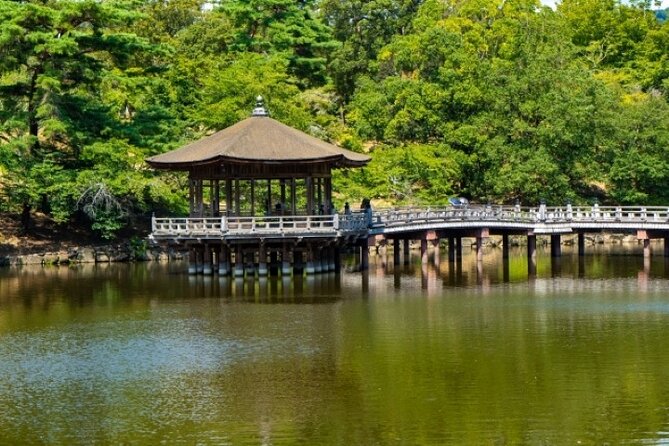
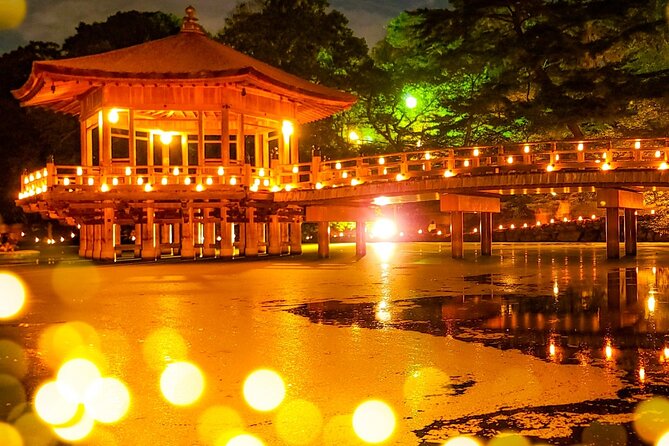
The tour then includes Ukimido Pavilion, for about 30 minutes. This stop is a breather. The pavilion is hexagonal and sits over Sagiike, a pond surrounded by trees. On a clear day, you can see the blue of the sky and the green of the nature around it, plus the pavilion reflection on the water.
This is the kind of scenery that works even if you are not a photography person. It gives your eyes something quiet to do after walking temple courtyards and park paths. It also helps the day feel balanced: you get awe, action, and then a calm view.
Because this stop is short, you will want to use your time well. Look for the reflection angle and then give yourself a moment to just stand there. If you are traveling with family, this is a nice place to reset energy before the next temple.
Practical note: since everything is outdoors, you will feel the weather. The tour information specifically flags August heat in Japan as a concern, with temperatures often exceeding 35 degrees Celsius. Bring water, consider shade help like a parasol, and plan to slow down your pace when the sun is strongest.
Kofuku-ji: the Five-Story Pagoda and its sheer presence
The final temple stop on the route is Kofuku-ji, spending about 30 minutes here. The big attraction is the Five-Story Pagoda, one of Nara’s most striking silhouettes. It was originally built in 730 and stands about 50 meters tall, which is a huge visual anchor in a city of temples and gates.
This part of the tour is where architecture fans usually perk up. Even if you are not into temple history, the pagoda’s shape and height give you something you can measure with your eyes. It is also a good contrast to Todai-ji. Todai-ji feels massive and complex. Kofuku-ji feels more pointed and vertical.
A guide can make this stop more meaningful by explaining what you are seeing in plain terms. In positive reviews, guides were praised for helping the sites feel connected rather than random. That is exactly what you want at the last stop, because it makes the whole day feel like a coherent Nara introduction.
What you really get from a private guide in Nara
This is private, meaning it is only your group. That matters a lot in Nara because you are making a lot of small decisions. Where do you stand to see the right view? How do you time your movement through crowds? When do you take a breather? A private guide gives you control.
Guests also highlighted friendliness and professionalism. Multiple reviews mentioned guides being polite, patient, and very knowledgeable, especially George and Kimu. One review praised a guide’s ability to add details that do not show up in history books. Another emphasized efficient planning so the walking felt manageable despite crowds.
There was that one negative note too, about a guide who seemed disinterested and lacked patience. I do not sugarcoat it, because for a private tour, service quality is personal. If you get a guide who is less engaging, you still have the sites and the included tickets, but you might wish you had more interaction.
My practical advice: if you want lots of interaction, start with one or two questions early. Ask what order makes the most sense for your interests, or what detail is most worth looking for at Todai-ji. A good guide will treat that like a welcome prompt.
Price and value: $96.67 per person for a short, ticketed plan
At $96.67 per person for a 3 to 4 hour tour, the price is not a bargain in the way a city bus ticket is. But it can be excellent value because three things are bundled in:
- Professional guide time for a private group
- Admission tickets included for the temples and shrines visited
- A built-in experience (deer feeding) with 1 cracker packet
If you were planning the same stops yourself, you would still pay for admissions, and you would spend time figuring out routes and timing. In Nara, that time cost adds up fast. You also risk ending up with an uneven day, too much temple, not enough park, or the reverse.
Reviews also suggest the pacing is a big part of the perceived value. One guest said 3 hours is about right for this area once you get the lay of the land. Another called it an efficient way to see top spots without burnout. That lines up with the tour length and the stop order.
Who gets the best deal: first-timers, families, and anyone who wants to see the main highlights without spending their whole day planning.
Logistics that affect your day (start point and how to end)
The tour starts at Todai-ji Museum in Nara, located in the Todai-ji General Cultural Center area. That is a good meeting spot because it is directly connected to the first sights. The tour ends near Kintetsu-Nara Station. Since it is private, your group can disperse based on where you want to go after.
You will also get a mobile ticket. That helps keep the day smooth, since you spend less time hunting for paperwork.
The route is described as near public transportation, which matters in a city where you might otherwise overpay for taxis. Still, this is a walking tour with outdoor time, so you want comfortable shoes and a hydration strategy, especially in summer.
Who this tour suits best
This is a strong fit if you are:
- A first-time Nara visitor who wants the key World Heritage anchors
- Traveling with kids who will enjoy the deer feeding and open park time
- Short on time and want a tightly planned half-day
It is also a good option if you are the type who likes structure. The tour gives you a sequence, and then you can branch out after.
If you are the type who hates being on a schedule, or if you need deep museum time, you might find 3 to 4 hours a bit fast. The emphasis is movement between highlights, not lingering for hours in indoor exhibits.
Should you book it? My honest take
If you want a practical, first-timer friendly introduction to Nara that includes Todai-ji, Nara Park, Ukimido Pavilion, and Kofuku-ji, this private tour is a smart way to spend a half-day. The deer feeding is a true Nara-only style memory, and the included admissions help the price make sense.
I would book it with two conditions in mind. First, choose a time of day when heat and crowds are manageable. Second, if you care a lot about conversation, be ready to ask questions early so your guide can match your energy.
If those boxes check out, you will likely leave with the feeling that you got your bearings fast, saw the real icons, and still had enough time left to wander further on your own.
FAQ
How long is the Nara World Heritage PRIVATE TOUR?
It runs about 3 to 4 hours.
Is this tour private or shared?
This is a private tour. Only your group will participate.
What is included in the tour price?
The price includes entrance fees for the temples and shrines you visit, a professional tour guide, and one packet of cracker to feed a deer. It also notes that you get a mobile ticket.
Do I need to buy admission tickets for the sites?
No, entrance fees for all the temples and shrines on the tour are included.
Is deer feeding part of the tour?
Yes. The tour includes the deer feeding experience, and you are provided 1 packet of cracker.
Where does the tour start?
The start point is Todai-ji Museum in Nara, inside the Todai-ji General Cultural Center.
Where does the tour end?
The tour ends at Kintetsu-Nara Station. Since it is private, you can disperse according to where you want to go afterward.
What if the weather is bad?
The experience requires good weather. If it is canceled due to poor weather, you will be offered a different date or a full refund.
Is the tour suitable for most people?
The tour states that most travelers can participate. It is designed as a walking tour, so you should plan for time outdoors.
Newly listed around Nara
- Relax in Nara: Deer Park, Todai-ji Temple and Merchants’ Town★ 5.0 · 6 reviews
- Nara Todaiji Lazy Bird Walking Tour★ 5.0 · 11 reviews
- All must-sees in 3 hours – Nara Park Classic Tour! From JR Nara!★ 5.0 · 108 reviews
- Hammer a Pattern on Your Ring Workshop★ 5.0 · 57 reviews
- Nara Private Tour: Flexible Pickup from Kyoto, Osaka, or Nara★ 5.0 · 17 reviews
- Nara Sake Tasting Tour at Local Brewerie(tasting fee included)★ 5.0 · 12 reviews
- Nara – Heart of Nature Cross Bike Tour★ 5.0 · 19 reviews
- Nara – Craft Beer, Sake & Food Walking Tour★ 4.0 · 7 reviews
Historical Tours, compared.
World Heritage Shirakawa-go and Experience Tours from Kanazawa
Read our review →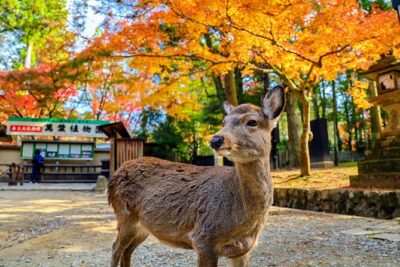
World Heritage Kyoto & Nara Uji Authentic Matcha Experience
Read our review →
World Heritage Shirakawa-go Morning Guided Tour
Read our review →
Hiroshima Historical Walking Tour – Why A-Bomb was Dropped
Read our review →
Hiroshima Peace (Heiwa) Walking Tour at World Heritage Sites
Read our review →
Yanaka Walking Tour: Historic and Traditional District of Tokyo
Read our review →
Shinjuku Historical Walking Tour & Secret Backstreets
Read our review →Browse the lists this tour appears in