
Review · JAPANESE CRAFT WORKSHOPS
Tokyo: Knife Making Workshop (Sharpening, Engraving)
Your knife gets personal in Tokyo. In a 90-minute session in Asakusa, you sharpen a Japanese-style blade and learn why these tools matter for cooking and craftsmanship, taught in English with hands-on sharpening coaching.
I especially like that the guides keep it practical, not just show-and-tell, and they help you get your technique under control.
You also get a real keepsake moment, engraving your name in Japanese and finishing the build, and that name engraving part turns the workshop from a class into something you will actually use (or proudly display).
The main tradeoff is effort and focus. Sharpening takes real concentration, and if you want bigger or specialty blade upgrades, there can be extra fees, so plan your expectations and budget.
In This Review
- Key Things That Make This Workshop Worth It
- Getting Oriented in Asakusa, the Heiwa Building Way
- Choosing Your Knife Type, and Why It Changes What You’ll Enjoy
- The 90-Minute Sharpening Session, Where Technique Feels Like Meditation
- Learning the Knife and Sword Story, Without Making It Weird or Pretentious
- Engraving Your Handle in Japanese, Then Attaching It the Traditional Way
- Snacks, Tea, Packaging, and the Take-Home Moment That Matters
- Price and Value: Is $161 Fair for a Finished Knife Souvenir?
- Practical Notes for Your Day, From Transport to Clothing
- Who Should Book This Workshop, and Who Might Skip It
- Should You Book This Tokyo Knife Workshop?
- FAQ
- Where is the meeting point for the workshop?
- How long does the experience take?
- What is the price for the class?
- What do I get to take home at the end?
- Can I engrave my name in Japanese on the knife handle?
- Is the workshop suitable for beginners?
- Is the workshop wheelchair accessible, and are there any restrictions during the class?
Key Things That Make This Workshop Worth It
- Pick from up to 5 knife options, including upgrades for larger specialty styles if you want them
- Start with tea and a short history lesson, covering how Japanese knives differ from sword traditions
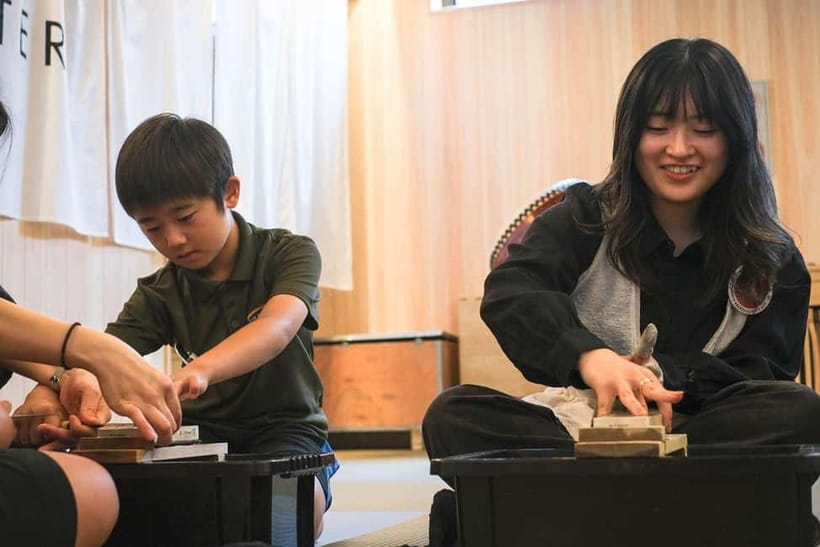
- Get nonstop, English support while you sharpen, polish, and correct your movements
- Engrave on the handle, then attach it using a traditional hammer, so you take home a finished, personalized knife
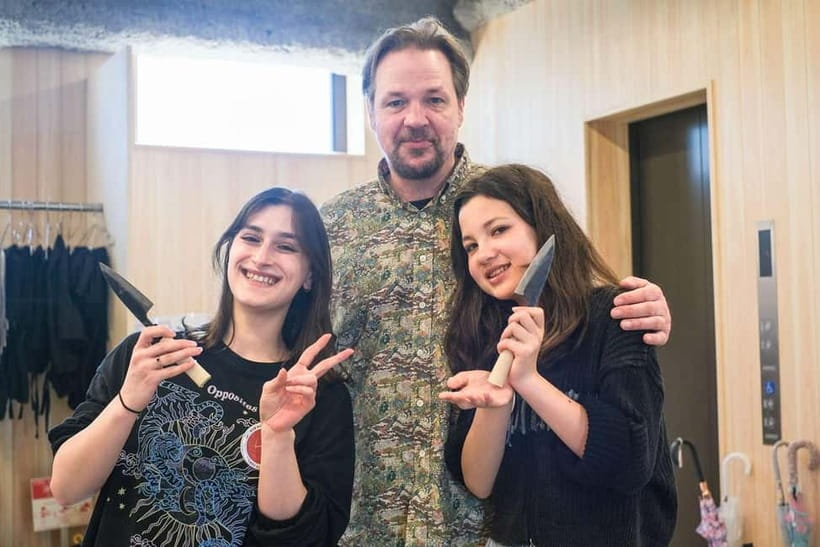
- Leave with more than a knife, including aesthetic packaging plus a customized key-holder
- Asakusa location helps you keep the day going, with lots of kitchen shops nearby for post-class browsing
Getting Oriented in Asakusa, the Heiwa Building Way
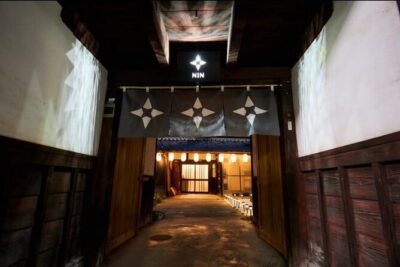
The workshop meets at BUB Activity Center in Asakusa, in the Heiwa Building. You take an elevator up to the 5th floor, so go in expecting stairs to be part of your imagination, not your route.
When you arrive, you get set up fast. The crew provides a light version of a haori (a kimono-style jacket) to protect your clothes from accidental stains, and you also get a badge with your name written in Japanese letters. It sounds small, but those two details make the workshop feel official and fun from minute one.
You will also get a drink right away, usually tea or juice, plus soft drinks. That soft start matters because sharpening is physical and mental, and you want to be relaxed before you start concentrating on the blade.
More Craft Workshops in Tokyo
- Chopstick Making Workshop in Ginza
★ 4.8 · 1,366 reviews - Tokyo: Samurai Sword & Archery Class from Samurai Descendant
★ 5.0 · 603 reviews - Tokyo: Shinjuku Chopstick Making Class
★ 4.9 · 440 reviews
Choosing Your Knife Type, and Why It Changes What You’ll Enjoy
One of the smartest parts of this workshop is that you choose what you are sharpening. You can select from up to five knife types, and the size matters too, since different shapes feel different in hand and behave differently in the kitchen.
The base “standard” option is a multi-tasking knife, which is a great choice if you want a practical, everyday tool. If you want to get more specific, you may be able to upgrade to larger or specialty blades, including options like usuba, deba, and petit yanagiba for an additional charge.
Here is the practical way to think about it: if you want the most everyday usefulness, lean toward the all-purpose style. If you already cook a lot with Japanese knives at home, or you have a specific curiosity about one blade profile, upgrades can be worth it. The key is that you are choosing your souvenir based on how you will actually use it, not just because it looks cool.
The crew helps you decide, and they also guide you on how to sharpen without turning it into a technical exam. Even if you are a true beginner, you can leave knowing what you picked and why.
The 90-Minute Sharpening Session, Where Technique Feels Like Meditation
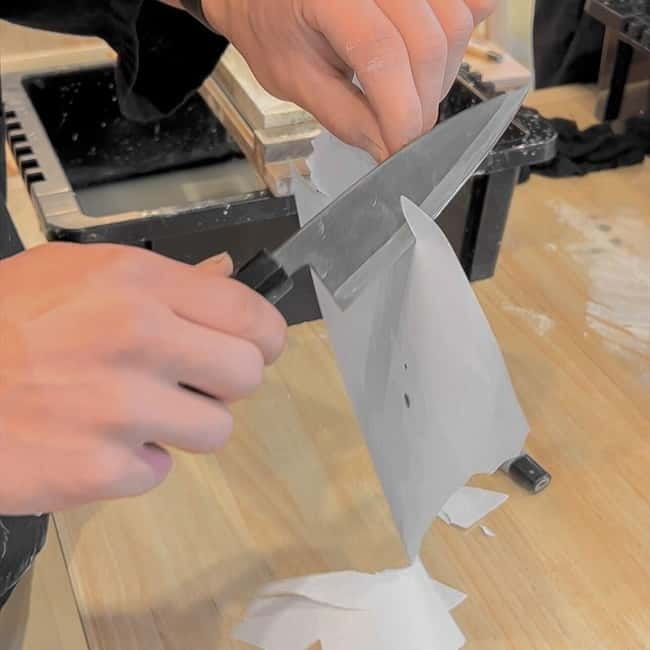
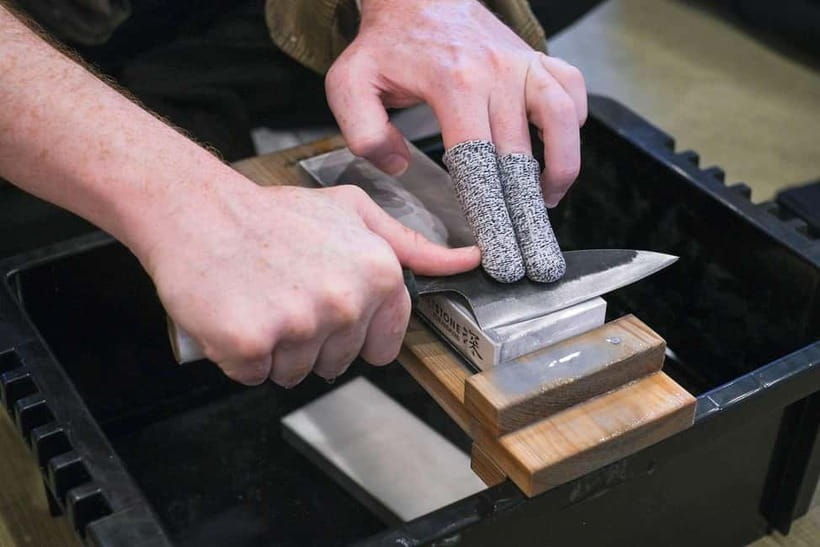
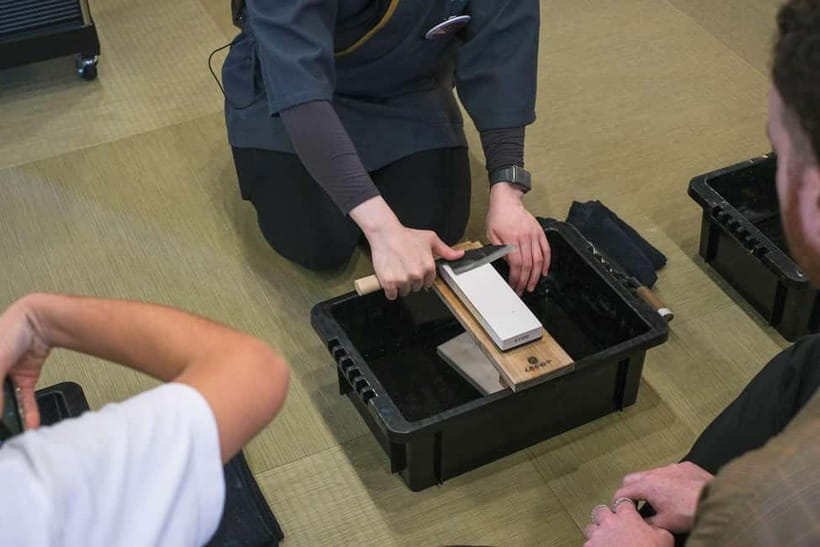
Then comes the main event: sharpening and polishing. The workshop is designed around a step-by-step process where you grind and refine the blade, focusing on concentration and steady movements.
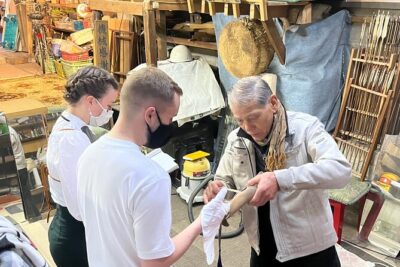
You will quickly learn that sharpening is not about speed. It is about control. Your crew members stay close by and correct your movements in real time, which is huge if you are worried about doing it wrong. Multiple English-speaking staff members are there, so you can ask questions without guessing at what they mean.
This is also where the workshop earns its reputation as stress-reducing. The repetitive, tactile motions give you a focused rhythm, and the blade’s transformation is satisfying in a very hands-on way. You feel the progress as you go, instead of waiting until the very end to find out if you did anything right.
Learning the Knife and Sword Story, Without Making It Weird or Pretentious
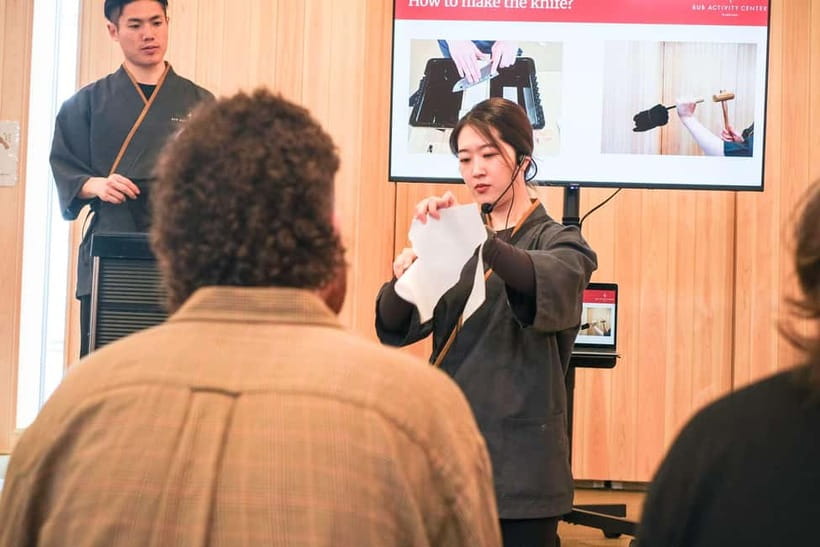
Before you start finishing the knife, you get context. The crew shares cultural and historical background about Japanese knives and swords, including differences between Japanese swords like katanas and sword traditions more broadly, in plain English.
You do not need to be a history buff to get something out of this. The point is to connect what you are doing, sharpening a blade edge, with why Japanese makers put so much care into metal, shape, and use.
It also helps you understand what you are looking at in Japanese knife shops later. After class, you are less likely to stare at blades like they are all the same, because you now have a framework for how shape and purpose connect.
In the reviews, guides like Agata and Mori get special mentions for energy and clear English. If you happen to learn with them or other bilingual staff, you can expect explanations that match your level and a lot of encouragement while you work.
A different sort of day in Japan:
- Mt Fuji and Hakone 1-Day Bus Tour Return by Bullet Train
★ 5.0 · 26,383 reviews - 1-Day Tokyo Bus Tour
★ 5.0 · 14,250 reviews - Tokyo: TOKYO SKYTREE® Admission ticket
★ 4.5 · 11,192 reviews - Tokyo: teamLab Planets TOKYO Digital Art Museum Entry Ticket
★ 4.6 · 9,779 reviews
Engraving Your Handle in Japanese, Then Attaching It the Traditional Way
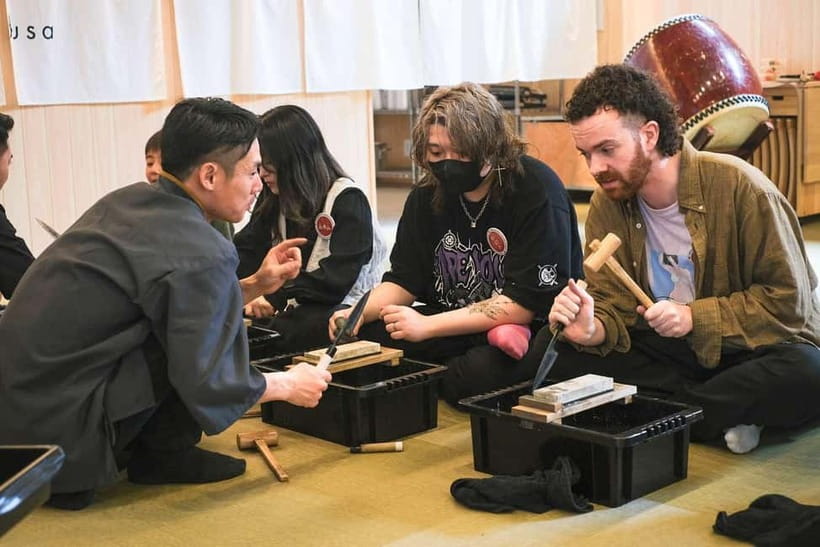
After sharpening, you move into the personalization phase. You engrave your name in Japanese letters on the handle, which turns your knife into something genuinely yours, not just a generic souvenir.
You might also be able to engrave more than text, such as a picture or your own imagined design. If you choose something extra, be ready for it to be harder than it looks. Engraving feels precise, and it is easy to overthink it. The crew helps when needed, though, including a delicate guide who can teach Japanese basics if you want to get your characters correct.
One of the most memorable moments is when you finish by attaching the handle using a traditional hammer. That step makes the knife feel like an assembled craft project, not just a “class souvenir.” You get to hear and feel the effort transforming into a customized tool.
Snacks, Tea, Packaging, and the Take-Home Moment That Matters
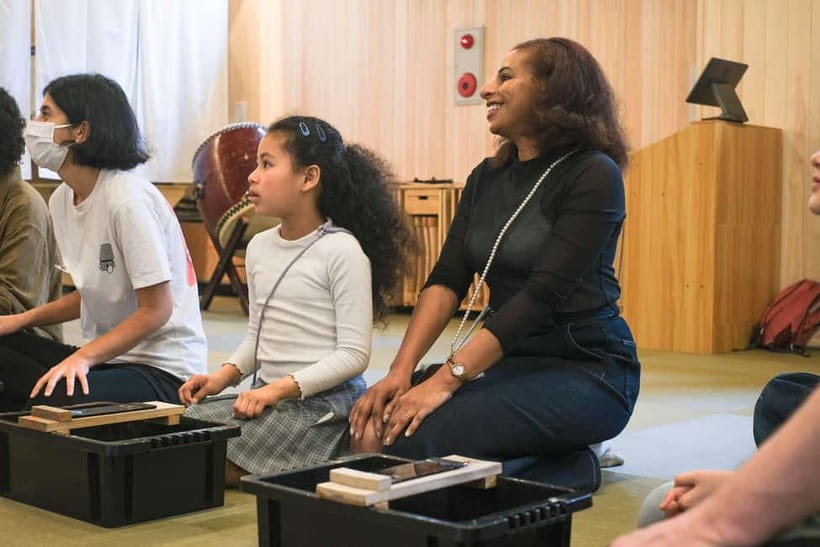
The workshop does not end when you stop sharpening. You get Japanese snacks and tea, which gives you a little decompression time before you handle the finished piece.
Then you get aesthetic packaging for your knife. This matters more than you might think. A knife is not a small trinket, and you want it protected for transport.
You also receive a customized key-holder with a unique design. It is a fun bonus, but it also adds to the sense that this is a full experience, not just a one-off demo. The key-holder is light, easy to carry, and it feels like the workshop team wants you to take something home even if you later decide you only plan to keep the knife in storage.
Price and Value: Is $161 Fair for a Finished Knife Souvenir?
At $161 per person for about 90 minutes, you are not paying for a short show. You are paying for a hands-on craft experience plus a finished, usable item you take home.
Here is what you get that justifies the cost:
- A standard size multi-tasking Japanese knife to take home
- The guided sharpening and assembly work you cannot easily replicate on your own in Tokyo
- Japanese snacks and drinks during the session
- Bilingual staff support throughout
- Aesthetic packaging and a customized key-holder
The value gets even better if you want the learning part too. Sharpening technique is hard to learn from YouTube alone because you need someone to correct your angle and motion. You get that correction live, and it pays off later when you care for your knives at home.
The main reason the price might not fit everyone is that upgrades for bigger specialty blades cost extra. If you go in thinking you want the largest possible knife type, you should expect the final total to rise.
Also, meals are not included. If you do not have a plan for lunch or dinner before or after, you might want to build time around eating nearby in Asakusa.
Practical Notes for Your Day, From Transport to Clothing
You do not need to bring your own jacket or fancy equipment. The crew provides a light haori version to protect your clothes from small stains.
You should still dress smart. Even if they manage the mess well, sharpening is tactile and requires attention. Comfortable closed-toe shoes are a safe bet since you will be focused at your workspace.
For transport back home, think ahead. You are advised to put your knife box into your check-in luggage, or you can ask staff to ship it. That shipping option can be a big help if you are traveling with a carry-on only.
One more boundary: alcohol and drugs are not allowed. If you are trying to stack a late night in Tokyo with this class, keep it sober and timed correctly.
If you are coming as a couple or family group, you can have someone observe instead of participate. There is an observation fee paid on site for non-participants, which is useful if you want one person to do the hands-on work while the other watches.
Who Should Book This Workshop, and Who Might Skip It
This is a great pick if you want an authentic Tokyo craft experience with a real outcome. If you cook, this is not just a souvenir purchase. You will learn how Japanese knives are handled and how to care for them, and you will walk away with an actual tool.
It also fits well if you like making things with your hands. The sharpening portion is tactile and you can feel your progress as you work, plus the engraving step is creative enough to stay fun.
You might consider skipping if you hate careful, slow tasks. Sharpening is concentration-heavy, and if you prefer passive sightseeing or you are short on time, it may feel like work. Budget-wise, also double-check whether you want a specialty blade upgrade.
The flip side is that beginners are welcome. You do not need prior experience. You just need patience, and the crew is there to keep you moving in the right direction.
Should You Book This Tokyo Knife Workshop?
Yes, if you want a meaningful, usable souvenir and you like the idea of learning a skill you can keep using. For a lot of people, the real win is the combination: you get hands-on sharpening, a cultural story about knives and swords, and a personalized knife you assemble yourself.
Before you book, do two quick checks:
- Are you ready to focus for about 90 minutes, especially during the sharpening stage?
- If you want a bigger specialty knife type, are you okay with extra fees?
If those answers are yes, this is an experience that feels like Tokyo craft at its most practical, and it leaves you with something you can bring out in your kitchen, not just in a display case.
FAQ
Where is the meeting point for the workshop?
It meets at BUB Activity Center in Tokyo, Taito-ku, Asakusa, 2 Chome 6-11, in the Heiwa Building. You should take the elevator to the 5th floor.
How long does the experience take?
The workshop duration is approximately 1.5 hours.
What is the price for the class?
The price is listed as $161 per person.
What do I get to take home at the end?
You take home a standard size knife (multi-tasking) crafted during the experience, plus a customized key-holder and aesthetic packaging. The class also includes Japanese snacks and drinks.
Can I engrave my name in Japanese on the knife handle?
Yes. You engrave your name in Japanese letters on the handle, and you may also be able to engrave a picture or other design.
Is the workshop suitable for beginners?
Yes. It is suitable for beginners and requires no prior experience.
Is the workshop wheelchair accessible, and are there any restrictions during the class?
It is wheelchair accessible. Alcohol and drugs are not allowed.
Newly listed around Tokyo
- Tokyo private transfer for Yokohama Port★ 4.5 · 63 reviews
- Luxury Kimono Photoshoot at Ginza Tokyo★ 5.0 · 7 reviews
- Tokyo Allstar Food Tour★ 4.5 · 206 reviews
- Tokyo: Best Ginza Food Tour at 3 Local Eateries★ 5.0 · 83 reviews
- Private One Day Nikko Tour with Bilingual driver★ 3.5 · 11 reviews
- Tokyo Art Aquarium Museum E-Ticket with optional Tokyo Metro Pass★ 5.0 · 17 reviews
- PRIVATE tour in 180SX to Daikoku+++++★ 5.0 · 6 reviews
- Kabuki Talk★ 5.0 · 10 reviews
Japanese Craft Workshops, compared.
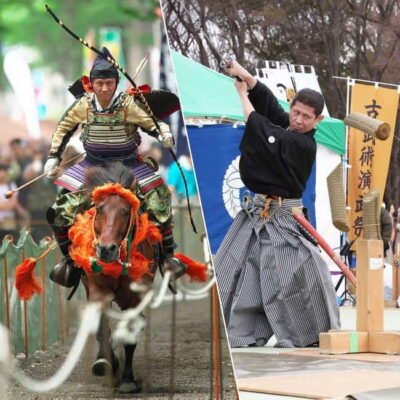
Samurai Sword & Archery Class from Samurai Descendant
Read our review →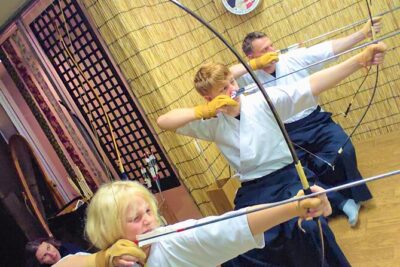
Japanesel Archery Experience HIROSHIMA CASTLE SHARAKU
Read our review →
Authentic knife making experience at a blacksmith in Kyoto
Read our review →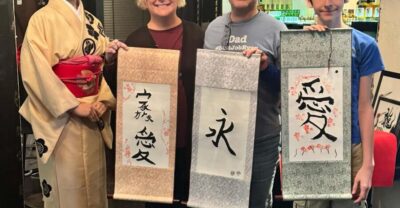
Browse the lists this tour appears in