
Review · JAPANESE CRAFT WORKSHOPS
Authentic knife making experience at a blacksmith in Kyoto
That hammering moment in Kyoto is seriously addictive. In this 3 hour workshop, you make a real, practical knife with guide Mao. I like that you get a hands-on craft you can actually use later, and I like the strong safety coaching so you are not guessing. One drawback to plan for, it is physically demanding and the work happens around very hot metal.
You’ll also leave with a finished souvenir that feels earned, not bought, plus the studio is easy to reach from the station. The session runs in a small group, and you can shoot photos and video during key steps. Just note you are expected to bring socks, and children under 15 have extra rules.
In This Review
- Key Things That Make This Knife Workshop Worth Your Time
- Why Making a Knife Beats Another Kyoto Souvenir
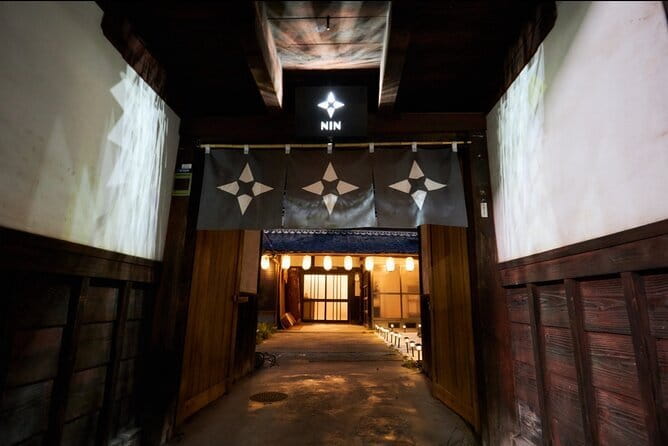
- The Location Puzzle in Sakyo-ku: Studio Shinobi YASE and Studio NIN
- What Happens in 3 Hours: From Traditional Attire to Your Finished Blade
- Hammering the Blade: The Forge Moment You Will Remember
- Cooling, Refining, and Sharpening the Edge
- The Finish and Rust Reality: Kurouchi Looks Good for a Reason
- Your Knife as a Gift: Boxed, Bagged, and Sized Right
- Heat, Safety, and the Real Work Factor
- Who This Workshop Suits Best
- Price and Value: $154 for a Take-Home Craft
- The Bottom Line: Should You Book This Kyoto Knife Workshop
- FAQ
- How long is the Kyoto knife making experience?
- What is the price per person?
- Where do I meet, and how do I get there?
- Which studio will I attend, Studio NIN Yase or Studio NIN Kendo?
- What do I need to bring?
- What knife size do I take home?
- Is this suitable for children or older adults?
- Are alcohol and drugs allowed during the workshop?
- Is cancellation possible and how late can I cancel?
Key Things That Make This Knife Workshop Worth Your Time
- A rare blacksmithing experience in Kyoto, not the typical pottery or food class
- Hands-on forging guidance on hammer angle and rhythm, not just watching
- You take home your finished blade, boxed and bagged for travel
- A classic small studio format in Sakyo-ku, with staff confirming which studio you attend
- Sharpening and finishing instruction so the knife is more than a “cool rock”
- Kurouchi-style charm may be part of the look, which can help with rust resistance (so skip the urge for a shiny, mirror finish)
Why Making a Knife Beats Another Kyoto Souvenir
Kyoto has no shortage of nice shops. This experience is different because you create something that has a real job. You do the heat, the hammering, the shaping, the edge work. Then you walk out with a knife that is sized for everyday kitchen use, not just display.
The value is not only the object. It is the skill you borrow for the rest of your life. Even if you never forge anything again, you come away understanding why steel behaves the way it does, why heat matters, and why finishing determines how it performs and how long it stays comfortable to use.
Two things I really liked about this workshop are simple. First, the process is paced so beginners can finish with a usable result. Second, the instructors emphasize craft details, like correct hammering technique and careful sharpening, so the work feels guided rather than chaotic.
More Craft Workshops in Kyoto
- 1-Hour Japanese Archery Experience in Kyoto
★ 5.0 · 176 reviews - Kyoto: Calligraphy class at Buddhist temple in city center
★ 5.0 · 167 reviews - Kyoto: Japanese Archery Workshop with Experienced Instructor
★ 4.9 · 132 reviews
The Location Puzzle in Sakyo-ku: Studio Shinobi YASE and Studio NIN
Your meeting point is Studio Shinobi YASE at 168-1 Yase-no-secho, Sakyo-ku, Kyoto City. The address lists it as a one-minute walk from the Yase-Hieizan Exit of the Eizan Electric Railway. I recommend train if you can, since you will be following a straightforward path.
Here is the practical wrinkle. The workshop runs out of two studios in Sakyo-ku: Studio NIN Yase or Studio NIN Kendo. Staff message you before your visit to confirm which studio you attend. One past participant also advised that walk time can feel longer depending on how you route yourself, so give yourself a small buffer.
Also, plan your day like a local craft workshop, not like a museum. You will want energy when you arrive, not a rushed dash with cold coffee in your hand.
What Happens in 3 Hours: From Traditional Attire to Your Finished Blade

The class runs for 3 hours, and you leave with a knife about 13 to 15 cm long. You can take home something that is compact enough for gifts, packing, and everyday use.
When you arrive, you check in and meet your instructor. Mao is named as a seasoned knife professional with 10 plus years of experience, and the teaching team includes other instructors who are English and Japanese speakers. The workshop also supports small groups, so you are less likely to disappear into the back row.
You then change into traditional smith attire worn by Japanese smiths. It is not just costume. It acts like a switch in your brain. You start treating the tools with respect, because the studio sets the tone immediately.
After that, you get tool and safety instruction. You learn how to handle items like hammers, tongs, and grinders, and you get clear guidance so you can participate safely. Since this is hot-work, they take safety seriously, and you should, too.
Hammering the Blade: The Forge Moment You Will Remember
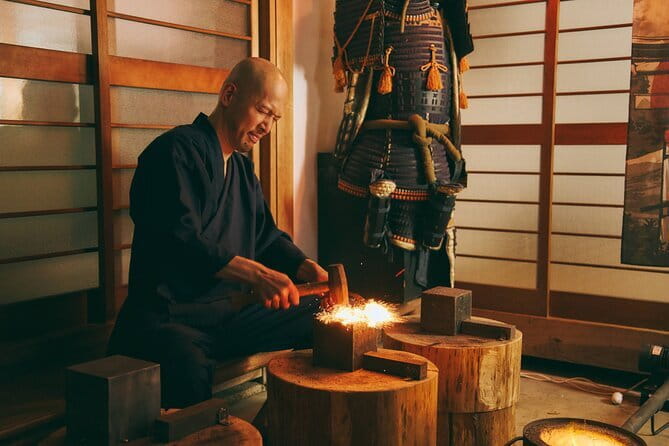
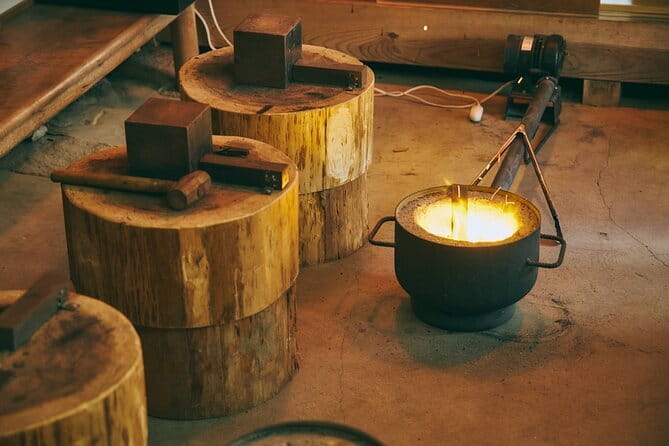
The heart of the experience is forging. First, the metal is heated in the furnace until it glows red-hot. Then you strike the glowing steel repeatedly, guided closely by Mao.
This is where the class earns its reputation. You are not just swinging a hammer until something happens. The instructor teaches hammer angle, rhythm, and precision. You stay safe while you learn the feel of moving hot steel into shape.
One review specifically mentions the metal being around 800 to 900 °C, which explains the intensity of the session. It also explains why stretching before you arrive is smart. You are doing real physical work with your shoulders and forearms, not a desk craft.
If you like learning by doing, this is the sweet spot. You can feel progress within the same session. The blade stops being raw steel and starts looking like a knife.
A different sort of day in Japan:
- PERFECT KYOTO 1-Day Bus Tour
★ 5.0 · 13,518 reviews - Kyoto: Fushimi Inari, Kinkakuji, Bamboo Grove 1 Day Bus Tour
★ 4.8 · 4,316 reviews - Kyoto: Tea Ceremony in a Traditional Tea House in Kiyomizu
★ 4.9 · 3,519 reviews - Kyoto Geisha Walking Tour: Gion District & Hidden Gems
★ 4.7 · 3,273 reviews
Cooling, Refining, and Sharpening the Edge
After forging, the metal is cooled and checked for shape. Then you refine rough edges and prepare the blade for sharpening.
Sharpening is not an afterthought. It is a big part of whether your knife feels satisfying in your hand. You use sharpening stones and grinders under expert instruction to bring the edge to life. Even if you start with no metalworking experience, the class is structured so you can still leave with a functional result.
Then comes polishing and final finish. At the end, your knife is ready to take home. Photos and videos are welcome during the process, and multiple reviews mention the staff taking photos and video for participants. That is a nice extra if you want proof without spending the whole time hiding your face behind your phone.
The Finish and Rust Reality: Kurouchi Looks Good for a Reason
Kyoto-style knife aesthetics can be shiny, but this workshop leans into the charm of a more rustic look. One participant pointed out that the finish can be Kurouchi, described as a rustic, rawly forged finish that also helps with anti-rust properties.
So here is a practical tip. Do not chase a mirror shine just because it looks like what you expect from a knife. If you end up with a Kurouchi-style finish, that look is part of the design and it can help with rust resistance.
Also think about ownership mindset. This knife is handmade. It is not a factory-perfect blade, and the whole point is that you earned the imperfections and the character. Reviews also mention that instructors will help fix mistakes if needed, which matters because forging is unforgiving when you are learning.
Your Knife as a Gift: Boxed, Bagged, and Sized Right
The workshop gives you what you need to transport the knife. Included in the session are a box and bag, along with materials, tools, and the usual support items like a towel and water.
That matters for value. A knife workshop only feels worth it if you can pack your purchase without panic. Here, the packaging is built into the deal.
As for usefulness, the finished knife is about 13 to 15 cm long. That makes it a great gift size, but also a knife you can actually use at home, especially for typical kitchen prep. Multiple reviews frame it as perfect for gifting or daily use because it is practical, not just decorative.
One extra note from a review: someone mentioned you might choose knife options and handle styles, and that handle versions could cost extra (they cited 5000 yen for handle versions). If you care about a specific style, ask your instructor at the start about what options are available for your session.
Heat, Safety, and the Real Work Factor
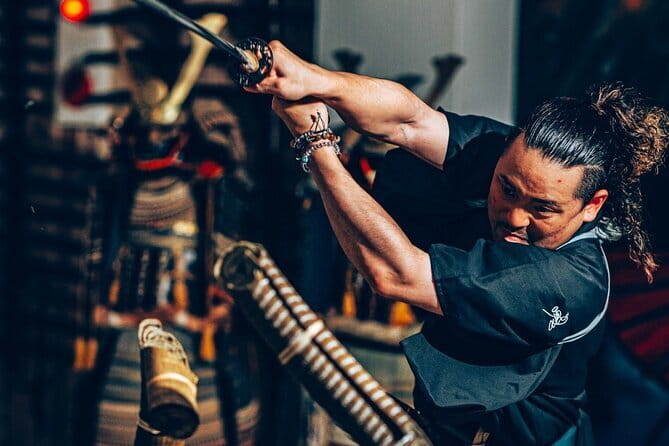
Let’s talk honestly about effort. This is not a light, sit-and-smile class. Reviews repeatedly describe it as physically demanding. You hammer near hot metal. Your grip and posture matter. Your brain needs to stay focused.
The studio provides safety instruction before the forging part. You learn tool handling and what to do if something feels off. Multiple reviews mention clear safety guidance and patient instruction.
Also be prepared for heat. One review calls out furnace heat making the session intense, and they mention the studio provided frozen neck coolers and even had air conditioning to help. That is exactly the kind of comfort detail that can make the difference between enjoying the class and just surviving it.
One more serious practical note: the workshop mentions that some parts involve danger and that in the unlikely case of injury or accident, the customer is responsible. That is not meant to scare you. It is there so you take safety and attention seriously. If you have mobility issues or you are uncomfortable with hot-work environments, pick a different type of class.
And do the simple stuff. Bring socks. Consider stretching your wrists, shoulders, and back before you put your hands on the hammer.
Who This Workshop Suits Best
This experience is a strong match if you want a hands-on Kyoto activity with an end product you will keep. If you like learning from skilled people and you want a cultural craft that feels rare, this is the kind of activity that actually changes your trip.
It also works well for couples and small groups. Reviews mention everything from solo travelers to families, and the small group format helps. One review even described a very small group session with extra personal guidance.
Age-wise, it is not suitable for children under 15 and it is also listed as not suitable for people over 95. Children under 15 must be accompanied by a guardian, per the workshop rules.
If you are traveling with teens, this can be a memorable option. Reviews highlight teenagers being genuinely excited, especially because you take home a practical object made with your own hands.
Price and Value: $154 for a Take-Home Craft
At $154 per person for a 3 hour session, you are paying for more than materials. You are paying for expert instruction, studio time, hot-work equipment, and finishing steps that result in a take-home knife that is usable.
Knife making does not get cheap when it is real craft, not a quick demo. The value here comes from the full arc. You heat, forge, refine, sharpen, and polish within one visit, and included items like costume, towel, water, tools, materials, box, and bag mean you are not scrambling for basic essentials.
It also helps that you are not starting from scratch. The class teaches correct technique as you go. And instructors can help if you make mistakes, so you do not end with a failed souvenir.
One additional cost note you should keep in mind: larger knife formats can take longer, and the workshop notes that knives requiring more than 5 hours cost more than $400. This session is described as a refined 2.5-hour format in the notes, but your booked duration is 3 hours, so you should treat the session as a full half day in your schedule. If you want a bigger knife, plan on budgeting more time and money.
The Bottom Line: Should You Book This Kyoto Knife Workshop
Book it if you want a Kyoto experience that feels truly hands-on and ends with something you can use. I especially think it is a great fit if you like practical souvenirs, you enjoy making things with your hands, and you are curious about a blacksmithing craft that is rare even in Japan.
Skip it if you want something gentle and low physical effort. This class includes hot-work, real hammering, and focused safety steps. Also skip it if you hate the idea of bringing socks and following workshop rules around substances.
If you book, go with a simple mindset: treat it like a craft lesson, not a product purchase. With Mao and the team guiding you, you should leave with a knife that feels personal, plus the kind of story you can tell for years.
FAQ
How long is the Kyoto knife making experience?
The workshop duration is 3 hours.
What is the price per person?
The price is $154 per person.
Where do I meet, and how do I get there?
The meeting point is Studio Shinobi YASE (168-1 Yase-no-secho, Sakyo-ku, Kyoto City). It is listed as a one-minute walk from the Yase-Hieizan Exit of the Eizan Electric Railway. The recommendation is to come by train, and taxis are also available.
Which studio will I attend, Studio NIN Yase or Studio NIN Kendo?
The experience operates out of two studios in Sakyo-ku. Staff will message you before your visit to confirm which location you should attend.
What do I need to bring?
You should bring socks.
What knife size do I take home?
Your finished knife is about 13 to 15 cm long and fully handmade.
Is this suitable for children or older adults?
Children under 15 must be accompanied by a guardian, and the activity is not suitable for people over 95.
Are alcohol and drugs allowed during the workshop?
No. Alcohol and drugs are not allowed.
Is cancellation possible and how late can I cancel?
Free cancellation is available up to 24 hours in advance for a full refund.
Newly listed around Kyoto
- Taste of Nishiki Market Walking Food Tour with Local guide★ 5.0 · 17 reviews
- Kyoto: Sushi Making Class with Sushi Chef★ 4.8 · 64 reviews
- Simple Plan with Maiko★ 4.4 · 10 reviews
- Shibori Furoshiki Course at Kyoto Shibori Museum★ 5.0 · 21 reviews
- Kyoto: City Secrets eBike Tour★ 4.9 · 196 reviews
- Sacred Pathways: Discover the Philosopher’s Path of Kyoto★ 4.9 · 20 reviews
- Private Tour to Monkey Park and Arashiyama Highlights★ 5.0 · 22 reviews
- Private Sake Tasting in Central Kyoto — 1 Group Only★ 5.0 · 11 reviews
Japanese Craft Workshops, compared.
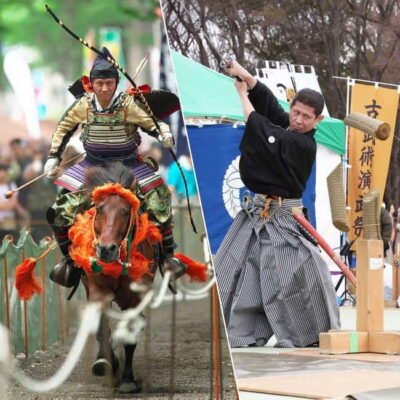
Samurai Sword & Archery Class from Samurai Descendant
Read our review →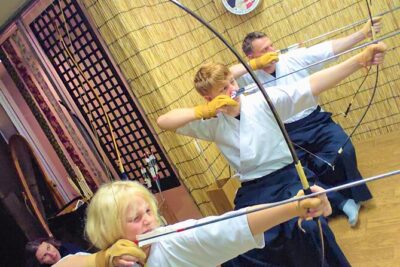
Japanesel Archery Experience HIROSHIMA CASTLE SHARAKU
Read our review →
Calligraphy class at Buddhist temple in city center
Read our review →Browse the lists this tour appears in