
Review · SUMO STABLE VISITS
Tokyo Sumo Morning Practice: Viewing & Exclusive Interaction
Want sumo without the match chaos? This morning visit puts you very close to real wrestlers training in Sumida, with the rituals and momentum that TV never shows. You get a top-notch English-speaking guide who sets the scene before you watch the work up close, then helps you make the most of the interaction afterward. One thing to plan for, ring-time access can be restricted by long-standing sumo tradition, and the session rhythm may feel stricter than a casual sightseeing stop.
A big win here is the way the morning is structured. Before you reach the stable area, your guide starts at Narihira Park (near the multipurpose restroom) with a briefing that makes what you’re seeing feel understandable, not just impressive. I also like how guides such as Sarah, Momo, Peach, Haru, and Taka are described as friendly and ready to help you through what the wrestlers are doing and how to ask good questions.
The main drawback is not about the wrestlers, it’s about expectations and access. Some guests may hope for more hands-on ring time than the format provides, and that can be disappointing, especially given tradition-based limits. If you want a relaxed, go-at-your-own-pace stop, this is more of a quiet, follow-the-process morning.
In This Review
- Key things that make this sumo morning special
- The Narihira Park start that makes everything click
- What the morning practice viewing feels like, up close
- Exclusive Q&A and photos with wrestlers, plus ring rules to know
- The closing session and the banzuke souvenir set
- Optional Japanese brunch, and whether it’s worth planning for
- Price and value: why $95.77 can be a fair deal
- Timing and logistics that matter in Tokyo
- Who this sumo morning practice tour fits best
- Should you book this sumo morning practice experience?
- FAQ
- How long is the Tokyo sumo morning practice tour?
- Where does the tour start?
- Does the tour include an English-speaking guide?
- Is the ticket mobile?
- What is included in the souvenir?
- Is sumo morning practice viewing included in the price?
- Is brunch included?
- How large is the group?
- Is the meeting point near public transportation?
- Can I cancel for free?
Key things that make this sumo morning special
- Narihira Park briefing first, so you understand the rituals before you watch training
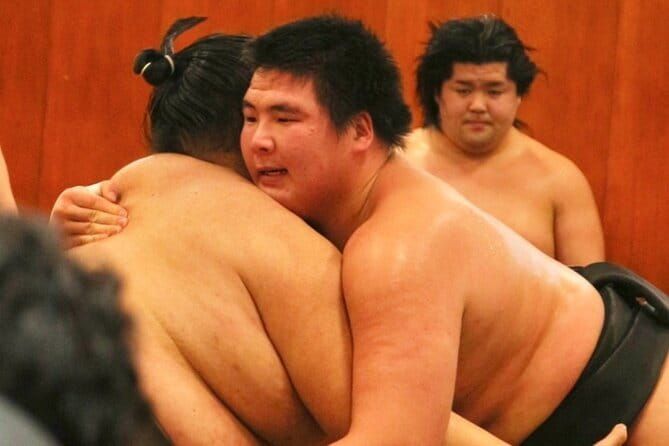
- Up-close morning practice viewing, where you feel how hard they work
- Q&A and photo session with wrestlers, with guided support for communication
- Official banzuke souvenir set, delivered with a proper closing session
- Small-group feel, since the tour caps at 45 people
- Optional Japanese brunch afterward, if you want to keep the momentum going
The Narihira Park start that makes everything click
The experience begins at Narihira Park in Sumida, specifically at 2-chōme-3-番 Narihira, Sumida City, Tokyo 130-0002. The meeting area is near the multipurpose restroom, which matters more than it sounds. Sumo mornings have their own rhythm, and you will want to be in the right spot early so you do not lose time before the briefing.
This first stop is not just waiting around. The guide welcomes you and gives an insider briefing that adds context on the hidden history and rituals you’ll see later. In plain terms, it turns the stable from a mysterious building into a place with rules, meaning, and purpose.
If you’ve ever watched sumo clips and thought, I get the basics, but what am I actually looking at, this is the fix. You will get the key background up front so the training does not feel random. Guides described across the tour experience as communicative and ready to translate, including support for English to Japanese questions and back again during the interaction portion.
Compare these Sumo Stable visits in Tokyo:
- Tokyo: Sumo Show Experience with Chicken Hot Pot and a Photo
★ 4.8 · 6,678 reviews - Tokyo: Sumo Show and Dining Experience
★ 4.8 · 2,742 reviews - the SUMO show
★ 5.0 · 1,960 reviews
What the morning practice viewing feels like, up close
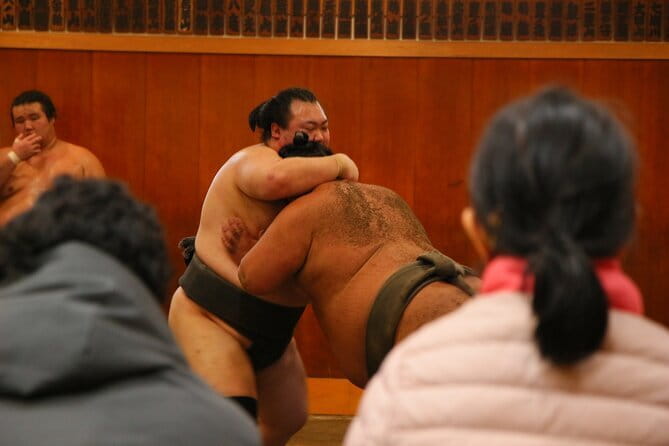
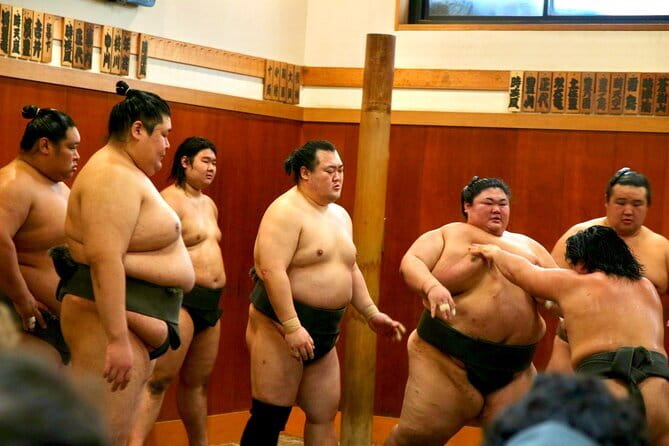
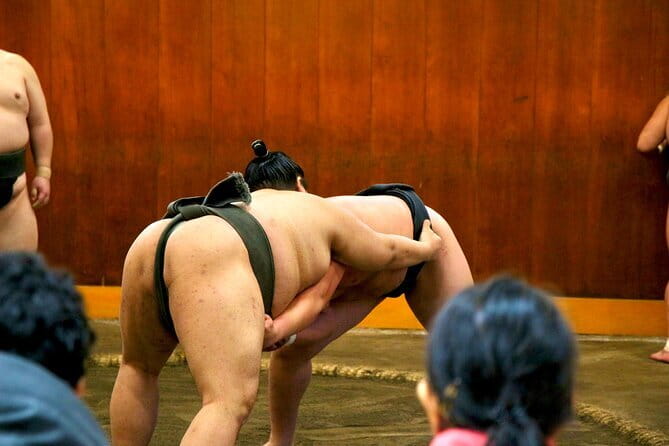
After the briefing, you head to the training setting for the main viewing block, about 1 hour 30 minutes. This is where the tour earns its reputation. Morning practice is not the polished, high-spotlight version you see on tournament days. Instead, it is real work, done with focus and repetition.
The standout is the distance. You are close enough to see the details in movement and hear the physical impact. The feel you want here is raw power, not a distant performance. Multiple descriptions emphasize that it is not staged like a tourist show, which is exactly what makes it worth your time in Tokyo.
You’ll also likely see practice bouts during the morning session. That matters because it shows how training translates into the moment of pressure. Watching the athletes work through drills and then shift into more sparring-style practice gives you a better sense of their style and discipline.
Practical note: the stable environment requires respect and quiet attention. You are not there to chatter. If you want a lively, loud tour experience, this may feel more controlled than you expect. But if you can sit, watch, and listen, you’ll get a lot more out of what’s happening.
Exclusive Q&A and photos with wrestlers, plus ring rules to know
One of the biggest selling points is the interaction period: about 30 minutes for Q&A and a photo session. This is not a generic meet-and-greet where you ask one question and move on. The format gives you time to talk directly with the wrestlers, and the guide helps bridge language so your questions land.
This is also where you can learn the personal side of sumo. People often expect sumo to be all tradition and strength, but the best questions tend to bring out the human answers. What does training feel like day to day? What habits matter most? How does a wrestler approach learning and improvement?
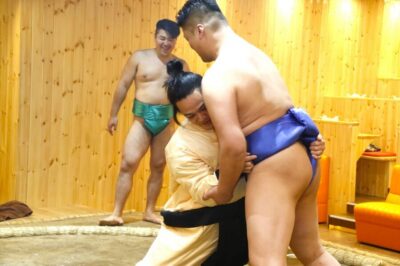
Photos are part of the interaction, and that is a nice bonus because it turns your memory into something you can actually share later. The tour experience is also described as letting some participants try hands-on moments in the ring area. That said, this is where you need to be realistic.
Long-standing sumo tradition can limit who is allowed onto the ring area. One guest mentioned disappointment that, due to tradition, women were not allowed into the ring. Even if you are part of the same group, the exact participation might vary based on rules in effect. So if your personal goal is to push or step in, treat it as a possibility, not a guaranteed feature.
How to get the most from this stage
- Come with 2 to 3 simple questions, not a speech
- Focus on training and routine, since those connect well to what you watched earlier
- Let the guide do the heavy lifting on translation, so you can keep your tone clear and respectful
The closing session and the banzuke souvenir set
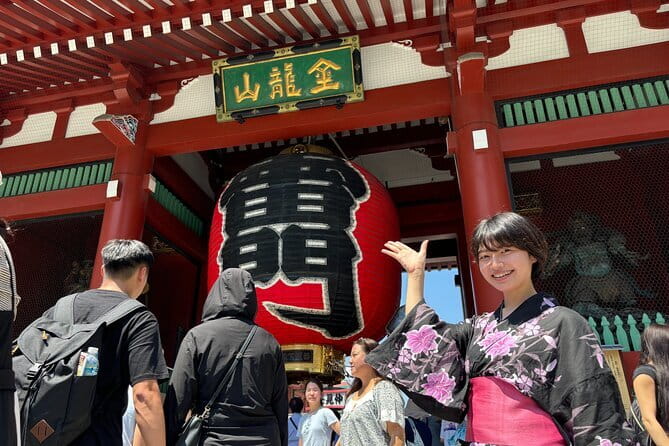
The tour ends back at Narihira Park with a closing session, about 30 minutes. This is more than a wrap-up. The guide presents an official banzuke ranking sheet, delivered in a specially designed souvenir folder.
A banzuke is one of those sumo items that feels more meaningful when you understand the context of ranking and performance. You are not just leaving with a photo, you’re leaving with a piece of the sport’s official culture. It is also a satisfying bookend to the morning, because you watched training and then you go home with a tangible symbol of the tournament world.
You’ll also have time for extra Q&A at the park. If you found the training especially fascinating, this is your chance to ask follow-up questions while the morning is still fresh.
A few more Tokyo days to weigh up
- Mt Fuji and Hakone 1-Day Bus Tour Return by Bullet Train
★ 5.0 · 26,383 reviews - 1-Day Tokyo Bus Tour
★ 5.0 · 14,250 reviews - Tokyo: TOKYO SKYTREE® Admission ticket
★ 4.5 · 11,192 reviews - Tokyo: teamLab Planets TOKYO Digital Art Museum Entry Ticket
★ 4.6 · 9,779 reviews
Optional Japanese brunch, and whether it’s worth planning for
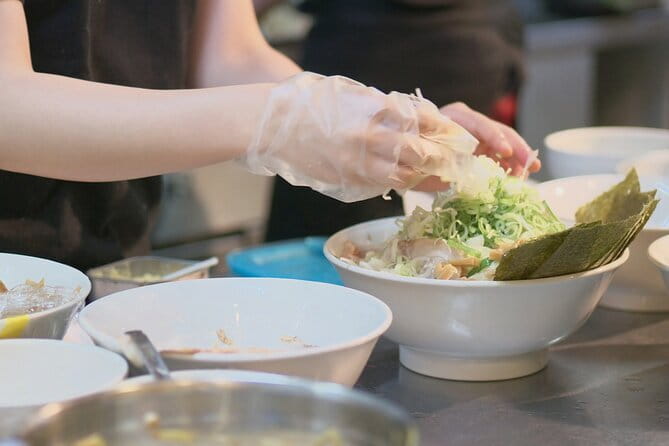
After the experience, there is an optional Japanese brunch. The tour does not force it, but if you enjoy continuing the cultural thread, it makes sense.
In at least one case described, the brunch was handled with care by the guides, who explained dishes and helped people choose. Also, brunch can end up feeling more like a meal or light lunch in the European sense, depending on what you order.
One helpful detail: a review noted typical costs for brunch in the range of about 1,000 to 2,000 yen, depending on dishes. That means you should treat it as an add-on meal with its own budget, not as a guaranteed included perk.
If you’re aiming to maximize your morning, the optional brunch is a smart way to keep the experience going before you scatter across Tokyo. If you already have a reservation, skip it and leave room for sightseeing right after the tour.
Price and value: why $95.77 can be a fair deal
At $95.77 per person, this tour is not cheap. But it is also not trying to be a generic attraction. What you’re paying for is a package that combines access, translation, and structure.
Here’s the value math in plain language:
- You get the sumo morning practice viewing fee included, which is the core reason you’re here
- You get an English-speaking guide to translate, set expectations, and help you ask questions
- You get an official banzuke souvenir set, not just a ticket and a handshake
- You get a real interaction and photo window, which is usually the hardest part of scheduling with traditional sports
Also, sumo tournaments in Tokyo only happen a few times a year. That means if your dates do not line up with tournament weeks, this kind of morning access can feel like the next-best option. You are still seeing authentic training life, not a substitute.
Possible value concern
A couple of comments flagged that the price can feel high for what you get if you expect a longer session, or if you prefer more in-depth explanation beyond translation and question handling. If you know you want deep storytelling at every minute, you might wish the guide explanations were heavier. On the other hand, if your main goal is close viewing and genuine access, most people seem to feel the experience delivers.
Timing and logistics that matter in Tokyo
This is a morning-style experience that runs about 2 hours 30 minutes to 3 hours. That time range is important because it affects how you plan the rest of your day. The good part is that it leaves room for Tokyo sightseeing afterward, so you are not stuck inside a full-day tour bubble.
A few practical points based on the provided details:
- The tour uses a mobile ticket
- The meeting point is near public transportation
- The group maximum is 45 travelers
- The activity ends back at the meeting point
Also, make sure you pin down the correct meeting location before you go. One participant warned that ticket location information can be off, and the safe fix is to rely on the given meet-up spot near Narihira Park and the multipurpose restroom.
If you’re staying in a far-off neighborhood, you’ll want to build in extra time to get there on time. Traditional sports mornings move on their own schedule, and a late arrival can be a real problem.
Who this sumo morning practice tour fits best
This is a strong match if:
- You want an inside view of sumo, not just a stadium day
- You care about rituals and rules, and you enjoy structured context
- You like asking questions and meeting people, even if the conversation is guided
- You travel as a family and want an unforgettable cultural activity
It may be a tough fit if:
- You struggle with sitting quietly for extended viewing blocks
- You expect lots of free-form time in the ring, beyond what tradition allows
- You want a very laid-back, spontaneous morning
Language and behavior help here. The guide is English-speaking, and the interaction is designed around proper stable conduct. When you follow the rules, you get rewarded with a respectful, up-close look at how sumo life is built.
Should you book this sumo morning practice experience?
If you’re in Tokyo and your dates do not match a sumo tournament, I think booking this is a smart move. The combination of close morning practice viewing, Q&A and photos, and the official banzuke souvenir gives you something you cannot easily recreate on your own. It is also short enough that you still have time to enjoy Tokyo after.
I would especially book it if you want the real working side of sumo, the part most people miss. Just go in with two clear expectations: the stable rules mean quiet attention, and ring participation is not guaranteed for everyone due to tradition-based restrictions.
FAQ
How long is the Tokyo sumo morning practice tour?
The tour runs about 2 hours 30 minutes to 3 hours.
Where does the tour start?
It starts at 2-chōme-3-番 Narihira, Sumida City, Tokyo 130-0002, Japan, near the multipurpose restroom at Narihira Park.
Does the tour include an English-speaking guide?
Yes. The tour includes an English-speaking guide.
Is the ticket mobile?
Yes. The tour uses a mobile ticket.
What is included in the souvenir?
You receive an official banzuke ranking sheet in a specially designed souvenir folder.
Is sumo morning practice viewing included in the price?
Yes. The sumo morning practice viewing fee is included.
Is brunch included?
Brunch is optional. The experience mentions an optional Japanese brunch after the practice.
How large is the group?
The maximum group size is 45 travelers.
Is the meeting point near public transportation?
Yes. The meeting point is near public transportation.
Can I cancel for free?
Yes. Free cancellation is available up to 24 hours in advance of the experience start time for a full refund.
Newly listed around Tokyo
- Sumo Wrestlers Morning Practice Tour – Tokyo Sumida District★ 5.0 · 54 reviews
- Sumo Wrestling Tournament A-Class Seats & ExpertGuide | Tokyo MAY★ 5.0 · 14 reviews
- Sumi-e Ink Painting Suiboku-Ga Workshop in a Japanese Teahouse★ 5.0 · 20 reviews
- 【Contemporary Culture】Bar Hopping I Always Visit in Shinjuku!★ 5.0 · 29 reviews
- Snow Experience at Mt.Fuji, Hakone Pirate Ship & Gotemba Premium Outlet★ 4.0 · 32 reviews
- Asakusa’s Historic Treasures★ 5.0 · 30 reviews
- Small-Group Wagyu Beef and 7 Japanese Dishes Tokyo Cooking Class★ 5.0 · 190 reviews
- Flavours of Tokyo: A Journey Through Time – Small Group Food Tour★ 5.0 · 149 reviews
Sumo Stable Visits, compared.
Sumo Show Experience with Chicken Hot Pot and a Photo
Read our review →
Tokyo Sumo Entertainment Show with Chicken Hot Pot and Photo
Read our review →
Tokyo Grand Sumo Tournament Viewing Tour with Tickets
Read our review →
Sumo Show & Experience w/ Optional Kimono & Hot Pot
Read our review →Browse the lists this tour appears in