
Review · FISH MARKET WALKS
Tsukiji and Asakusa Food and Drink Cultural Walking Tour (Half day)
Tsukiji smells like Tokyo. This half-day food and culture walk threads outer Tsukiji tastings with Asakusa temple streets, so you learn what locals eat and why it matters. You start at Tsukiji Hongwanji Temple, then work through the market area, and finish in Asakusa near Kaminarimon.
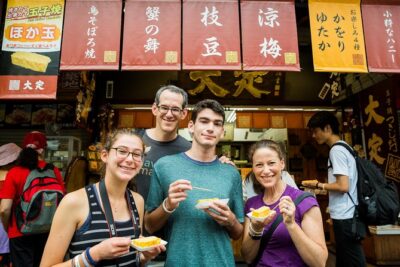
I especially like the way this tour turns the market into something you can actually understand, not just stand in. You get guided stops for classic bites like Japanese-style omelette, dried bonito, fried fish cakes, sushi, and drinks like Japanese tea and sake. I also like the pacing of a small group (max 20), which helps when you are moving through crowded stalls and narrow aisles.
One thing to consider: the menu can change with availability and season, so you should be flexible. Also, it is a lot of walking, so bring comfortable shoes and plan for a moderate fitness level.
In This Review
- Key things I’d circle before you go
- Entering the day: 8:15 am start, 5.5 hours of Tokyo flavor
- Tsukiji Hongwanji Temple: your calm, useful launch pad
- Outer Tsukiji Jogai Market: tastings that teach you how Tokyo eats
- Tsukiji Fish Market area: walking through about 400 shops
- Asakusa Cultural Center, Nakamise Street, and Senso-ji: from market to temple streets
- The Asakusa sweet stop: your finish line
- What you actually learn about Japanese food culture
- Guides and group size: why the human factor matters
- Price and value: is $164 reasonable for this half day?
- Who this tour is best for (and who should skip it)
- Should you book this Tsukiji and Asakusa food walk?
- FAQ
- Where do I meet the guide, and where does the tour end?
- What time does the tour start, and about how long is it?
- How large is the group?
- Is alcohol included, and what is the minimum drinking age?
- What happens if I arrive late?
- What admissions are included versus free?
- Do the food and drink items ever change?
- What is the cancellation policy?
- Do I get a mobile ticket?
Key things I’d circle before you go
- Outer Tsukiji first: you begin at Tsukiji Hongwanji Temple and then move into the Jogai Market area.
- Sake and classic seafood snacks: you sample items like fried fish cakes, Japanese tea, dried bonito, sushi, and more.
- A lot of stalls in less time: you explore the Tsukiji Fish Market area with about 400 shops.
- Asakusa sweets after the temple walk: a sweet cafe stop plus time in Nakamise Shopping Street and Senso-ji area.
- Tour group stays small: capped at 20 people for easier navigation through the market.
Entering the day: 8:15 am start, 5.5 hours of Tokyo flavor
This is a true half-day plan. You meet at 8:15 am at Tsukiji Hongan-ji Temple (3-chome-15-1 Tsukiji, Chuo City). The tour runs about 5 hours 30 minutes, and you end at the Asakusa Information Center area near Kaminarimon (2-chome-18-9 Kaminarimon, Taito City).
That early start matters. Tsukiji is the kind of place where things move fast, and starting on time helps you get a smoother route through the outer market stalls. Since you do a lot of walking, it is smart to arrive with your shoes on and your route ready. The tour is near public transportation, but transportation to the meeting point is on you.
More Food Tours in Tokyo
- Tokyo: Shinjuku Food Tour (13 Dishes at 4 Local Eateries)
★ 5.0 · 6,603 reviews - Tokyo Tsukiji Fish Market Food and Culture Walking Tour
★ 5.0 · 3,184 reviews - Tokyo: Shinjuku Food Tour (15 Dishes and 4 Eateries)
★ 4.9 · 2,033 reviews
Tsukiji Hongwanji Temple: your calm, useful launch pad
Your first stop is Tsukiji Hongwanji Temple, with the tour starting in front of the gate. It is a practical “meet and orient” point, and it also anchors the market in local context. The area has been tied to fish trading for decades, and the tour introduces that connection with the note that Tsukiji’s fish market role spans about 80 years as Japan’s biggest fish market.
Here is why I like this opening: it prevents the market from feeling like pure chaos. You are not just thrown into a maze of stalls. You start with a landmark, then you transition into the food world with a guide’s explanations.
Timing is short here, around 15 minutes, and admission is listed as free. So you use this segment to get bearings, not to sit around.
Outer Tsukiji Jogai Market: tastings that teach you how Tokyo eats
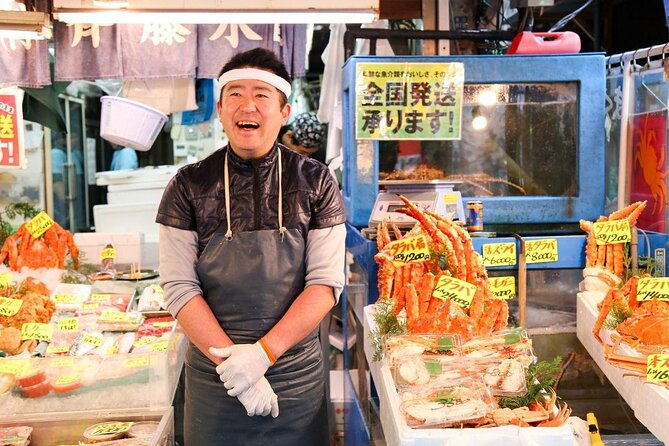
Next you move into the Jogai Market area, where the focus turns directly to food. Even locals see Tsukiji as special for buying high-quality seafood and ingredients, and chefs visit for top-tier supplies. That chef connection is useful because it explains what you are actually looking for: quality ingredients, and food traditions built around them.
This is where the tastings concentrate. Expect a mix like:
- Japanese-style omelette
- dried bonito
- Japanese tea
- fresh tuna
- fried fish cakes
- sake
- sushi
A key practical note: the exact menu is subject to change based on availability and season. That means you should treat this as a guided sampler of food culture, not a checklist that must match a specific item.
The Jogai Market stop is about 2 hours, and admission is included for this segment. That matters for value, because this part is not just walking past shops. It is the tour’s most structured “eat as you go” portion.
Also, if you are sensitive to alcohol, you still have options. There is a clear rule: the minimum drinking age is 20. The tour states that another drink is prepared for people under 20, so you do not get left out of the experience.
Tsukiji Fish Market area: walking through about 400 shops
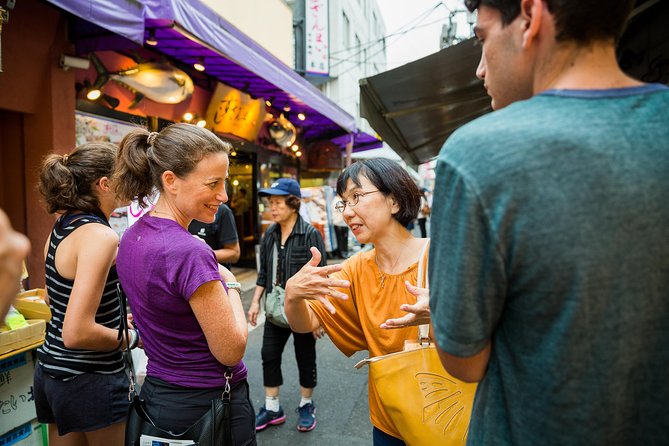
After the main tastings, you continue through the Tsukiji Fish Market area, where you explore around 400 shops. This is more movement, less sitting. The point is to show you how the market functions as a working network of stalls, not just a place for visitors.
This segment is about 1 hour, and admission is listed as free. Since the time is short, you will want to keep your attention on your guide’s route and explanations rather than trying to self-navigate every side aisle. In a place this dense, the “right” experience is often about knowing where to look and how to connect what you see to what you ate earlier.
Practical tip: pace yourself. You may be full from the tastings, then hit more browsing. Bringing a watchful eye helps you enjoy both the food memories and the visual market cues without feeling rushed.
More Market Walks in Tokyo
- Tokyo: Tsukiji Fish Market Food and Walking tour
★ 5.0 · 1,724 reviews - Tokyo: Tsukiji Fish Market Guided Walking Tour
★ 4.9 · 1,397 reviews - Tokyo Sushi Making Class in Tsukiji with Professional Chef
★ 5.0 · 1,177 reviews - Tsukiji Fish Market Guided Tour and Sushi Making with Pro Chef
★ 5.0 · 775 reviews
Asakusa Cultural Center, Nakamise Street, and Senso-ji: from market to temple streets
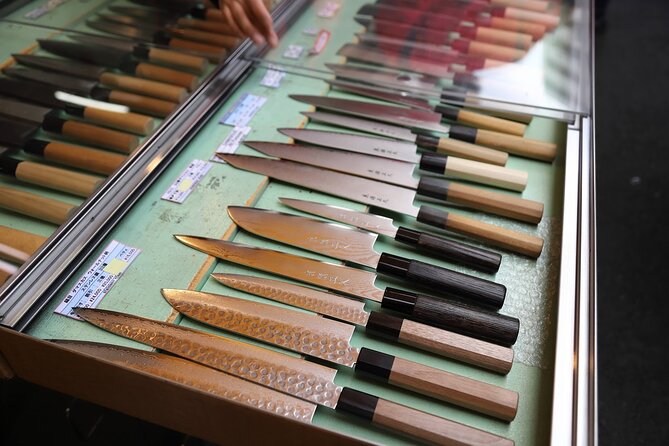
Once Tsukiji finishes, the tour shifts from fish ingredients to classic old Tokyo neighborhoods. You start with the Asakusa Culture Tourist Information Center (about 10 minutes). It is listed as a beautiful information center, and that kind of stop is more useful than it sounds. It gives you a quick mental map before you get pulled toward the biggest sights.
Then comes Nakamise Shopping Street near Kaminarimon, around 15 minutes. The tour highlights it as the oldest shopping street. This matters because Nakamise is not just a souvenir lane. It is part of how Asakusa’s visitor flow works, and how people line up for snacks that match the temple district’s rhythm.
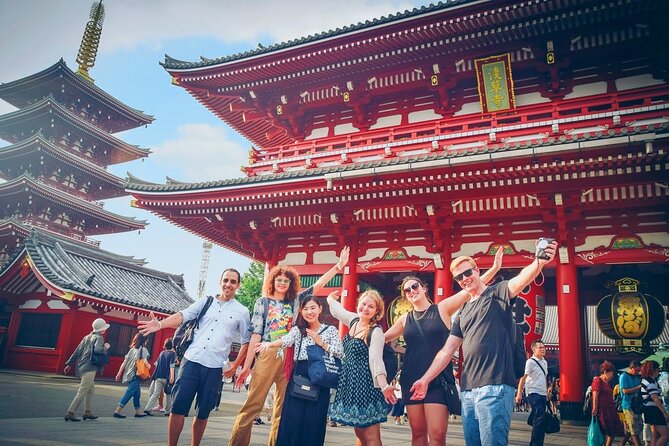
From there, you pass by the shrine in Senso-ji temple and then spend about 30 minutes at Senso-ji. The tour frames it as the biggest temple, and the time is set for a smooth look without burning your whole half-day. If you love photos, this is your anchor moment.
One small consideration: this part mixes walking with sightseeing, so keep your energy for both. If you start Tsukiji a little “too hungry,” you might feel full by the time temple crowds and shopping street foot traffic pick up. If you start Tsukiji a little underfed, you will likely love the sequence more.
The Asakusa sweet stop: your finish line
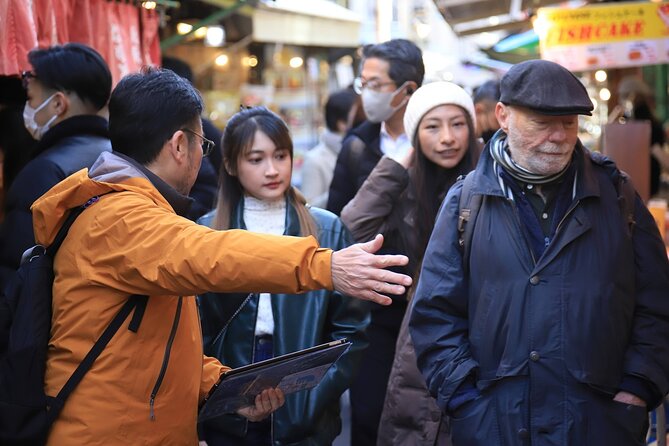
You finish in Asakusa with time to explore the traditional town area and try Japanese sweets. There is also an included admission during the Asakusa portion (listed as included for about 1 hour 20 minutes).
This ending is smart. Tsukiji gives you food rooted in seafood supply and everyday culinary technique. Asakusa shifts to sweets and temple-street treats, which helps you see how different food traditions anchor different parts of Tokyo.
The tour concludes back near the Asakusa Information Center so you can continue your day on your schedule. That is helpful. You are not locked into a long sit-down ending, and you are not forced into a single nearby transit option.
What you actually learn about Japanese food culture
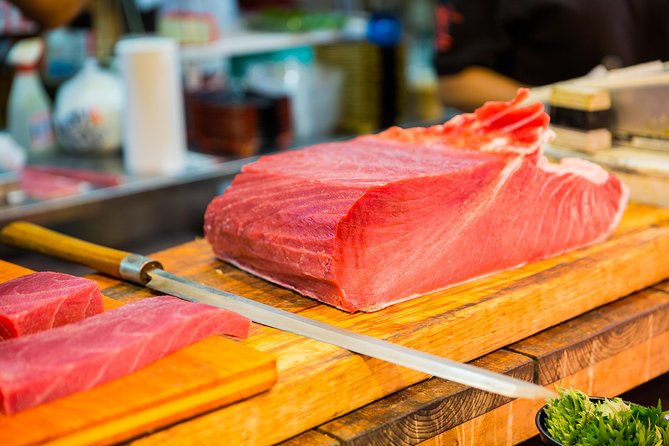
This is not only a taste parade. It is structured around the idea that Japanese culinary traditions make more sense when you see the supply chain and the neighborhood context.
At Tsukiji, the guide’s explanations connect several dots:
- fresh seafood and high-quality ingredients come from specialized sourcing
- chef purchases shape what gets emphasized in the market
- classic items like dried bonito and sushi are tied to tradition, not just novelty
Then in Asakusa, the tour keeps the cultural thread going by moving into a neighborhood where food is part of the walking experience. Nakamise and Senso-ji create a stage where snacks make sense, because the area is designed for strolling, looking, and sampling.
If you care about the meaning behind what you eat, this tour is a strong format. You get context early, then you eat while that context is still fresh.
Guides and group size: why the human factor matters
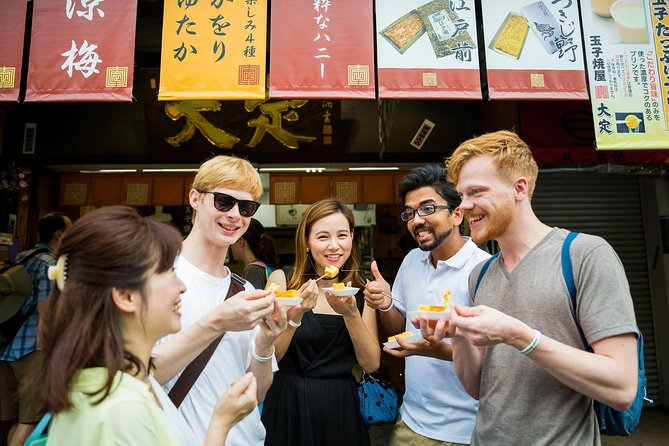
One of the most praised pieces of this experience is the guide. People highlight guides like Naoko, Meiko, Hiro, Tak, Yoko, Asaka, Sayo, and Yuriko as friendly, attentive, and clear. That lines up with what you want most for a place like Tsukiji, where signage, stall layout, and food variations can feel overwhelming.
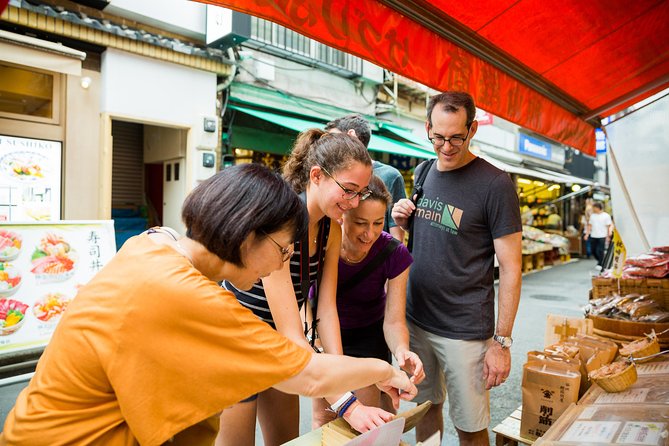
Because the group is capped at 20, it is easier to keep the flow. You can get closer to vendors when it is time to eat, and you are less likely to get lost in a long train of strangers.
Price and value: is $164 reasonable for this half day?
At $164 per person, this is not a cheap snack crawl. But it also is not just sightseeing with a couple of bites. For that price, you get:
- guided market navigation through outer Tsukiji
- multiple tastings and drinks, including items like sake and tea
- an Asakusa sweet stop plus time in major sights like Nakamise and Senso-ji
- a small-group format with a guided route designed for food access
Also, several admissions are listed as included or free depending on the stop. For example, admission is included for the Jogai Market tasting segment, and included again for the Asakusa portion. Other key landmarks you walk past are free, like Tsukiji Hongwanji and most temple and street areas.
So the value question comes down to your priorities:
- If you want a guide to help you eat your way through Tsukiji without guessing what is worth trying, this price can feel fair.
- If you mostly want to browse markets at your own pace and pick snacks later, a DIY plan might be cheaper.
Who this tour is best for (and who should skip it)
I think this works best for:
- food-first travelers who like structured tastings
- people who want a guided route in Tsukiji rather than wandering blind
- travelers combining seafood culture with classic Asakusa temple streets
I would think twice if:
- you hate walking for 5.5 hours or have trouble with moderate physical fitness demands
- you want a guaranteed, exact shopping list of food items, since menus can change
If you are traveling with kids, the tour is described as kid friendly in at least one guide experience, but the alcohol policy still applies. Also, for under-20 travelers, another drink is prepared.
Should you book this Tsukiji and Asakusa food walk?
I would book it if you want the simplest path to both worlds: outer Tsukiji food culture and Asakusa sweets plus temple-area atmosphere. The tour’s strongest advantage is that it guides you through the parts that are hardest to do well on your own, like figuring out what to try in the market and keeping the day moving.
Book sooner rather than later. It is noted that this tour is often booked about 46 days in advance on average. Since it is limited to a maximum of 20 people, earlier reservations tend to reduce stress.
Finally, go in with the right mindset: expect a guided sampler where items may shift, you will walk a lot, and your payoff is understanding how Tokyo’s food culture connects seafood markets to neighborhood traditions.
FAQ
Where do I meet the guide, and where does the tour end?
You meet at Tsukiji Hongan-ji Temple, 3-chome-15-1 Tsukiji, Chuo City, Tokyo 104-8435, Japan. The tour ends at 2-chome-18-9 Kaminarimon, Taito City, Tokyo 111-0034, Japan, at the Asakusa Information Center area for onward travel.
What time does the tour start, and about how long is it?
The tour starts at 8:15 am. The duration is listed as approximately 5 hours 30 minutes.
How large is the group?
The tour has a maximum of 20 travelers.
Is alcohol included, and what is the minimum drinking age?
Sake is part of the tasting program, and the minimum drinking age is 20. For under 20, the tour prepares another drink.
What happens if I arrive late?
If you are late, the tour cannot be extended. The information also notes there are no refunds for late arrivals on the day of the tour.
What admissions are included versus free?
Admission tickets are listed as free for some stops, including Tsukiji Hongwanji Temple and other sight stops. Admission is included for the Tsukiji Jogai Market tasting segment, and admission is also included for the Asakusa portion where sweets are tried.
Do the food and drink items ever change?
Yes. The menu items are listed as subject to change depending on availability and season.
What is the cancellation policy?
Free cancellation is available up to 24 hours in advance for a full refund. If you cancel less than 24 hours before the experience’s start time, the amount paid is not refunded.
Do I get a mobile ticket?
Yes. The tour notes a mobile ticket as a feature.
More Food & Drink in Tokyo
- Shinjuku Izakaya Food Tour
★ 5.0 · 1,041 reviews - Eat and Drink Like a Local: Tokyo Ueno Food Tour-Taverns&Ramen
★ 5.0 · 957 reviews - Tokyo: Shibuya Food Tour (13 dishes and 4 Eateries)
★ 5.0 · 770 reviews - Tokyo: Tsukiji Fish Market Food and Culture Walking Tour
★ 4.7 · 757 reviews
More Walking Tours in Tokyo
- Tokyo: Shinjuku Local Bar and Izakaya Guided Walking Tour
★ 4.9 · 1,794 reviews - Tokyo: Asakusa Walking Tour with Sensoji Temple Visit
★ 4.8 · 1,583 reviews - Tokyo Castle & Imperial PalaceーShogun Walking Tour
★ 4.7 · 1,068 reviews - Tokyo: Imperial Palace Japanese History Walking Tour
★ 4.9 · 987 reviews
Newly listed around Tokyo
- Private Tokyo Food Tour – A Journey Through Time Through Food★ 5.0 · 36 reviews
- Private Tokyo Tour with Licensed Guide & Vehicle (Max 15 persons)★ 5.0 · 107 reviews
- Private Tokyo Custom Full-Day Tour by Chartered Vehicle★ 5.0 · 16 reviews
- Private Tokyo Custom Half-Day Tour by Chartered Vehicle★ 4.5 · 13 reviews
- Private Outstanding Nikko Tour with English Speaking Driver★ 4.0 · 11 reviews
- Private Sightseeing to Mt Fuji and Hakone with English Driver★ 5.0 · 51 reviews
- Private Snow Monkeys park Day Trip From Tokyo or Nagano★ 4.5 · 26 reviews
- 4 Day Tour – Mount. Fuji, Tokyo, Hakone, Kamakura and Yokohama★ 5.0 · 19 reviews
Fish Market Walks, compared.
Tokyo Tsukiji Fish Market Food and Culture Walking Tour
Read our review →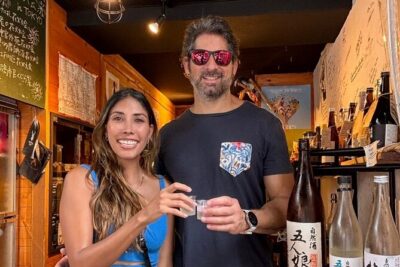
Nishiki Market Brunch Walking Tour (7 Tastings + Brunch)
Read our review →
Tokyo Sushi Making Class in Tsukiji with Professional Chef
Read our review →
Tsukiji Fish Market Guided Tour and Sushi Making with Pro Chef
Read our review →Tsukiji Fish Market Food and Culture Walking Tour
Read our review →Browse the lists this tour appears in