
Review · WALKING TOURS
Kyoto Fushimi-Inari Night Walking Tour
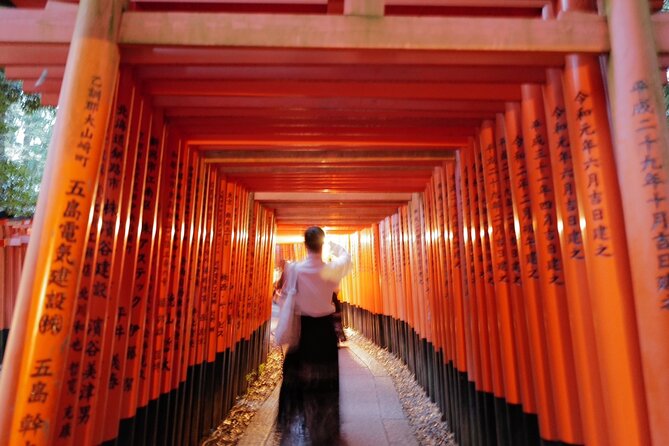
Red gates feel different after dark. This Kyoto Fushimi Inari night walk helps you see the famous torii corridors with more breathing room as evening settles in. You get a calm, guided route through the shrine grounds and up the mountain paths, with lights along the way.
I especially like two things: the small-group size (up to 12) and the way guides explain what you are actually looking at. From Inari, the god of rice and agriculture, to how fox statues and smaller shrine spots fit into Shinto practice, it turns a bucket-list place into something you understand.
One thing to consider, though, is that you are walking on mountain paths in proper night for part of the experience, so wear sturdy shoes and expect darkness on some stretches.
In This Review
- Key highlights to know before you go
- Why the torii gates feel calmer after dark
- Price, time, and group size: what $43.11 buys you
- Meeting at the fox statue: logistics that save time
- Fushimi Inari Taisha at night: what you’ll see up close
- How your guide turns the shrine into a story
- Timing tips: what dusk turns into after dark
- What to bring and how to plan the rest of your evening
- Who this tour is best for (and who might skip it)
- Should you book this Kyoto Fushimi-Inari night walking tour?
- FAQ
- How long is the Kyoto Fushimi-Inari Night Walking Tour?
- How big is the group?
- Where do I meet the guide?
- Is there an admission fee for the shrine?
- How do I get the ticket?
- Can I get a refund if my plans change?
Key highlights to know before you go
- Small-group experience (max 12): easier pacing, more questions, and a less chaotic feel.
- Night timing that reduces crowds: you get a quieter look at the torii gates compared with daytime surges.
- Guide-led meaning, not just directions: you learn why things are arranged the way they are at Fushimi Inari.
- Prayer and ritual context: you can learn how people pray at different sites and why the actions vary.
- Photo-friendly guidance: guides help with navigation and are patient while you stop for pictures.
- Free shrine admission included: you pay mainly for the guided walking time.
Why the torii gates feel calmer after dark
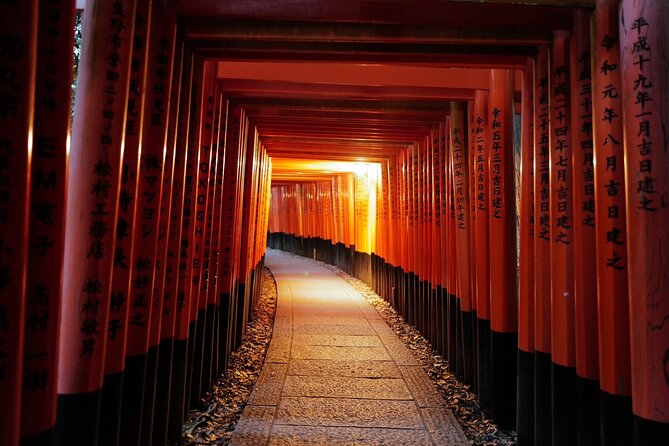
Fushimi Inari is one of those places that looks simple from afar: thousands of red torii gates, a steady climb, and lots of fox-themed symbolism. At night, that same scene hits differently. The lights on the paths and the shrinking crowds make the whole area feel quieter and more personal.
Daytime works if you want sheer spectacle. Night works if you want the shrine to feel like a shrine, not a photo line. You are still at a major Kyoto attraction, but the vibe shifts as evening moves the crowds along.
I also like that night walking helps you notice the details you usually miss. Smaller shrine areas, fox statues, and the rhythm of the torii tunnels make more sense when you are not being rushed forward by the crowd flow.
More Evening Tours in Kyoto
- Night Walk in Gion: Kyoto’s Geisha District
★ 4.5 · 2,003 reviews - Kyoto Night Foodie Tour in Gion (9+ dishes + 6 Sake tastings)
★ 5.0 · 1,762 reviews - Kyoto: Gion Magical Night Walking Tour with Geisha Insights
★ 4.9 · 1,286 reviews
Price, time, and group size: what $43.11 buys you
At $43.11 per person, the value is mostly about the guide time and the context. The good news is that the shrine admission is free, so your money is not paying an entrance fee. What you are really buying is a structured route, historical and cultural explanations, and help staying oriented in an easy-to-get-lost site.
The tour runs about 1.5 to 2 hours, so it is short enough to fit into a busy Kyoto schedule. You also end back at the meeting point, which keeps things simple if you plan dinner after.
Group size is capped at 12, and that matters more than it sounds. With smaller groups, you can ask questions without shouting, and you can pause for photos without holding up a massive crowd. Many guides also keep an easy pace that lets you take in the gates without feeling like you are on a race to the next photo spot.
Meeting at the fox statue: logistics that save time
You start at the fox statue at the entrance to Fushimi Inari Taisha Shrine, located in Kyoto, Fushimi Ward near Inari Station. The tour ends back at the meeting point, which removes a common anxiety when you are walking a maze of paths after dark.
You will use a mobile ticket, and confirmation is provided at booking time. That combination is practical for Kyoto, where you do not want to lose time searching for paper tickets.
This tour is also described as near public transportation, which is helpful if you are mixing neighborhoods or trying to time your night plans around other sights. If you are arriving by train, aim to give yourself a little buffer so you can find the exact fox statue meeting point without stress.
Fushimi Inari Taisha at night: what you’ll see up close
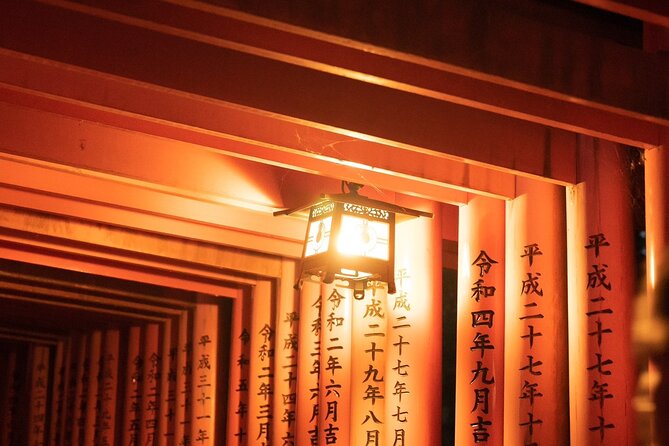
Your main focus is Fushimi Inari Taisha Shrine, the spiritual heart of Kyoto built around the Inari tradition. You will walk through the torii gate paths that lead up Mount Inari, surrounded by shrine buildings, nature, and countless fox-related details.
Here is what you can expect to notice as the route continues:
- Torii gates in long sequences: the corridors of red gates create a tunnel-like effect that feels more cinematic at night.
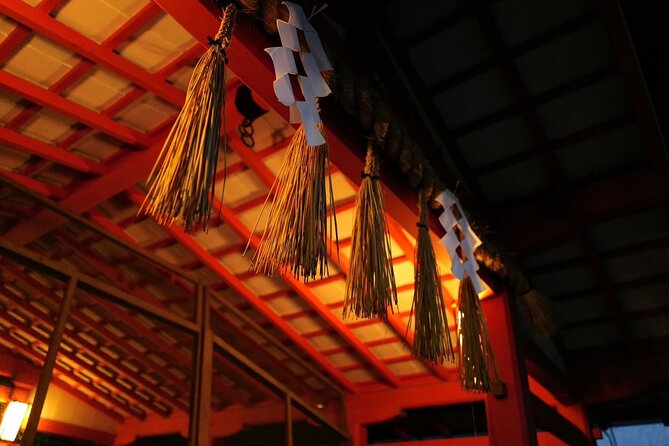
- Stone fox statues: these are a core visual theme, and your guide explains what they represent within Inari symbolism.
- Smaller shrine spots: you will pass areas dedicated to different aspects of worship, not just the main halls.
- Scenic viewpoints along the way: the walking route includes spots where you can pause and look around.
The shrine is dedicated to Inari, commonly associated with rice, agriculture, and business. People come to pray for success, health, and happiness, which your guide will connect to what you are seeing around you.
One of the smartest parts of a guided walk here is learning how to read the site. Fushimi Inari can feel like a maze, and at night that gets more intense. With a guide, you are not just following a path, you are learning the logic of where you are and why it matters.
More Walking Tours in Kyoto
- Kyoto Geisha Walking Tour: Gion District & Hidden Gems
★ 4.7 · 3,273 reviews - Kyoto: Gion Geisha District Walking Tour – Stories of Geisha
★ 4.7 · 2,187 reviews - Kyoto Gion Geisha District Walking Tour – The Stories of Geisha
★ 5.0 · 1,441 reviews - Nishiki Market Brunch Walking Tour (7 Tastings + Brunch)
★ 5.0 · 1,355 reviews
How your guide turns the shrine into a story
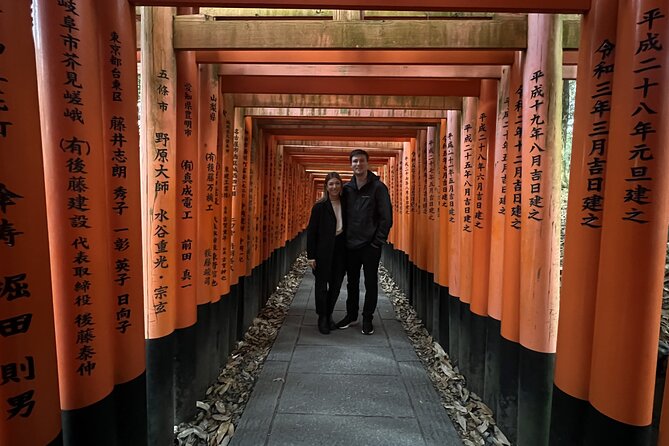
This tour’s biggest advantage is the human factor. The guides are repeatedly praised for combining friendly energy with clear explanations, and you can feel the difference between walking through a famous place and actually understanding it.
You may hear standout personal styles from guides like Jem, Tammy, Caleb, Masaki, Hiro, Navi, Yessi, and Vincent. The consistent theme is that they connect the physical setup of the shrine to Shinto meaning, including why certain items and spaces show up where they do.
A great example is prayer guidance. One of the strongest tips in the feedback is learning how people pray at different sites because rituals can vary. That is the difference between watching worship from the sidewalk and participating in a respectful, informed way.
Guides also help with pacing and navigation, especially when the site feels confusing at night. One guest specifically pointed out that a guide is worth it just to avoid getting turned around after dark.
Photos are another real benefit. Multiple people noted that guides are patient with photo stops and help with the timing and route so you do not spend the whole tour distracted and lost.
Timing tips: what dusk turns into after dark
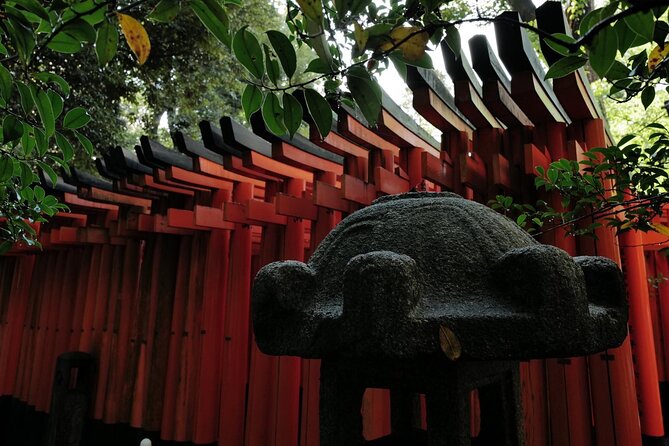
Even if your start time feels like late afternoon, the tour can include a stretch where you are walking in proper night. One traveler noted that much of their tour was actually night, with the mountain paths lit.
That shift matters because it changes your comfort level. You are still moving at a normal walking pace, but darkness reduces visibility, and the terrain is described as mountain paths. So treat this like a walking outing, not a quick stroll.
Weather can also shape the experience. There is at least one mention of rain, and the guide maintained the group experience even in less friendly conditions. If your date is cold, you might want layers, since one review specifically called out December walking comfort.
If you are traveling in hot months, night can be a relief. One guest mentioned August heat and said the night timing helped make the tour more enjoyable. Even when the weather is mild, late-day and night hours are often the sweet spot at a major shrine like this.
What to bring and how to plan the rest of your evening
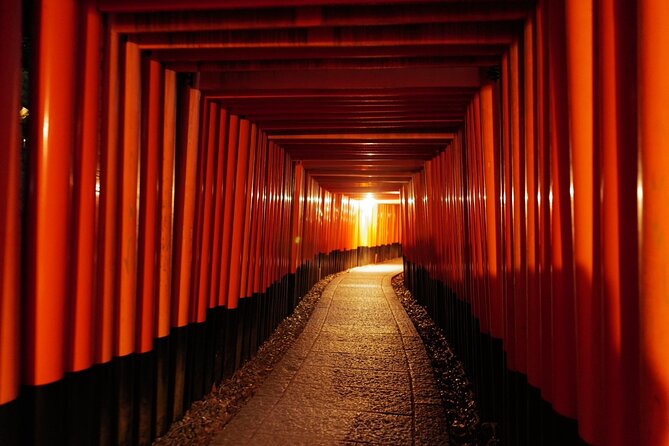
Start with the basics: comfortable, grippy walking shoes. This is not a museum shuffle. You are walking through torii corridors and up the mountain paths, and you will want your feet to feel supported.
For timing, plan to do something calm after. Since the tour is about 1.5 to 2 hours and ends near the start, it is easy to pivot to dinner nearby or continue exploring Kyoto without complicated transfers.
Also, take advantage of the guide’s practical side. At least one review mentioned dinner recommendations. Even if yours does not include restaurant suggestions, having someone who knows the area can help you decide what to see next based on where you are already located.
If you are visiting with kids, the tour can still work. One family-friendly note praised a guide who explained things in an easy way for children. Just remember it is still a nighttime walk through shrine grounds.
Who this tour is best for (and who might skip it)
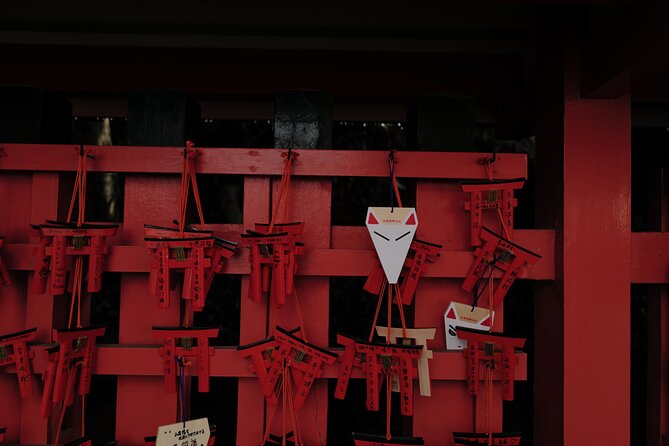
This night tour is best for you if:
- You want to see Fushimi Inari with fewer crowds and more calm than daytime.
- You care about context, like Shinto meaning, Inari symbolism, and how prayer works at different sites.
- You prefer a small-group pace and like asking questions.
- You want photos, but also want to understand what you are photographing.
You might consider skipping if you only want a quick overview and you are comfortable navigating on your own after dark. Also skip if you dislike any walking in darkness, since the tour can include stretches where the day is fully gone.
If you are pairing Kyoto highlights, this is an easy add-on because it is short and starts at a well-known shrine entrance. It also fits nicely into a plan that starts earlier in the day and uses the night hours for the quieter version of the same icon.
Should you book this Kyoto Fushimi-Inari night walking tour?
Book it if you want Fushimi Inari to feel like a meaningful experience, not just a sightseeing checklist. The standout value is the combination of small-group pacing, free shrine admission, and guides who explain what you are seeing, including prayer behavior and symbolic details like fox statues.
If you are on the fence, here is my practical test: if you would feel frustrated getting turned around at night, or if you want someone to point out what to look for, this tour makes that problem disappear. For the price, you are paying for guidance, interpretation, and a calmer way to experience one of Kyoto’s most famous places.
FAQ
How long is the Kyoto Fushimi-Inari Night Walking Tour?
The tour is about 1 hour 30 minutes to 2 hours.
How big is the group?
The group size is capped at a maximum of 12 travelers.
Where do I meet the guide?
You meet at the fox statue at the entrance to Fushimi Inari Taisha Shrine, in Kyoto near Inari Station. The tour ends back at the meeting point.
Is there an admission fee for the shrine?
The admission ticket is listed as free.
How do I get the ticket?
You receive a mobile ticket. Confirmation is received at the time of booking.
Can I get a refund if my plans change?
Free cancellation is available. You can cancel up to 24 hours in advance for a full refund.
More Evening Experiences in Kyoto
- Kyoto Gion Night Walk & Geisha District Guided Tour
★ 5.0 · 786 reviews - Kyoto Ghost Tour: Dark Tales, Urban Legends, Bamboo Forest Night
★ 5.0 · 625 reviews - Kyoto Bar Hopping Night Tour
★ 5.0 · 613 reviews - Kyoto Night All-Inclusive Eats and Streets, Gion and Beyond
★ 4.7 · 601 reviews
Newly listed around Kyoto
- Taste of Nishiki Market Walking Food Tour with Local guide★ 5.0 · 17 reviews
- Kyoto: Sushi Making Class with Sushi Chef★ 4.8 · 64 reviews
- Simple Plan with Maiko★ 4.4 · 10 reviews
- Shibori Furoshiki Course at Kyoto Shibori Museum★ 5.0 · 21 reviews
- Kyoto: City Secrets eBike Tour★ 4.9 · 196 reviews
- Sacred Pathways: Discover the Philosopher’s Path of Kyoto★ 4.9 · 20 reviews
- Private Tour to Monkey Park and Arashiyama Highlights★ 5.0 · 22 reviews
- Private Sake Tasting in Central Kyoto — 1 Group Only★ 5.0 · 11 reviews
Walking Tours, compared.

Kyoto Geisha Walking Tour: Gion District & Hidden Gems
Read our review →
Tokyo Tsukiji Fish Market Food and Culture Walking Tour
Read our review →
Gion Geisha District Walking Tour – Stories of Geisha
Read our review →

Shinjuku Local Bar and Izakaya Guided Walking Tour
Read our review →

Asakusa Walking Tour with Sensoji Temple Visit
Read our review →
Kyoto Gion Geisha District Walking Tour – The Stories of Geisha
Read our review →Browse the lists this tour appears in