
Review · LICENSED GUIDES & PRIVATE DRIVERS
Nagasaki Half-Day Private Tour with Government-Licensed Guide
Nagasaki hits differently when you have a local voice. This half-day private tour is built for exactly that: a licensed English-speaking guide meets you in the morning, you pick 2 to 3 stops, and you move at a comfortable pace without getting stuck in a giant bus crowd.
What I like most is the way the tour stays personal and practical. You avoid a fixed script, and you can build a morning around what you care about, from memorial sites to street-level neighborhoods.
One consideration: it’s a walking and public transport format, and entrance fees are not included for most stops, so your final cost depends on what you choose.
In This Review
- Key reasons this half-day tour works
- How the 4-hour private format plays out
- Picking your 2 or 3 stops: build the morning you actually want
- Nagasaki Peace Park: a calm start that sets the tone
- Inasayama Observation Deck: get the big-picture views fast
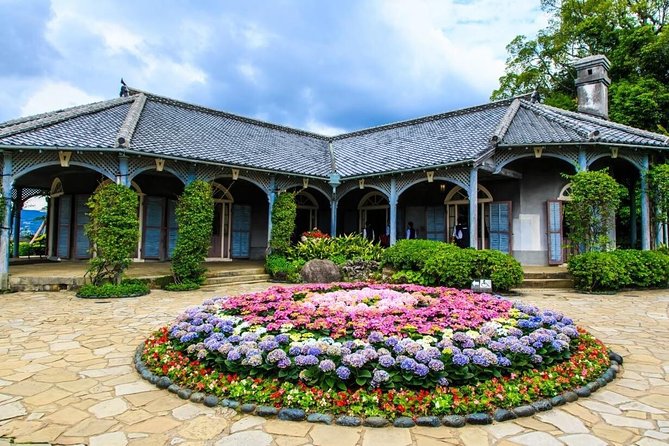
- Glover Garden: the hill that tells the port story
- Sofukuji and Kofukuji: Chinese-founded temples in real walking distance
- Dejima: the port’s controlled contact zone
- Christian Nagasaki: Urakami, Oura, and the martyr story
- Bridges and streets: Dutch Slope and Meganebashi for a lighter reset
- The Atomic Bomb Museum: when you want the story to be specific
- Logistics that matter: walking comfort and how transport shows up
- Price and value check: what $122.20 buys you
- The guide factor: why quality can feel personal
- Who this tour fits best, and who should consider another option
- Should you book this Nagasaki half-day private tour?
- FAQ
- FAQ
- How long is the Nagasaki half-day private tour?
- Can I choose which sites to visit?
- Do you provide hotel pickup?
- Are entrance fees included?
- Is this tour private or shared with other groups?
- What’s included in the tour price?
Key reasons this half-day tour works
- Private, customizable pacing: you choose 2 to 3 stops, not a rigid route.
- Government-licensed English speaking guide: guides like Hiromi, Yoshi, Hiro, Koko, Yuko, and Noriko (Norah) have delivered strong, personal storytelling.
- Memorial plus city views: Peace Park and the Atomic Bomb Museum pair well with lookout time.
- Street-level Nagasaki feel: bridges, slopes, and temple town streets make the city feel lived-in.
- Weather flexibility: some guides have arranged easier taxi options or offered practical help when it rained.
- No need to read a guidebook: you get context while you walk, then the rest of the day is yours.
How the 4-hour private format plays out
This is the kind of tour that’s small enough to feel human and focused enough to be worth your time. In about 4 hours, you meet your guide in the Nagasaki area (pickup is offered, but it’s on foot within a designated zone, not a chauffeured private vehicle), then you head out on foot and by public transport as needed.
The big win is control. You’re not locked into a predetermined loop. Instead, you pick 2 to 3 sites from the set of options, and your guide shapes the timing around them. That means you can do a “heavy” morning (Peace Park plus the Atomic Bomb Museum) or a “many layers” morning (Western, Chinese, and Christian Nagasaki) depending on your mood.
Also, it’s truly private. Only your group participates, so questions never feel awkward and you do not have to wait for someone else’s bathroom stop to move the whole pack.
More Private Guides in Nagasaki:
- Nagasaki Full-Day Private Tour with Government-Licensed Guide
★ 5.0 · 66 reviews - Tokyo 6hr Private Tour with Government-Licensed Guide
★ 5.0 · 3,902 reviews - Kyoto Early Morning Tour with English-Speaking Guide
★ 5.0 · 1,427 reviews
Picking your 2 or 3 stops: build the morning you actually want
Think of the stop list as three themes you can mix and match.
1) Memorial Nagasaki
- Nagasaki Peace Park
- Nagasaki Atomic Bomb Museum
2) Lookouts and Western-era Nagasaki
- Inasayama Observation Deck (Mount Inasa)
- Glover Garden
3) Port history and religion across communities
- Dejima
- Urakami Cathedral
- Oura Church
- Sofukuji Temple, Kofukuji Temple, and other Chinese-founded temples
- Confucian Temple (Confucius Shrine)
- Twenty-Six Christian Martyrs Monument
- Nagasaki’s temple district options (Teramachi)
- Gokoku Shrine
If you’re short on time in Nagasaki, your best strategy is to choose sites that are close in theme and emotion. For example, pairing Peace Park with the museum gives you a coherent story, then you still have time to enjoy bridges and neighborhoods afterward.
Nagasaki Peace Park: a calm start that sets the tone
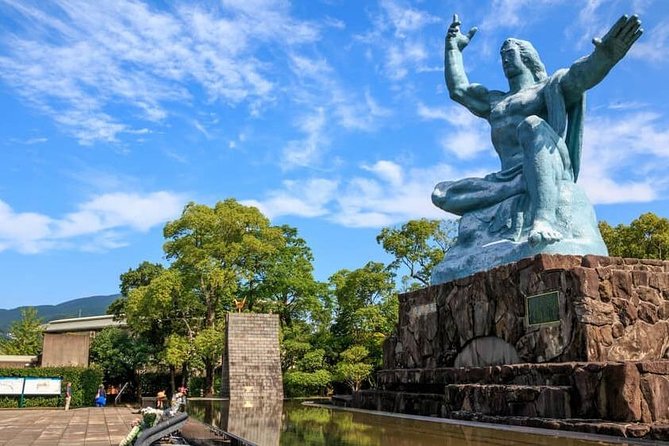
Your morning can begin at Nagasaki Peace Park, which is free to enter and focuses on the city’s experience of the atomic bombing on August 9, 1945. Even if you’ve read about it, being there changes the pacing of your thoughts. The atmosphere is quiet, and it’s the sort of place where the guide’s framing matters as much as the facts.
In practice, Peace Park works because it gives you context before you start hopping between cultural districts. It’s also a good “reset” if you arrive in Nagasaki feeling rushed from earlier travel.
A practical note: you might want to keep this stop earlier in the tour. If you plan to include churches or temples afterward, the emotional tone stays clearer when you’ve got the memorial story up front.
Inasayama Observation Deck: get the big-picture views fast
From there, many people add the Inasayama Observation Deck on Mount Inasa. The best part is the time investment. It’s short (about 15 minutes) and it’s free, yet it helps you understand why Nagasaki is built the way it is, with water and hills folding together so tightly.
If you’re visiting in good weather, this is your chance to see the city’s geography in one glance. Your guide can also help translate what you’re seeing, like which areas feel “port” versus “hillside,” and how that ties into the city’s international connections.
If the weather is cloudy, you’re not necessarily wasting time. The view may be limited, but the deck still gives you a sense of scale, and that makes the later walking around streets and bridges feel more connected.
A few more Nagasaki days to weigh up
- Nagasaki: Private Walking Tour with a Local
★ 4.7 · 79 reviews - Visit Gunkanjima Island (Battleship Island) in Nagasaki
★ 4.0 · 32 reviews - Nagasaki: Private Tour with Local Guide
★ 4.8 · 18 reviews
Glover Garden: the hill that tells the port story
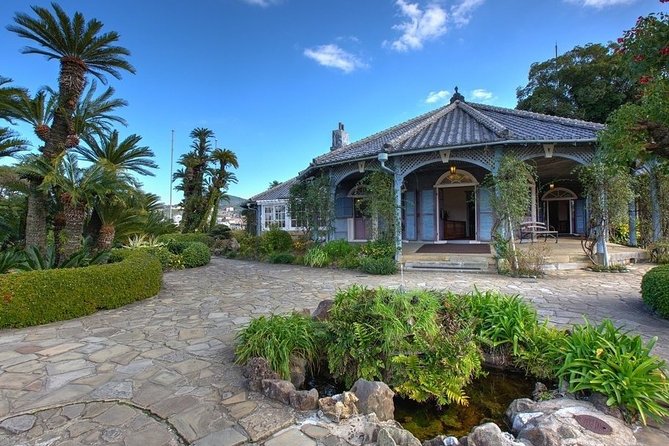
Next up, Glover Garden is a classic choice when you want Nagasaki’s foreign resident history without doing a full-day deep dive. It’s an open-air museum of mansions and related structures, and the location on a hill gives you views even before you start reading plaques.
The key thing I appreciate here is how it balances the story. Nagasaki isn’t only memorial sites. It was also an international trading port with Western influence showing up in architecture and street life. Glover Garden is a compact way to see that contrast.
Downside: the entrance is not included, so if you’re cost-conscious, treat this as an optional “pay to see” highlight. It’s still worth it if you like visual history, because the buildings help you imagine what life in that era looked like.
Sofukuji and Kofukuji: Chinese-founded temples in real walking distance
If your tour includes Sofukuji Temple and/or Kofukuji Temple, you’ll get a different angle on Nagasaki’s identity. These are connected to Zen Buddhism and to Chinese-founded temple traditions in the city, and they bring you into Nagasaki’s “Temple Town” atmosphere.
What makes these stops feel valuable is the sense of continuity. You’re not only seeing religion as an exhibit. You’re walking through spaces that have their own long rhythms. The guide’s interpretation makes it easier to understand why these sites matter in a port city where different cultures intersected.
The entrance fees are not included for these temples, so again, your final out-of-pocket cost depends on what you add. If you’re traveling with limited time, I’d prioritize one major temple stop over trying to do too many paid ones.
Dejima: the port’s controlled contact zone
Dejima is one of those places that explains why Nagasaki became internationally important while also showing how controlled that connection was. It was constructed in 1636 to segregate Portuguese residents from Japanese residents and regulate missionary activity.
Even though this stop is relatively short, it can stick in your mind because it’s a “system in a place” kind of story. You start to grasp that cultural exchange often came with borders and rules, not just friendship.
Entrance is not included, so for value, consider whether this theme fits your interests. If you want the port history layer, it’s a strong pick.
Christian Nagasaki: Urakami, Oura, and the martyr story
For many people, the Christian sites are the heart of their Nagasaki morning. The tour options can include:
- Urakami Cathedral, a working Catholic church in a red brick European-style building
- Oura Church, built in 1864 by a French missionary for foreign merchants
- The Twenty-Six Christian Martyrs Monument and adjacent museum, tied to executions in 1597
If you’ve only heard Christianity in Japan discussed in general terms, this part of Nagasaki gives it a sharper local shape. You’re seeing how faith spread, how it was practiced in the city, and how it intersected with international communities.
These stops often come with heavier emotion. Your guide can help you read what you’re seeing without turning it into a lecture. One thing I really like about this tour style is that you can adjust the depth based on your comfort level.
Entrance fees are not included for these sites, so if you want to manage costs, choose which single Christian stop feels most meaningful to you, then pair it with a complementary theme like Dejima or a nearby memorial site.
Bridges and streets: Dutch Slope and Meganebashi for a lighter reset
Not every stop needs to be serious. Two favorites from the list are:
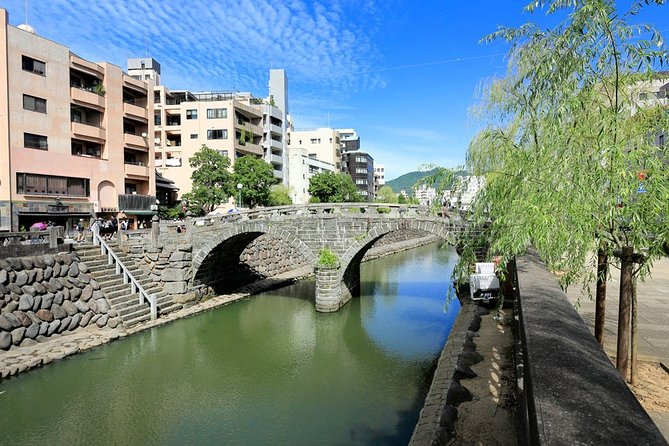
- Dutch Slope (Oranda-zaka), a stone-paved street tied to foreign traders after the port opened in 1859
- Spectacles Bridge (Meganebashi), a stone bridge over the Nakashima River with a name inspired by its shape
These free stops do something important in the flow of a half-day tour. After temples, churches, and memorial framing, you get street life again. You can look around. You can take photos. You can actually feel like you’re walking through Nagasaki, not just collecting stops.
Even if you skip paid attractions, these free streets give you a strong “memory layer” of the city.
The Atomic Bomb Museum: when you want the story to be specific
If your itinerary includes Nagasaki Atomic Bomb Museum, you’re going to the place where the city’s recovery and the bombing’s devastation are documented. It’s near the hypocenter area, and the tone here is usually solemn.
From my perspective, the museum is most powerful when it’s paired thoughtfully with Peace Park earlier. Peace Park sets the moral and emotional frame. Then the museum gives you detail and specificity, which can help the whole story click into place.
Entrance is not included, so this is where you should assume extra expense. Still, if memorial topics matter to you, it’s the kind of museum that’s hard to replace with anything else in a short visit.
Logistics that matter: walking comfort and how transport shows up
This tour is built for walking. The listing specifically recommends comfy shoes because you will be on streets. It’s not an all-vehicle experience, and that’s a feature, not a bug. You see more by moving slowly and reading the neighborhoods instead of passing them from behind glass.
Public transport is part of the approach. In at least one guide-led day, the route used tram travel to reach Peace Park areas before continuing on foot. You should plan to use trains or trams where they make sense, especially between districts.
If rain shows up, don’t panic. In my experience, the quality of a walking tour often comes down to flexibility. Some guides have offered taxi options when weather turned, even helping plan what might cost extra. That kind of on-the-ground problem solving is exactly what keeps this tour from feeling stressful.
Price and value check: what $122.20 buys you
At $122.20 per person for about 4 hours, this is not a budget bus excursion. You’re paying for three things:
1) a licensed English-speaking guide
2) a private format that lets you choose 2 to 3 stops
3) a morning structure that saves you research time
If you only want to see one thing, the price can feel steep, because your guided value comes from turning multiple stops into one coherent story. But if you’re deciding between a self-guided morning and paying for interpretation, I think this is good value when:
- you care about memorial context and want a local voice
- you want to understand why Nagasaki has multiple cultural layers close together
- you have limited time in the city and want to maximize a half-day
Also, since entrance fees and transportation aren’t included, your actual total depends on your selections. Paid sites like Glover Garden and the Atomic Bomb Museum are where your budget can rise quickly. For best value, choose a mix of paid and free stops so you don’t feel like every step is a new bill.
The guide factor: why quality can feel personal
This tour’s success often comes down to who’s holding the conversation. In the high-rating feedback, guides like Yoshi and Hiro are praised for clear storytelling, personal ties to Nagasaki, and making the schedule fit real needs. Others, like Hiromi, are specifically noted for pre-planning and adjusting when rain hit.
There’s one caution worth mentioning from lower feedback: English clarity and audibility can vary. One guest noted a guide with very broken English and visuals that looked worn. Even with that outlier, the overall rating is extremely high, and most guides appear to communicate well and adapt smoothly.
My advice is simple: pick your must-see theme, message your preferences early, and be ready to ask follow-up questions on the spot. A private guide can’t read your mind, but they can respond fast when you’re direct.
Who this tour fits best, and who should consider another option
This is a great fit if you:
- want a customizable morning in a city that has emotional weight
- prefer smaller scale, private pacing over crowds
- like mixing memorial sites with culture and street scenes
- need help connecting the dots between foreign trading history, Chinese communities, and Christian sites
This may not be ideal if you:
- want a vehicle-based tour with minimal walking, because it’s designed as walking plus public transport
- are trying to keep all costs tightly controlled, since most major attractions have entrance fees not included
- need a very fast, checklist-style tour, because time is spent on context, not just “photo at the gate”
Should you book this Nagasaki half-day private tour?
Yes, if you want a morning that feels like Nagasaki, not just a list of sights. The private format, the ability to choose 2 to 3 stops, and the chance to get local context while walking make it a strong way to kick off a day in town.
Book it especially if you’re interested in any mix of memorial sites, Christianity across communities, and port-era history. If you’re unsure what to choose, I’d prioritize one emotional anchor (Peace Park and possibly the Atomic Bomb Museum) plus one “city-feel” stop like Meganebashi or Dutch Slope so the whole half-day balances head and heart.
FAQ
FAQ
How long is the Nagasaki half-day private tour?
It’s about 4 hours.
Can I choose which sites to visit?
Yes. You can customize your tour by selecting 2 to 3 sites from the listed options.
Do you provide hotel pickup?
Pickup is offered, but it’s a walking and public transport tour, with meeting up on foot within a designated area in Nagasaki rather than a private vehicle pickup.
Are entrance fees included?
No. Entrance fees are not included, except the tour notes that tickets for certain stops like Nagasaki Peace Park and the Inasayama Observation Deck are free.
Is this tour private or shared with other groups?
It’s private. Only your group participates.
What’s included in the tour price?
You get a licensed local English speaking guide, a customizable tour of your chosen 2 to 3 stops, and you receive a mobile ticket. Transportation and entrance fees are not included.
Newly listed around Nagasaki
- Nagasaki: Explore Japanese Teas on a Tea Tour★ 5.0 · 7 reviews
- Nagasaki like a local: Private Guided Walking Tour★ 4.4 · 12 reviews
- Nagasaki: Private Tour with Local Guide★ 4.8 · 18 reviews
- Nagasaki: Private Walking Tour with a Local★ 4.7 · 79 reviews
- Nagasaki Full-Day Private Tour with Government-Licensed Guide★ 5.0 · 66 reviews
- Visit Gunkanjima Island (Battleship Island) in Nagasaki★ 4.0 · 32 reviews
Licensed Guides & Private Drivers, compared.
Tokyo 6hr Private Tour with Government-Licensed Guide
Read our review →
Kyoto Early Morning Tour with English-Speaking Guide
Read our review →
Tokyo 4hr Private Tour with Government-Licensed Guide
Read our review →
Kyoto 6hr Private Tour with Government-Licensed Guide
Read our review →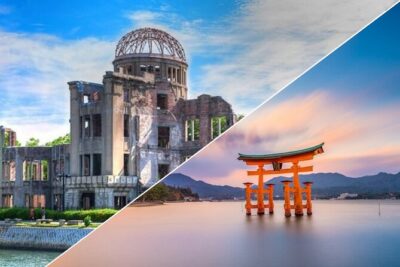
Hiroshima / Miyajima Full-day Private Tour with Government Licensed Guide
Read our review →Early Morning Tour with English-Speaking Guide
Read our review →
Tokyo Private Sightseeing Tour by Car- English speaking chauffeur
Read our review →
Mt Fuji Private Tour with English Speaking Driver
Read our review →Browse the lists this tour appears in