
Review · CITY TOURS
Guided Kyoto City Cherry Blossom One Day Private Tour
Six Kyoto classics in one day, handled.
This private Kyoto one-day tour strings together the big names you came for, with a guide who explains what you are seeing and how it fits together, plus an air-conditioned ride that saves you from transit math. The cherry blossom angle matters too, because spring is when these iconic neighborhoods start feeling extra special, even if the flowers are not the only star.
What I like most is the personal attention you get on a private route, so you can actually ask about temples, gates, and garden legends without shouting over a bus crowd. I also like the practical setup: pickup and hotel-friendly logistics, plus a hotspot on board so you can check routes, translate signs, and plan your next bite at Nishiki Market.
One consideration: this is a packed day, with six major stops and about 1 hour at each. You will move fast, and you should also budget for extra spending since lunch is not included and admission tickets are not included for the sights listed.
In This Review
- Key highlights that make this Kyoto tour work
- Why a one-day private Kyoto route feels less stressful
- Price, timing, and what you really get for $569
- Starting at Kyoto Station: how the day stays organized
- Stop 1: Arashiyama Bamboo Grove, what to notice in your first hour
- Stop 2: Kinkaku-ji Golden Pavilion, seeing the story behind the gold leaf
- Stop 3: Kiyomizu-dera, Pure Water Temple and the wooden stage effect
- Stop 4: Fushimi Inari Taisha, how to enjoy the torii walk in limited time
- Stop 5: Gion, traditional Kyoto streets and geisha-era atmosphere
- Stop 6: Nishiki Market, Kyoto’s kitchen for snacks and giftable finds
- Who this tour suits best, and who should skip the private pace
- Should you book this Kyoto cherry blossom one-day private tour?
- FAQ
- What time does the tour start?
- Where is the meeting point?
- How long is the Kyoto one-day private tour?
- What is included in the tour price?
- Are lunch and admission tickets included?
- Is the tour private, and is free cancellation available?
Key highlights that make this Kyoto tour work
- Private, just your group focus means quicker decisions and less waiting around
- Hotel and pickup on request plus a clear start point near Kyoto Station
- Arashiyama Bamboo Grove gives you that instant Kyoto wow factor
- Golden Pavilion plus Kiyomizu-dera delivers the two styles of temple beauty most first-timers miss
- Fushimi Inari Taisha is the world-famous torii gate walk, timed for a one-day schedule
- Gion + Nishiki Market balances culture viewing with practical food shopping
Why a one-day private Kyoto route feels less stressful
Kyoto can feel like a choose-your-own-adventure book written in kanji. You line up one temple, then realize you still need another district, then you check bus routes, then you lose the day to transfers. This type of private planning is built to prevent that spiral.
With an 8-hour schedule and a set sequence of stops, you get momentum from the start. You are not wondering where to go next or how to get there. You are spending your time watching the details, hearing the context, and taking the photos you actually came for.
Also, you get the comfort of an air-conditioned vehicle in a city that can swing from bright to humid fast. That matters when you are doing multiple legs on foot.
A few more Kyoto days to weigh up
- PERFECT KYOTO 1-Day Bus Tour
★ 5.0 · 13,518 reviews - Kyoto: Fushimi Inari, Kinkakuji, Bamboo Grove 1 Day Bus Tour
★ 4.8 · 4,316 reviews - Kyoto: Tea Ceremony in a Traditional Tea House in Kiyomizu
★ 4.9 · 3,519 reviews
Price, timing, and what you really get for $569
At $569, this is not a budget tour. But it is also not just a ride to six places. You are paying for private transportation, guide time, and a tight route that tries to minimize wasted hours.
Here is how that translates into value for you:
- You reduce time lost to transit and logistics, which is usually the hidden cost in Kyoto.
- You get dedicated attention, not a “herd and hurry” style of pacing.
- You have a vehicle with tolls included and a hotspot on board, so you can stay connected while you travel.
The trade-off is that you are still paying for Kyoto in the ways that every one-day plan runs into. Lunch is not included, and admission tickets are not included for the listed stops. The upside is you get to decide what you want to eat rather than being forced into one preselected meal.
If you like structure, want maximum sights without guessing, and value convenience, the price starts to make sense. If you love wandering with no agenda, you might prefer a self-guided day and spend less.
Starting at Kyoto Station: how the day stays organized
The tour starts at 8:00 am at Kyoto Station, near Higashishiokoji Kamadonocho in Shimogyo Ward. It ends back at the meeting point. In plain terms, you get a simple “morning out, evening back” loop, which helps if you are coordinating other parts of your trip.
Pickup is offered on request, so you might be able to start closer to where you are staying. Either way, having Kyoto Station as the anchor is helpful, because it is one of the easiest bases to reach from different hotels.
One small but genuinely useful inclusion is the hotspot on board. That sounds minor until you need it to look up station exits, translate a menu, or check the best time to move between areas. It saves battery life too, which matters when you are using your phone camera for torii gates and temple details.
Stop 1: Arashiyama Bamboo Grove, what to notice in your first hour
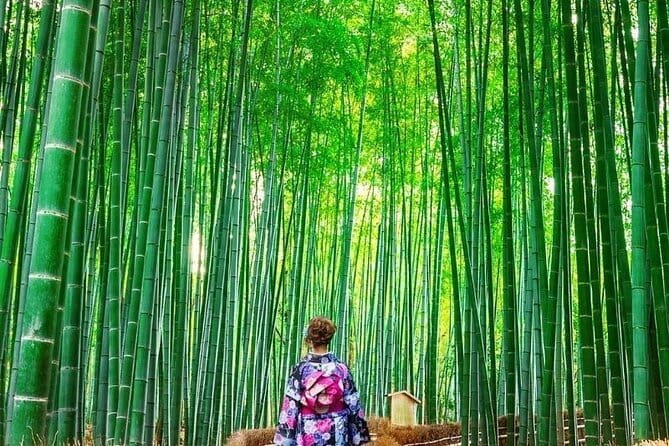
Your morning begins in Arashiyama Bamboo Grove, also called the Kyoto bamboo forest. This is the Arashiyama district on Kyoto’s outskirts, and it has been a visitor draw since the Heian Period (794 to 1185). The concept is simple: towering bamboo stalks create a corridor of sound and shade, and when the wind moves through, the whole grove looks like it is breathing.
You are there for about 1 hour, which is enough time to do the main paths, take photos, and still keep your energy for the temples later. Admission is not included, so plan on possible extra costs at the gate.
What I would focus on here:
- The light shifts under the stalks, so aim for a few angles rather than snapping one shot and moving on.
- Listen for the wind. It is part of why this spot feels calming, not just scenic.
- Stay mindful of flow. This place draws people from everywhere, and your 1-hour window works best if you do not linger in bottlenecks.
Possible drawback for this stop: if spring crowds are heavy, your photos may include people in the background. The practical fix is to move slowly to the less crowded side paths when you can, and shoot more from the edges.
A different sort of day in Japan:
- Kyoto Geisha Walking Tour: Gion District & Hidden Gems
★ 4.7 · 3,273 reviews - Kyoto: Tea Ceremony Ju-An at Jotokuji Temple
★ 4.9 · 3,207 reviews - Kyoto: 45-Minute Tea Ceremony Lesson Experience
★ 4.3 · 2,378 reviews - Kyoto: Gion Geisha District Walking Tour – Stories of Geisha
★ 4.7 · 2,187 reviews
Stop 2: Kinkaku-ji Golden Pavilion, seeing the story behind the gold leaf
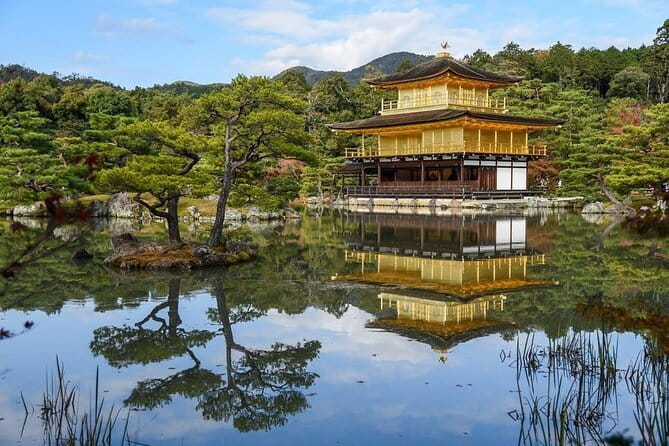
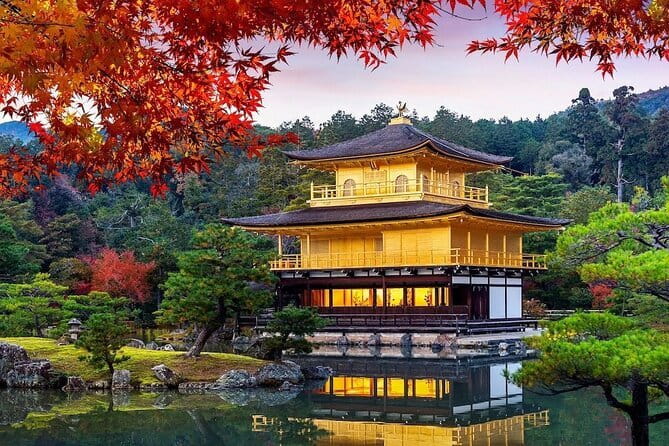
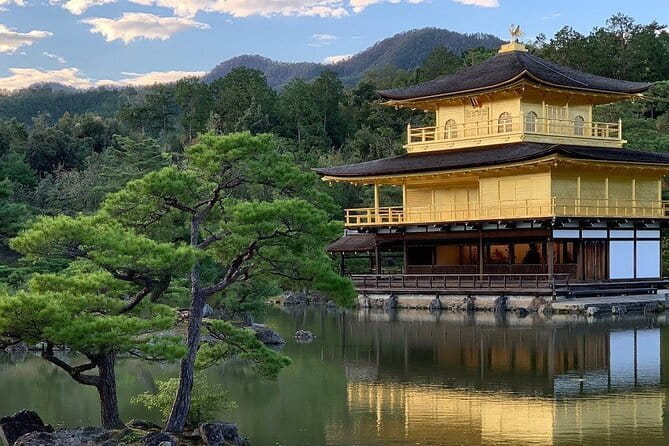
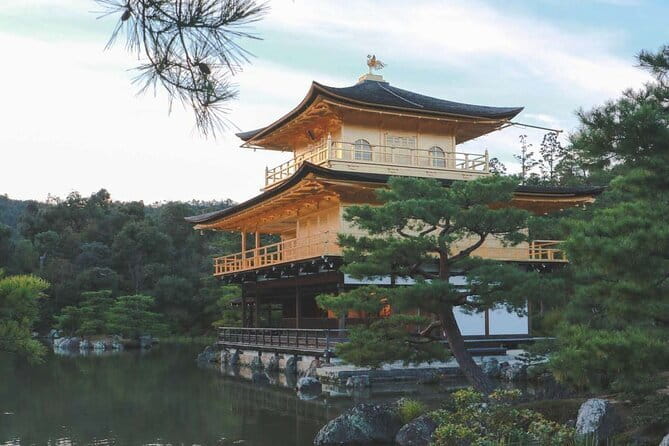
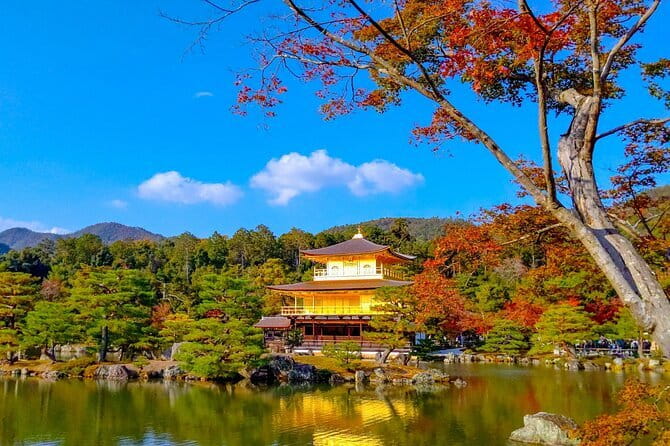
Next up is Kinkakuji Temple, officially known as Rokuon-ji, the Golden Pavilion. This is the Zen Buddhist temple famous for its top two floors covered in gold leaf. Even if you have seen photos, the real thing has a different effect because it reflects the sky and surrounding landscape in ways images cannot fully catch.
A few context points that make the visit click:
- The temple was built in 1397 as a retirement villa for shogun Ashikaga Yoshimitsu.
- After his death, it was converted into a Zen temple.
- It has burned down several times. The current structure dates to 1955, rebuilt after a fire in 1950.
You get about 1 hour here. Admission tickets for this stop are not included, so again, expect an extra charge at some point during your visit.
If you want to make your hour count, do this:
- Walk a little and change your viewpoint before you commit to the “money shot.”
- Look at the gold leaf contrast against darker roofs and the way it stands out in shade.
- Pay attention to how the temple’s design looks from different angles, because it is meant to be seen from multiple distances.
The only “gotcha” with Kinkaku-ji is time. If you linger too long photographing one corner, you can end up sprinting later. This tour’s strength is that it keeps you moving, so use your hour intentionally.
Stop 3: Kiyomizu-dera, Pure Water Temple and the wooden stage effect
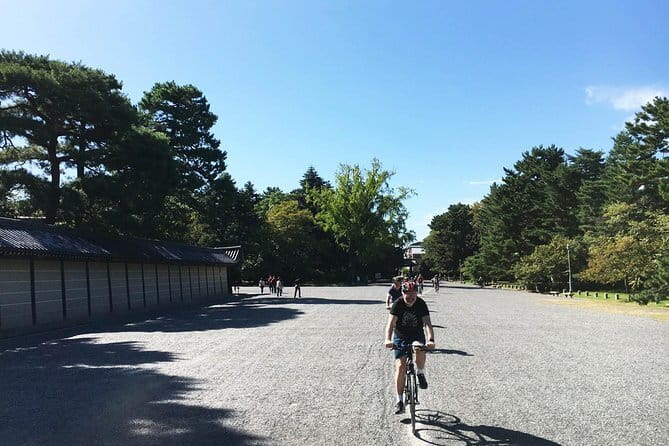
Then you head to Kiyomizu-dera Temple, one of Kyoto’s most iconic Buddhist sites. It is known for its wooden stage and the feeling of stepping into a place that has held ceremonies for centuries.
A few details that help you understand what you are looking at:
- Kiyomizu-dera was founded in 778, making it one of the oldest temples in Kyoto.
- It was associated with the Hosso sect until it became independent in 1965.
- The name Kiyomizu-dera means Pure Water Temple, taken from the Otowa Waterfall that runs through the temple grounds.
You have about 1 hour. Admission tickets are not included.
What makes this stop special in a practical way is how it works for different travel styles. If you love architecture, the stage is the main event. If you love atmosphere, the waterfall area and temple grounds add texture beyond the main viewing points.
Possible drawback: you will likely be on your feet for a lot of the hour, and the areas around the stage can be crowded during peak times. If you prefer quieter moments, plan to arrive ready to move a bit off the main flow within your hour.
Stop 4: Fushimi Inari Taisha, how to enjoy the torii walk in limited time
Your next highlight is Fushimi Inari Taisha Shrine, one of Japan’s most significant Shinto shrines. It is dedicated to Inari, the Shinto god of rice, fertility, and agriculture. The headline feature is the thousands of red torii gates that create tunnels along the paths leading up Mount Inari.
You get about 1 hour here, and admission tickets are not included.
A couple of useful context points:
- The torii gates are called Senbon Torii, and they have been donated by individuals and businesses for blessings.
- The shrine is famous for the feeling of moving through repeating gate frames, which changes how the climb feels.
Here is the practical way to do this with limited time:
- Expect to do the main route segment, not the entire climb. With an hour, your goal is the signature torii corridor experience and the viewpoints you can reach without rushing.
- Wear shoes you can walk in comfortably. The steps and uneven paths can add up.
- Keep an eye on your turning points. When people run out of time, it is usually because they are unsure where to start heading back.
The only real consideration is that this is one of Kyoto’s most photographed spots, so it can get busy. Your strategy is simple: move with purpose, take a few solid shots, and then focus on the walk itself.
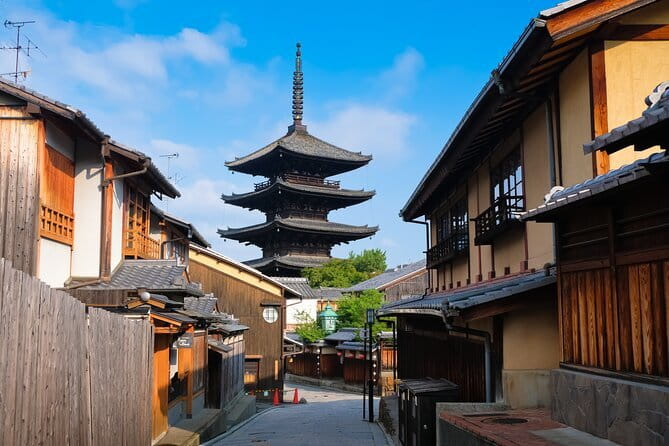
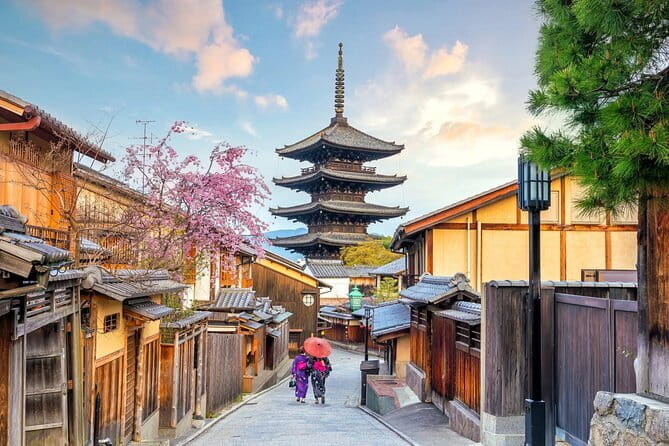
Stop 5: Gion, traditional Kyoto streets and geisha-era atmosphere
After the shrine, you transition to Gion, one of Kyoto’s best-known historic districts. Gion is known for traditional machiya townhouses, teahouses, and its association with geisha culture. Even when you are not trying to spot performers, the district feels like a different pace of Kyoto, with architecture and street scale that slow you down.
You get about 1 hour in Gion. Admission tickets are not included.
What to do with your time:
- Walk slowly enough to notice the old townhouse shapes and the street layout.
- Treat it like a neighborhood, not a theme park. That means moving respectfully and not blocking doorways or small side lanes.
- Use your photos for details, not just wide shots. That is where Gion feels most real.
Possible drawback: this area is also popular, so it can be harder to find wide open streets for photos. If you are chasing clear compositions, aim for smaller gaps in traffic and choose times within your hour when foot traffic momentarily thins.
Stop 6: Nishiki Market, Kyoto’s kitchen for snacks and giftable finds
To close the day, you visit Nishiki Market Shopping District, often called Kyoto’s Kitchen. This narrow, five-block long shopping street has over 100 shops and restaurants and has been a center for food and commerce for centuries.
You get about 1 hour, which is just right for sampling and buying a few edible souvenirs. Admission tickets are not included.
Since lunch is not included, Nishiki can be your answer for a late afternoon meal or a snack-based dinner. The street layout makes it easy to compare options without walking far, and you can usually find small portions that help you try multiple things instead of committing to one big dish.
Practical tip: go in with a short list. If you try to taste everything, your hour disappears fast. Pick one savory, one sweet, and one drink or snack to share.
This last stop is also where the day’s pacing becomes clear. If your earlier temples went long, Nishiki can feel rushed. If your earlier stops stayed on schedule, this becomes the fun payoff hour.
Who this tour suits best, and who should skip the private pace
This private Kyoto one-day tour is a great fit if you:
- Want to hit the iconic sights without building a route.
- Prefer a guide’s context, especially for temple stories like the rebuilding history at Kinkaku-ji.
- Travel as a group that appreciates private transportation and fewer bottlenecks.
- Value convenience enough to pay for it, rather than spend hours planning transit.
It may not be the best match if you:
- Want a slow, open-ended day where you can linger for hours at one site.
- Expect food to be fully covered, since lunch and alcoholic beverages are not included.
- Need wheelchair access, because wheelchair access is not listed as available.
Should you book this Kyoto cherry blossom one-day private tour?
If you want a high-impact Kyoto day that feels organized, I think this is an easy yes. The route hits the major “first-timer must-see” names in a format that minimizes decision fatigue. You also get comfort extras like air-conditioned transportation and a hotspot on board, which quietly improve the experience.
Book it if your priorities are:
- Fast access to Kyoto’s biggest highlights
- Private, tailored attention
- A day plan that leaves room for photos and simple shopping
Skip it if you are allergic to schedules, love drifting, and would rather spend your money on meals and admissions than on private routing. Kyoto can reward independent wandering, but this tour is built for travelers who want results and sanity in one day.
One last helpful thought: do yourself a favor and plan your wallet before you start. With admission tickets and lunch not included, you will still spend, but you can control how much. That is where this tour tends to shine, you choose the exact Kyoto flavor at the end.
FAQ
What time does the tour start?
The tour starts at 8:00 am.
Where is the meeting point?
The meeting point is Kyoto Station, near Higashishiokoji Kamadonocho in Shimogyo Ward.
How long is the Kyoto one-day private tour?
It lasts about 8 hours.
What is included in the tour price?
Included items include air-conditioned vehicle, private transportation, child seat, hotspot on board, and toll taxes of the road.
Are lunch and admission tickets included?
Lunch is not included, and entry fees for the listed stops are not included. The tour notes entry fees not more than USD 7.00 per itinerary, so you should still budget for additional costs.
Is the tour private, and is free cancellation available?
Yes, it is private, with only your group participating. Free cancellation is available, with full refund if you cancel at least 24 hours before the experience start time.
Newly listed around Kyoto
- Zen Meditation for Life in Kyoto★ 5.0 · 10 reviews
- Kyoto: Zen Meditation at a Private Temple with a Monk★ 5.0 · 25 reviews
- Kyoto Private Customizable Day Tour with Guide and Vehicle★ 5.0 · 52 reviews
- Private Wagyu Beef Tour with a Local Guide★ 5.0 · 6 reviews
- Kyoto: Gion Geisha District & Sake-in-Hand Walking Tour★ 5.0 · 37 reviews
- Your Private Vacation Photography Session In Kyoto★ 5.0 · 110 reviews
- Private Guided Traditional Buddhist Cooking in Japan★ 5.0 · 16 reviews
- Private Pewter Sake Cup Experience with a Kyoto Artisan★ 5.0 · 31 reviews
City Tours, compared.
Private City Highlights Tour with Local Guide
Read our review →
Asakusa, Skytree & Akhihabara Go-Kart City Experience
Read our review →
Hiroshima City 4hr Private Walking Tour with Licensed Guide
Read our review →

Private Haneda Airport (HND) to Central Tokyo City Transfer
Read our review →
3-hour Guided E-Bike Tour of the City’s Hidden Gems
Read our review →
Shibuya City: Daikoku PA GT-R R35, R34, R33 or R32 Tour
Read our review →Browse the lists this tour appears in